Wednesday, September 14, 2022

Local Men Help Build a Road to Alaska

Although I had heard of the AlCan or Alaska Highway long ago, I had no idea that Iowans had played any part in building this vital road until I heard from Wayne Olson, whose dad, Omar Olson (1903-1969), joined other Poweshiek County men who went north to work on the highway in the early 1940s. Once I started looking into the connections, however, the whole endeavor caught my imagination: how did Iowans come to take part in this massive project, and how did they adjust to working in the far North? Today's post follows the experiences and contributions of Iowans in building the Alaska Highway in the middle of World War II.

Map Detailing the Course of the Alcan (Alaska) Highway
(http://www.thealaskadream.com/rv-alaska/the-alaska-highway/)

###

Since at least the 1920s there had been talk about forging a road through the forests and tundra of western Canada and Alaska, but only World War II brought urgency and agreement to the idea. After the December 1941 Japanese attack on Pearl Harbor, the idea of an invasion of Alaska grew terribly credible, persuading the American and Canadian governments to embark on building a road into Alaska. The Canadians granted the right-of-way and the Americans agreed to construct and finance building of the highway; six months after the war, they agreed, Canada would assume control and maintenance of the road. Consequently, in 1942 some 10,000 men from the Army Corps of Engineers along with seven US Army regiments (three of which were African American in the still segregated US Army) cleared a rough path from Dawson Creek, British Columbia to Fairbanks, Alaska (R. E. Royall, The Alaska Highway: Second Year [Washington, DC, 1944, p. 1). Ramrodding through dense forest and bridging numerous rivers, the highway builders declared the 1500-mile road "complete" (if still quite rough) by October 25, 1942.

Even in 1942 a large number of civilians (about 7500 altogether) joined the adventure, but during 1943 the Public Roads Administration (precursor of today's Federal Highway Administration) organized more than fifty American and Canadian road-building and bridge-building construction companies—who employed more than 14,000 civilian employees—to improve, widen, and stabilize the road (ibid., p. 70), which was officially declared "open" in November 1943.

Photograph of the 1942 Iowa Construction Chiefs;
Montezuma's V. L. Lundeen is third from right, second row
("Iowa's AEF—Alaskan Expeditionary Force," Central Constructor, 20, no. 2 [July 1942]:8)

Thanks largely to the efforts of Iowa Senator Clyde L. Herring (1879-1945), Iowa construction firms gained a share of this monumental project. C. F.  Lytle Co. of Sioux City and Green Construction Company of Des Moines combined to win a management contract which permitted them to recruit seventeen Iowa construction firms, each of which had the task of working on one section of the 300+ miles at the Alaska end of the road. Among the Iowa sub-contractors were William Horrabin Construction of Iowa City, Duesenberg, Inc. of Clear Lake, and Van Buskirk Construction of Hawarden. Most important of the Iowa sub-contractors for Grinnell was V. L. Lundeen Construction of Montezuma, which dispatched crews from Poweshiek County in both 1942 and 1943 ("Iowa's AEF—Alaskan Expeditionary Force," Central Constructor 20, no. 2 [July 1942]:6).

Payments to Sub-Contractors of Lytle & Green Construction Group (The Alaska Highway: An Interim Report from the Committee on Roads, House of Representatives [Washington, DC: Government Printing Office, 1946], p. 45)

Contractors sought workers all over Iowa. Contracts prescribed that volunteers must be between the ages of 25 and 55, but some teenagers found their way north anyway. In order to avoid draining potential military recruits, the project sought men who were physically fit but held 3-A classification in the selective service registration, and all volunteers had to have a letter of release from their local draft board (Grinnell Herald Register, June 29, 1942). The overwhelming majority of volunteers were male, but small numbers of women also took part in the adventure, taking "stenographic and clerical jobs in camps along the rugged Alaskan Highway" (Muscatine Journal, June 29, 1943).

Over the two years of work in Alaska Vern Lundeen (1900-1958) employed about 130 local men, twenty of whom came from Grinnell (a few more in 1942 than in 1943); two Grinnell men, Roy Heiniker and Harold Gerard (1903-1983), went north both years, but most of the Grinnell volunteers went only once. Lundeen, who resided in Montezuma, recruited the largest number of workers from his hometown: nine Montezuma men joined the expedition in 1942 and eighteen in 1943 (four men, including Lundeen, worked in Alaska both years). Oskaloosa had the next largest contingent, but more than thirty other towns—mostly in Poweshiek County—sent at least one worker north. In addition, Lundeen hired a half-dozen specialists—"scoop" operators and big machine mechanics—from outside Iowa.

Newspaper Photograph of the 1942 Poweshiek County Men Prepared to Depart Grinnell
(Grinnell Herald-Register, June 29, 1942; special thanks to Monique Shore for taking his photograph from the archived copies of the newspaper)

Both years the local men began their adventure at the Grinnell Depot, where they boarded special trains that took them first to Minneapolis, and then onward into Edmonton, Alberta Province. Ernest Badger (1909-1970), for example, told readers of the Grinnell Herald-Register that his train left Grinnell June 26, 1942, reaching Calgary on the 28th. It took five days to get the men on the next leg of the journey to Edmonton where they spent another eight days, "just loafing and sightseeing" (Grinnell Herald-Register, August 24, 1942). Finally, on July 12th they flew on to Alaska, landing near Fairbanks, since the Lundeen men had as their assignment a section of the road in Alaska close to the Canada border.
Some of the 1943 Alaska Highway Volunteers at Grinnell Depot, Awaiting Their Train North (June 1943):
Omar Olson in hat at far right; John Queen, then from Oskaloosa but later partner with Olson in Grinnell furniture store, Queen & Olson, is fifth from right, partly visible; photo courtesy of Wayne Olson)

The long flights—ten or eleven hours in airplanes most of whose interiors had been cleared out for hauling freight—proved sickening for some men, especially for those who had never before been in an airplane. The men also had the novelty and excitement of seeing the Canadian Rockies and the Alaska Range, pristine mountainous landscapes to contrast with Iowa's plains back home. Owen Lawson (1923-1989), for example, a nineteen-year-old Jefferson man, in July wrote his parents about the stunning sights he had encountered: 

We went through the mountains, and it was a very beautiful sight. All the mountains are snow-capped and I saw an ice glacier across the river ... Coming to camp, we saw a great big brown bear, and, man, was he a big one—for he was way over six feet...That trip...through the mountains was the coldest I ever had on the 5th of July (Jefferson Herald, July 16, 1942).

Bern Brunsting (1922-2001), a Sioux Center volunteer, was similarly enthusiastic:

The trip was very thrilling. The only real way to see the mountains is from the air. The spectacular sight can only be told in travel folders; I'll not attempt it. The fifty-foot spruce trees look like a well-kept lawn. They don't look much larger than blades of grass from 15,000 feet. It seems funny to look at the clouds from the top. Try it some time and see how beautiful they are...[Our trip] took us about 10 hours, ten of the most thrilling and interesting hours I've ever spent in my life (Sioux Center News, July 16, 1942).

Even though it was July, Alaska's 1942 summer weather surprised the Iowa men with four frosts (Grinnell Herald-Register, August 24, 1942). Overall, however the Alaska weather proved satisfactory to most. Peter Conroy, who worked in Alaska for Clear Lake's Duesenberg Company and regularly posted reports home to the Mason City Globe-Gazette, told readers in early August that "the weather here now is just like the weather in Iowa in late fall—shorter days, cold nights and frequent rains." Despite the mosquitoes and the occasional chill, some men on hot days would work without shirts (August 15, 1942). Ernie Badger, the Grinnell man, was more reserved, telling readers that he liked the country "when the weather is good" (Grinnell Herald-Register, August 24, 1942).

Undated Photograph of V. L. Lundeen (center, white shirt) and Crew With Alaska Women
(Duesenberg, Alaska Highway Expeditionary Force, p. 143)

Vern Lundeen, writing from Calgary in 1942, described the Canadians as "very friendly and congenial" (Montezuma Republican, July 13, 1942), a sentiment many Poweshiek County men repeated. In Alaska, however, the Iowans encountered indigenous people, with whom they unconsciously shared their germs (with devastating effect) and whom they saw with varying perspectives. Vern Lundeen thought that the women he met looked "grand," "just as nature meant them to [look]. They look so pure but I guess the reason is the high tax on cosmetics and all unnecessary items" (Mount Pleasant News, August 21, 1942). Bern Brunsting had a different take, telling his family that he had "seen some of those Eskimos and they're not so hot" (Sioux Center News, July 16, 1942). Apparently the indigenous peoples responded warmly to the Americans, but overall the results of the encounter were not so positive. In 1992, when Alaskans were organizing a celebration of the 50th anniversary of the highway, a representative of the Yukon Indian Council (probably should be Council of Yukon First Nations) noted that, "'because of the things the highway brought'—disease, alcohol, a cash economy and other things that permanently changed the Natives' nomadic lifestyle—'we felt we couldn't celebrate it'" (Cedar Rapids Gazette, October 25, 1992).

Each construction company had a main camp on its assigned section of the road, and erected smaller camps along the way, as workers made progress on the road. In some places, tents served as sleeping quarters until more permanent barracks arrived. Some of the barracks sent north came from dis-assembled Civilian Conservation Corps buildings, but quonset huts or other structures served elsewhere.

Cedar Rapids Gazette, June 24, 1942.

Ernie Badger said that his group had begun life in Alaska in a log cabin, but had soon transferred to new barracks fitted out with bunk beds grouped in twos. Badger told Grinnell readers that he and fellow-Grinnellian Oliver Patrick (1503 Elm St.) occupied the lower bunks while Willis Potts (d. 1984) and Warren Grooms (1912-1955), also from Grinnell, slept above them (Grinnell Herald-Register, August 24, 1942). 

Photograph of some of the Poweshiek County men playing cards; Vern Lundeen is 2nd from left
(Engineering News-Record, vol. 130 [January 21, 1943]:91)

The work day in Alaska was a long one. In 1942 

most of the contractors worked two 11-hour shifts a day, seven days a week...Work, work and more work was the only program—day and night, seven days a week...Entertainment was simply non-existent. There was no recreational program provided for soldiers or civilians (Harold W. Richardson, "Alcan—America's Glory Road: Part II—Supply, Equipment and Camps," Engineering News-Record, vol. 129[December 31, 1942]:42/914). 

The pay was not bad, especially if compared to Depression-era pay checks. Truck-drivers earned between $1.20 and $1.55 an hour; tractor drivers and grader operators earned a bit more—$1.60/hour—and power shovel operators received $2/hour. Most unskilled labor received just under $1/hour, although everyone earned time-and-a-half for overtime. The Public Roads Administration had established these rates for all contractors on the project (The Alaska Highway: An Interim Report from the Committee on Roads, House of Representatives [Washington, DC: Government Printing Office, 1946], p. 180). 

The Employment Contract for Omar Olson with Lundeen Construction Co.
(Courtesy of Wayne Olson)

Supervisors received monthly salaries, independent of the number of hours worked. Omar Olson, for example, who signed a contract as Camp Superintendent in April 1943, received $400 per month. Charles Lear, who was hired as head cook, received $295/month (Lundeen Collection, Poweshiek County Historical and Genealogical Society Montezuma, IA). From each month's totals, the contractors subtracted taxes as well as a charge for room and board—between $1.50 and $2 per day (Harold W. Richardson, "Alcan—America's Glory Road. Part II: Supply, Equipment and Camps," Engineering News-Record, vol. 129 [December 31, 1942]:42/914). The resulting paychecks were not especially fat, but without many places where the men might spend the money, they managed to save or send home substantial amounts.

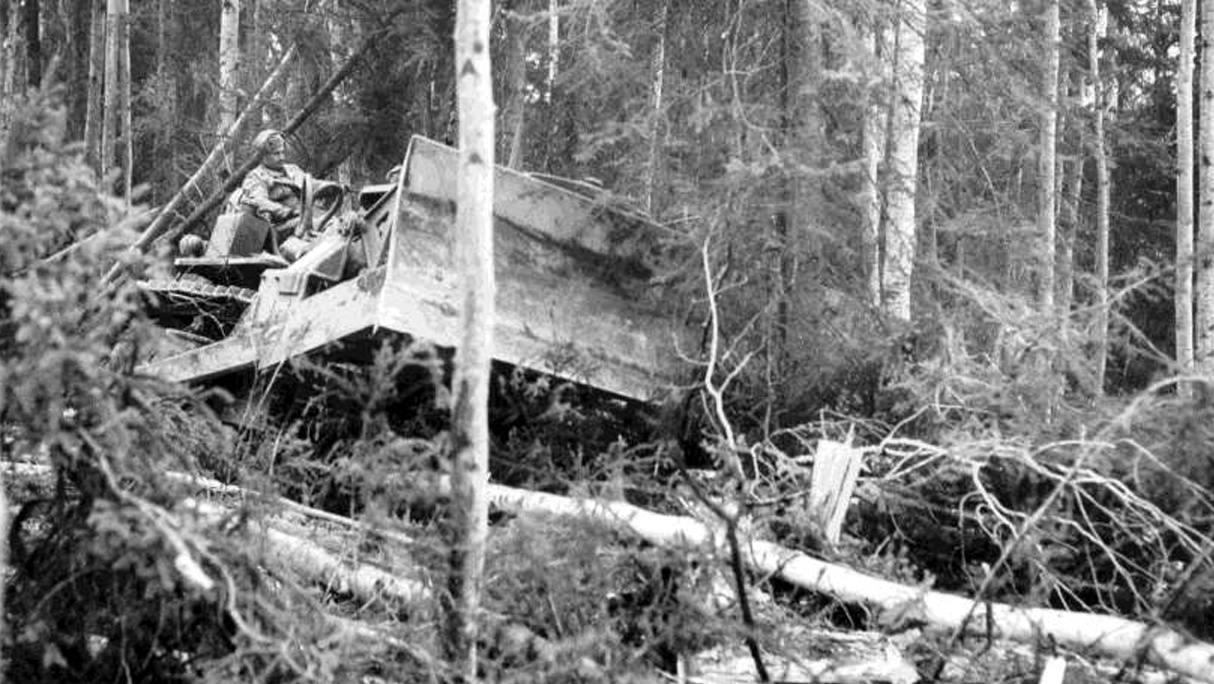
Undated Photograph of Bulldozer Flattening Spruce Forest to Forge Primitive Road
(J. David Rogers, "Construction of the Alcan Highway in 1942," https///web.mst.edu/~rogersda/umrcourses/ge342/Alcan%20Highway-revised.pdf.png)

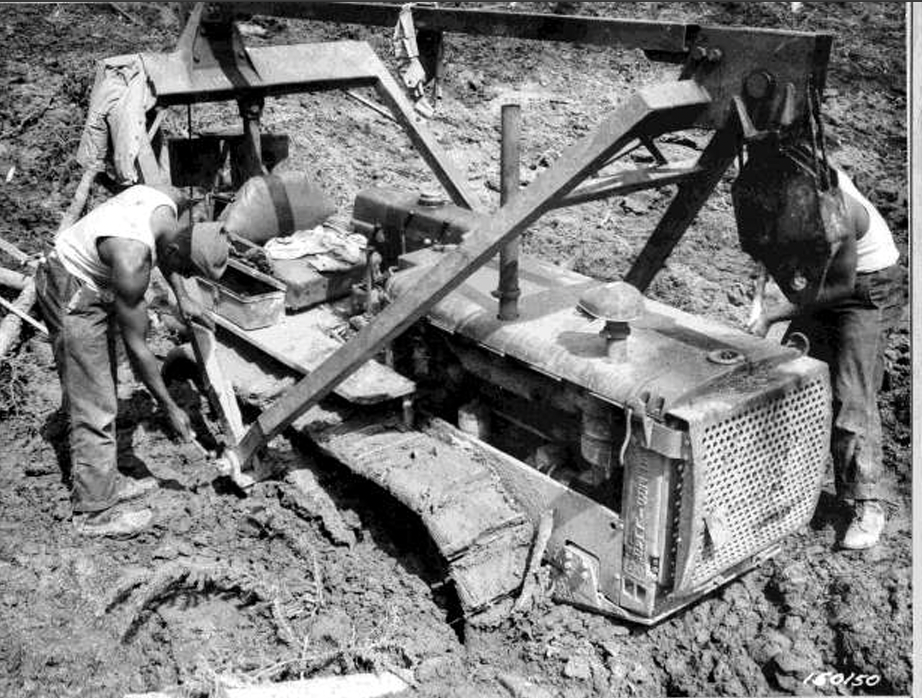
Much of the Canadian section of the road required flattening dense forest and devising bridges to ford the numerous rivers and creeks. In Alaska where most of the Iowa men worked, the chief complication for building the road was muskeg. A kind of peat that decomposed over time, muskeg provided a thick layer of insulation that kept the permafrost beneath it frozen. However, as temperatures rose in the warm season, and especially once contractors tried to move the organic material to fashion a roadway, the earth beneath the vegetation melted and disintegrated, gradually swallowing heavy machinery. Contractors often resorted to creating corduroy roads over the muskeg, helping preserve the insulation and distribute the weight of vehicles. 

Photograph of Bulldozer Captured by Muskeg
(Rogers, "Construction of Alcan Highway)

Like most of the contractors, Lundeen provided his own equipment, for which the government paid rent. But getting all that machinery to the work site (a job coordinated by Doak Construction of Des Moines) proved difficult; most of the caterpillar tractors, scrapers, and other items traveled part of the way by rail, then by sea, and then again by rail. Some of the machinery was trucked north, an exhausting if less complex delivery ("Iowans Again to Work on Alaska Road," Des Moines Register, March 28, 1943). Delays inevitably attached to the shipments, whether over land or sea, slowing construction progress. For example, only in mid-August 1942 did the Duesenberg group from Clear Lake collect the team's machinery at the Valdez docks (Mason City Globe-Gazette, August 25, 1942). 

Undated Photograph of Lundeen Men Loading Cat and Scraper for Shipment to Alaska
(Alaska Highway Expeditionary Force, p. 36).

While waiting for the arrival of the rest of the Lundeen heavy machinery in 1942, Ernie Badger was driving a "Ford gravel truck" (Grinnell Herald Register, August 24, 1942). Robert McLaughlin (1901-1993), a Newton resident who signed up with the Lundeen crew in 1943 (and who passed his last years at Grinnell's Mayflower Community), was also a gravel truck driver, helping create a hard surface for the improved road. As he recounted to Herbert C. Lanks on a night-time run to and from a gravel pit, McLaughlin had been a watchmaker back home, but, his doctor having ordered him to work out-of-doors, he had decided to join the Alcan Highway effort. So, there in Alaska's summer darkness an Iowa jeweler drove a five-ton truck back and forth along the emerging roadway (Highway to Alaska [New York: D. Appleton-Century Co., 1944], p. 163).

Some of the construction machinery on-site
(Engineering News-Record, January 14, 1943, p. 63/131)

Under the difficult conditions of work, often with low temperatures and rough terrain, the machinery frequently broke down, slowing the highway's advance (Richardson, "Part II," 35-40/908-912; idem, "Alcan—America's Glory Road: Part III: Construction Tactics," Engineering News-Record 130[January 14, 1943]:136/68). Ray C. Haman, whose father was part of the Duesenberg gang, traveled north along the highway in 1943, and in a self-published diary of his journey tells readers how often he was needed to help repair machinery (Adventure on the Alcan [Alaska Highway] [1945]). The rarity of spare parts led to cannibalizing disabled machines.

As hard as the work was and as exciting as the adventure might have been, there were, of course, costs. Experts have concluded that, in addition to the millions of dollars expended on the highway, some 30 men died during construction, including twelve soldiers who drowned when a ferry capsized in May 1942 at Charlie Lake near Ft. St. John.  According to the Lytle and Green 1942 project manager, civilian road-builders posted a better safety record.

Iowa contractors established a magnificent record. One man contracted pneumonia...three men suffered broken legs on bridge construction and one a broken arm...There were a few back injuries and hernias, none serious... (O. W. Crowley, "Iowans Work on the Alcan Highway," Central Constructor 20, no. 7 [December 1942]:12-13).

Milton Duesenberg offered other examples of injuries workers sustained:

Although most men remained healthy...there were cases of extreme homesickness, nervous breakdowns, food poisoning, and accidents. One sawmill hand lost his life when a tree fell on him, and a bridgeman had to be transported to the Fairbanks hospital for treatment of a broken collar bone and several ribs...Cleo Edgar of the Sears crew lost the sight in his left eye while repairing a broken cable...and a mechanic was knocked cold when he miscued while driving a tack pin and it...hit him in the head (Alaska Expeditionary Force, pp. 157, 159).

One of the injured was a Grinnell man, John Collum (1896-1978), who was part of the 1943 Lundeen work force; when the truck he was driving went over a fifty-foot embankment he suffered serious back injury (Newton Daily News, August 2, 1943).

By mid-October 1942 a rough, "pioneer" highway had been cleared all along the 1500+ miles with timber bridges fording most of the several hundred rivers and streams. A year later, the entire road had been widened, some of the worst obstacles improved, and most bridges made permanent. With the end of construction in sight, some of the volunteers headed home in September, but most Iowans departed Alaska in mid-October. Unlike the trip north, the route home for most of the Iowa men required a voyage of several days from Valdez to Seattle, bringing sea sickness to some. From Seattle, most took trains back to the midwest where they later appeared before the local Rotary, Kiwanis, and other organizations to share stories of their Alaska adventure (Mason City Globe-Gazette, October 30, 1942). A few men chose to drive home over the road to which they and thousands of others had given so much. For example, two Newton men, Forrest Warner and Robert McLaughlin, drove south from Fairbanks all the way to Edmonton (Newton Daily News, November 19, 1943), then took more conventional transport the rest of the way.

Mason City Globe-Gazette, November 13, 1942

Back home in Iowa, relatives of the Alaska Highway workers could learn details of their husbands, fathers, children and neighbors through the letters that most men sent regularly. However, since the authors of these letters knew that their missives were censored, the recipients could never be sure how close to reality the letters hewed. Fortunately, there were other routes by which to learn what life was like for the Iowa men in Alaska. As my report here shows, local newspapers often published letters from those working on the highway, thereby spreading news, however censored, of life up North. Then, in late January 1943 the Des Moines radio station WHO broadcast a report by H. W. Richardson, western editor of Engineering News-Record, who reported on the "Twelve Hundred Iowa Fighters in Construction" (Central Constructor, 20, no. 9[February 1943]:5). Perhaps there were similar broadcasts in other Iowa cities.

Ames Daily Tribune, August 14, 1943

Hollywood also tried to tap into public interest in the Alcan adventure, releasing in summer 1943 a feature film called "Alaska Highway," starring Richard Arlen (1899-1976) and Jean Parker (1915-2005). According to news reports, "the picture is full of thrills and breathtaking moments," depicting "a landslide, a forest fire, toppling death-dealing trees and all sorts of unexpected dilemmas" (Ames Daily Tribune, August 14, 1943). Iowans might also find in their newspapers advertisements that encouraged them to visit Alaska over the newly-built highway once the war was over.
Conoco Newspaper Advertisement, Burlington Hawk-Eye Gazette, July 9, 1943

###

Most analysts agree that forging a road through the wilds of British Columbia, the Yukon, and Alaska in the 1940s was well worth the cost and effort. If originally defined as fulfilling a narrowly-military goal, helping defend Alaska against the anticipated attack of the Japanese, the Alaska Highway in peacetime helped integrate Alaska into the Lower 48 and brought the American and Canadian economies closer, although the impact upon indigenous peoples was much less happy. 

But what about the men who went north to build this road? What did it do for them? Breaking through the forest and permafrost of the North, the Iowans could imitate the nineteenth-century pioneers who first made their way into the plains that became Iowa. Many of the project veterans regarded their Alaska experience as life-changing. Walter Mason, looking back on his experiences fifty years earlier, told a reporter in 1992 that "the road's part of me and I'm a part of it...I've had a number of experiences, but none more profound than that" (Cedar Rapids Gazette, October 25, 1992). Iowa City resident Bob Russell told an interviewer, "It was a wonderful experience. I loved it," despite—or perhaps exactly because of—the hardships (Iowa City Press-Citizen, June 6, 1987). 

Not all the volunteers were so enthusiastic, but the fact that many obituaries of Alaska Highway veterans mention their brief adventure in Alaska is telling. For example, when Clifford Benton, Jr. (1924-2008) died in Tiburon, California in 2008, his obituary—full of accomplishments in real estate and insurance, outstanding volunteer contributions to suicide prevention, and years of singing with men's choruses in California—began the recollection of achievement by remembering that "his first job at the age of 17 was building the Alaska Highway...." Similarly, when former Grinnellian Warren Baker (1912-1984) died in Abilene, Texas in 1984, forty years after his Alaska experience, his obituary recalled that "During World War II he worked on the Alcan Highway Project." Likewise, the obituary of Omar Olson (1903-1969), who farmed, worked as a traveling salesman, and co-owned a successful Grinnell furniture store during a career of more than forty years, recalled that he "worked on the Alcan Highway with the Lundeen Construction Co." 

Eighty years after the first Iowans traveled north to work on the Alaska Highway, living memories of that war-time experience have melted away. Other happenings, including, of course, the enormously significant moments of war in Europe and Asia, have outshone the collective memory of the highway project. But for the many Iowa men who tamed the wilds between Alberta and Fairbanks, the Alaska Highway was an important milestone. As the eighteen-year-old Harlan volunteer, Gordon Phipps, put it: "I'll be a man when I get out of this country" ("Caught Salmon in his Pants," Central Constructor, vol. 20, no. 3 [August 1942]:8).

###

If you are interested in learning more about the construction of the Alaska Highway, you might find the Alaska documentary interesting and helpful: https://www.youtube.com/watch?v=X3J80p365vY.  The 67-minute Hollywood feature film, Alaska Highway, is also available for free on the internet: https://archive.org/details/AlaskaHighway. There are also numerous official and unofficial materials available on the world wide web.


Tuesday, August 16, 2022

The First Jews to Find Grinnell

Four years ago I posted a story about the Daniel Berman family who were, I thought, the first Jews to live in Grinnell. It turns out, however, that I was wrong about that. Thanks to a note from a reader of that post, I learned about two more Jewish families who found Grinnell a few years before Daniel Berman did. When I carried the investigation further into the late nineteenth century, I learned about yet another Jewish family that took up residence in Grinnell as early as 1900. Today's post considers these pioneering Jewish families and their history in early Grinnell.

###

Few if any of the 3000 or so people living in late nineteenth-century Grinnell knew a Jew; certainly there were no Jews then living in Grinnell. Of course, the overwhelmingly Christian population of town, schooled in the Christian scriptures, knew about Jews and the Jewish world into which their Jesus had come, but all that had happened almost two thousand years earlier; Jews in the contemporary world were largely unknown. By the 1880s, however, more than forty Iowa towns had welcomed Jewish immigrants (Michael J. Bell, "'True Israelites of America': The Story of the Jews in Iowa," Annals of Iowa 53 [Spring 1994]:96). The most important of these for Grinnell was Muscatine, Iowa.

Later made one of the Midwest destinations for immigrants who passed through the hands of the Industrial Removal Office, Muscatine before 1900 had already attracted a small group of Eastern European Jews (Simon Glaser, The Jews of Iowa [Des Moines, 1904], 311-312). Most of the early arrivals hailed from Leckava, a small town in Kovno gubernia of the late Russian Empire. The 1897 Russian census reported that Leckava had a population of about 1100, some 800 of whom were Jews. Some of Leckava's Jews reached Muscatine in the 1880s, hard on the heels of the pogroms that flared up in the early 1880s in Russia's Pale of Settlement. How Muscatine attracted immigrants from Leckava is unknown. But the first arrivals soon summoned relatives and neighbors, providing the Muscatine newcomers reminders of their previous home in Europe. As one report noted, "The village of Latskivoh [the Russian name for the village-DK] in the Kovno district of Lithuania seems to have had a direct pipeline to Muscatine, Iowa...." 

Google Map showing Distance Between Klaipeda and Leckava (about 80 miles)

Among the Leckava Jews who reached Muscatine were two brothers, Marcus Louis Urdangen (1873-1918) and Barney Urdangen (1864-1934). I did not find ship's manifest from either brother's immigration, but the two men later told census-takers that they had arrived in the US around 1890. Louis, as he generally called himself, is the first to appear in Poweshiek County records. Together with Ed Greenberg (1873-1936), his brother-in-law, Louis founded a dry goods business known as Urdangen and Greenberg. No later than November 1899 the partners had opened their doors in what newspapers called "The Fair building" in central Montezuma; they soon had outposts in several other south central Iowa towns (Grinnell Herald, November 28, 1899). 

Marcus Louis Urdangen (1873-1918)
Oscar Grossheim Photograph (ca. 1901)
(http://www.umvphotoarchive.org/digital/collection/muspl/id/7465/rec/1)

In May 1901 the duo appeared in Grinnell where they rented space on Main Street, planning to open a "general store" (Grinnell Herald, May 3, 1901). The Golden Eagle, as they named their new Grinnell business, offered "a complete line of Clothing, Gents' Furnishings and shoes" (ibid., May 28, 1901).


Advertisement from the Grinnell Herald, May 31, 1901

Almost from the beginning, however, the newcomers ran into trouble. When, early in their occupation of the Corrough Building at 4th and Main, they declined to assume the five-year lease of the previous tenant, despite the owner's understanding that they had so agreed, the owner took them to court. Urdangen and Greenberg lost the argument, and were obliged to find replacement space, promptly reopening their store in the 900 block of Main Street, just a few steps from their previous address. Here the Golden Eagle resumed its advertising, dangling sales and low prices before Grinnell consumers. Business must not have met expectations, however, because by mid-November the local newspaper reported that Urdangen and Greenberg,were transferring their stock to Albia, "because they cannot oversee their stores in so many towns" (ibid., November 19, 1901).
Corrough Building, 901 Main Street (ca. 1905)
(Digital Grinnell)

So far as I could learn, neither Louis Urdangen nor his partner, Ed Greenberg, ever lived in Grinnell, even when operating the Golden Eagle in town. The 1900 US census reports that Louis Urdangen was then boarding at a Montezuma hotel and Greenberg, who in 1898 had married Urdangen's sister, Grace (Gute Freide) (1878-1946), was also resident in Montezuma. 

One member of the Urdangen family, however, was resident in 1900 Grinnell: Barney, the older brother to both Louis and Grace. The 1900 US Census found Barney, his wife Mollie (Malke; 1863-1952), and their five oldest children living at 511 Third Avenue, just south of the railroad tracks between Spring and Pearl Streets. Barney told the census official that he had arrived in the US in 1889, had later been naturalized (although I could not find this record), and was working as a "junk buyer" in Grinnell. The three oldest children—Libbie (Racha Liba) (1886-1940), Anna (Chana) (1888?- ), and Rebecca (Riwka) (1890?- )—had all been born in Russia. Golda (1895?-1918) was their first child born in America, followed by Louis J. (1898-1968). Esther (1901?-1933), Archie (1903-1964), Grace (1904- ), Harry (1906?- ), and Charlie (1909-1965) were all born in Grinnell. (Ethel [1910-1992] and an unnamed daughter [1913-1913] were later born in Muscatine.) Historical records reveal little about the children except that newspaper accounts of school honor-rolls regularly mentioned Golda and Esther in the years before 1910 when the family returned to Muscatine (see, for example, Grinnell Herald, June 16, 1908, when both girls were identified as honor students at Parker School). Whether any of the older girls attended Grinnell schools I could not learn.

Extract from 1911 Sanborn Insurance Map for Grinnell, Iowa, showing Third Avenue
(https://www.loc.gov/resource/g4154gm.g026731911/?sp=13&st=image)

Grinnell's newspaper at first had nothing to say about Barney Urdangen, even though Barney was then resident in town and operating a scrap metal business. It was brother Louis whose commercial enterprises attracted the newspaper's occasional attention.
Undated (ca. 1930?) Photograph of Barney Urdangen
(https://www.geni.com/people/Barney-Urdangen/6000000013903234386)

Beginning in 1902, however, Barney placed small ads in the Grinnell Herald, alerting readers to his interest in purchasing iron. Sellers could deliver their iron to the business premises "south of the Carriage Factory," referencing the Spaulding factory just north of the railroad and west of West Street. 

Grinnell Herald, April 22, 1902

Business seems to have prospered, because Urdangen began the 1903 calendar by advertising a new undertaking which he added to his scrap metal enterprise. Opening a "New and Second-hand Store" on Commercial Street, "Opp. Herald Office," Urdangen was still soliciting scrap for his yard on Third Avenue, but he also advertised "an entirely new line of goods: Men's Clothing and Furnishings, Boots and Shoes, Tinware, and most anything you want at prices that defy competition." At the same site Urdangen offered "second-hand goods," including "household goods, stoves and articles of all kinds" (Grinnell Herald, January 2, 1903). 

Extract of Page 6 of 1898 Sanborn Insurance Map of Grinnell, IA
(https://www.loc.gov/resource/g4154gm.g026731898/?sp=6&st=image)

About a month later he purchased the building on Commercial Street from which he ran his second-hand shop. The local newspaper reported that Urdangen planned to add a third story and rebuild the front, but the new owner seems never to have completed these improvements, as today's building still has just two stories (Grinnell Herald, May 15, 1903).

2015 Google Street view Photo of building that was formerly 806 Commercial,
home to Barney Urdangen's Second-Hand Store

An indication of Urdangen's success was the growing list of properties he purchased. In May 1904 he acquired title to the building across the street from his store, immediately renting it out to John Spencer, a local African American contractor (ibid., May 3, 1904; ibid., June 7, 1904). In early 1905 Urdangen bought the W. W. Stowe office building at the corner of Main and Commercial (ibid., February 24, 1905) and in May 1906 purchased the old Grinnell House at the corner of Main and Fourth, telling reporters that he intended to remodel the building to install a restaurant on the north side and use the south side for his second-hand store (ibid., May 8, 1906; ibid., June 12, 1906). This plan must have stimulated Urdangen to trade his original property on Commercial to John Hatcher of Brooklyn, giving Urdangen property in Malcom, too (ibid., January 26, 1906). Hatcher later complained about the deal, which apparently was reversed, because soon Urdangen's newspaper ads reported his business at the old address, "across from the Herald office."
Grinnell Herald, May 20, 1910

The 1910 tax assessments for street paving provide a handy summary of Urdangen's holdings. According to the list, Barney Urdangen owned two properties on the west side of Main Street and one on the east side of Main, as well as land on the north side of Commercial and the north side of Fourth Avenue. "Barney Urdangen," the newspaper observed, "has recently become quite a large holder of Grinnell downtown property." His total assessment came to $1,483.85, one of the highest totals among local landowners (ibid., May 20, 1910).

Amid these successes Barney encountered occasional difficulties. In September 1902, little Esther—who was only about 18 months old—evidently wandered from the family home adjacent to the railroad tracks and was struck by a passenger train coming into town from the west. Observers initially feared that the little girl had been killed, but subsequent examination discovered only a broken arm and several broken ribs (ibid., September 19, 1902; see also Marshalltown Evening Times-Republican which reported the girl as dead [September 18, 1902]). She recovered, although her parents must have been badly shaken by the accident.

Other troubles concerned the business. When a fire on Main Street erupted in the middle of the night in April 1903, a burglar took advantage of the distraction to enter Urdangen's Commercial Street store where he stole "about two hundred dollars' worth of...watches, watch chains, jewelry, shoes, and some clothing" (Grinnell Herald, April 17, 1903). Early the next year an unidentified man tried to steal some razors, but Barney, emerging from the basement, caught him in the act (ibid., February 23, 1904). In May Urdangen reported that his horse, a "roan mare, about five years old, branded with the letter 'H,'" had "disappeared from Grinnell." Whether the horse had merely strayed or been stolen Urdangen did not say, offering a "liberal reward for her return" (ibid., May 5, 1905). Perhaps the worst news of 1905 was the bankruptcy of his brother Louis, first reported in early May (ibid.; see also ibid., October 27, 1905). 
Advertisement in Grinnell Herald, February 15, 1907

There was also occasional competition for Barney's scrap metal and second-hand business. At least twice over the decade that Urdangen operated in Grinnell Amos Thompson (1852-1921) opened a business that competed directly with Barney. Adam Dunlap (1841-1921) also briefly ran a store for "New and Second-Hand Goods" on Main Street, around the corner from Urdangen's shop (Grinnell Herald, April 10, 1908), but neither of these enterprises seems to have provoked conflict with Urdangen.

2021 Google Street view Photo of 800 E. Eighth Ave., Muscatine, IA

In the run-up to 1910, the Urdangens prepared to abandon Grinnell and return to Muscatine, a decision which must explain the disappearance of Urdangen's Grinnell newspaper advertisements and his concentration upon real estate. The 1910 US census, conducted in late April, has the Urdangens already living at 811 Fifth Street in Muscatine. Barney no longer mentioned his junk business, but told census officials that he lived off his "own income," probably a function of his property investments in Grinnell and Muscatine. For the 1915 Iowa census he described himself as working in "real estate." No later than 1915 the Urdangen family was residing in Muscatine at 800 E. Eighth Avenue, a large building that still stands.

Returning to Muscatine, the Urdangens, who for the previous ten years had lived in Grinnell without a synagogue or other Jews with whom to observe the rituals of Jewish worship, were able to rejoin Muscatine's lively Jewish community. The B'nai Moses Synagogue, first erected in 1893 to serve some thirty Jewish families, now empty and abandoned, remains to confirm the existence of a local Jewish community which provided a warm welcome for the Urdangens' return to Muscatine. Barney spent his last several years in Muscatine where he died in June 1934. Embraced by the local Jewish community, Barney Urdangen took his farewell from the synagogue to which he had contributed. He was laid to rest in Muscatine's Jewish cemetery (Muscatine Journal, June 14, 1934).
Undated Photograph of Abandoned B'nai Moses Synagogue, Muscatine, Iowa
(https://samgrubersjewishartmonuments.blogspot.com/2014/06/usa-former-iowa-synagogue-up-for-sale.html)

###
The departure from Grinnell of Barney Urdangen opened the door for the arrival of another immigrant Jewish family. Just as Barney was closing out his scrap metal business in 1908, Ozer Winer (1877-1955) and his family arrived in Grinnell. The documentary record that explains how Winer found Grinnell remains thin. His first name usually referenced in US documents by the initial H, Ozer told 1910 US census officials that he had immigrated in 1896; his 31-year-old wife, Rizza (Rachel Shpall), told officials that she had reached the United States in 1898, but I could find no record of either arrival. Besides that, the 1910 census reports that the Winers had been married nine years, meaning that they had married around 1901. Their oldest child, Lena, said to be four years old in 1910, was born in Russia, which means that the Winers must have married in Russia and were still resident in Russia in 1905 or 1906. The 1910 census also reports that Max, the family's second-oldest child, was then one year old and had been born in Iowa, meaning that the Winers must have been living in Iowa no later than 1909 or late 1908. 
Undated Photograph of Ozer Winer
(https://www.geni.com/people/Ozer-Winer/2242591)

Winer's name first appears in the Grinnell newspapers in November 1909, when Ozer advertised his junk business at 711 Spring Street, just a block or two away from the site of Barney Urdangen's scrap metal business. Similar ads appear in early 1910, but with a different address: 716 Spring Street, across the street. Sometime that spring Winer purchased a half-lot at 716 West Street, which is where the 1910 US Census officials found him and his family.
Advertisement from Grinnell Herald, November 19, 1909

Apparently other Winer relatives lived in or near Grinnell at the time. For example, Rachel Ozer's sister, Lena Shpall (1881-1965) in 1909 married a Marshalltown man by the name of Samuel Bernstein (1888-1967). According to an Iowa State Affidavit of Delayed Birth Registration, Lena gave birth in Grinnell the following August to a son, Harry Simeon Bernstein. Unfortunately, only these shards of evidence survive to confirm that the Bernsteins resided in Grinnell. No directory or census puts them in Grinnell and the Grinnell newspaper makes no reference to them whatsoever.
Iowa State Department of Health Affidavit for Delayed Birth Registration
December 18, 1941

Local records then fall silent on the Winers, too, who left Iowa no later than 1913 when their third child, Sarah, was born in Colorado. The 1920 US Census found the Winers in Saquache, Colorado where "Henry" was operating a general store. In this document the Winer parents report more credible dates for their immigration, telling census officials that Ozer had reached the United States in 1906 and "Rose," his wife, in 1907; they both reported having become naturalized citizens in 1917. A fourth child, Rebecca, had been born in Colorado in 1918. By this time, however, Grinnell remained but a distant memory for the Winers, who later moved to Louisiana, and then finally to Tel Aviv, Israel where Ozer died in 1955 and Rizza in 1957. The Bernsteins also moved to Colorado at about the same time as the Winers; the 1920 US Census found them living in Denver where Samuel bought hides and wool. Moreover, the census identified their son Aron (elsewhere in the records known as Harry) as having been born in Iowa in 1911, but their next son, Morris, was born in Colorado in 1913. Unlike the Winers, however, Samuel and Lena remained in Colorado where they both died and were buried in Lakewood's Golden Hill Cemetery. 
Advertisement for Greenbaum's Crown Junk Yard
(Grinnell Herald, October 21, 1910)

Overlapping with the Winers in Grinnell was another Jewish family. First identified in Grinnell sources in the spring of 1910 was the family of Sigmund Greenbaum (1884-1970). Sam Green (as he later called himself after legally changing his name) had been born in 1884 in Russian Poland, and had immigrated to the US in 1906 via Stockholm. In New York City he met Gussie Mintz, who had been born in 1882 in Odessa, then also part of the Russian Empire. The couple married in New York in August 1908, and their first child, Emanuel (Manny) arrived a year later. By April 1910, when US census-takers were in Grinnell, the Greenbaums were living at 720 West Street, just one door away from the Winers on the east side of the street. Like their fellow-immigrant neighbors, the Greenbaums operated a junk business, using space at the north end of the block, closest to the railroad tracks and beneath the shadow of a grain elevator.
An Enlargement of a Section of a 1916 Billy Robinson Photograph of Grinnell, Looking South and Showing Grain Elevator in Center; Greenbaum Junk Business Was Located Just to the West and South of the Grain Elevator
(https://digital.grinnell.edu/islandora/object/grinnell%3A3291)

But soon the Greenbaums also deserted Grinnell, probably sometime late in 1910. The latest advertisement for Greenbaum's Crown Junk yard appeared in the October 21, 1910 issue of the Grinnell Herald, and in mid-February Mr. and Mrs. P. D. Barton, from whom Greenbaum had purchased the property on West Street, brought suit against him to cancel the arrangement "because of default in payments provided for in said contract..." (Grinnell Register, February 16, 1911). Greenbaums apparently returned to New York, where their second child, Bertha, was born in 1912, but by 1915 they were living in Los Angeles where Sam died in early January 1970.
###
Consequently, when Daniel Berman reached Grinnell in 1912, he followed in the wake of several Jewish immigrants who had preceded him to Grinnell. The Urdangens, Winers, and Greenbaums lived and worked in Grinnell for the first decade of the twentieth century, but the record preserves little evidence of how Grinnell's gentile population regarded them. Still, if years later the Bermans heard people call them "kikes," it requires little imagination to suppose that earlier Grinnell residents had behaved similarly.

Even if there was not much overt hatred, family life for Grinnell's first Jewish immigrant families must have been difficult. Instead of the predominantly Jewish, Yiddish-speaking populations of their European home towns where the oldest among them had been born, they found in Grinnell no other Jews with whom to worship or socialize. There was no synagogue, no rabbi for important family events. Only once does the Grinnell newspaper provide some insight into this dilemma, reporting that Barney Urdangen had invited some of Grinnell's gentile movers and shakers to attend the circumcision of his son (unnamed, but probably Archie, who was born in 1903); in addition to the Cedar Rapids rabbi who performed the rite, Urdangen had Rev. E. M. Vittum of the Congregational Church, local physician P. E. Somers, and local banker G. H. Hamlin in attendance. What these men made of the occasion the record does not reveal, but the event certainly signals Urdangen's attempt to reach across the religious and cultural divide that separated him and his family from the rest of the town (Grinnell Herald, October 17, 1905). The news reports no similar event later, although at least two other Urdangen sons (Harry and Charlie) were born while the family was living in Grinnell. Likewise the birth of Max Winer in 1909 left no evidence of making his circumcision public, so perhaps the experiment of reaching out to the gentiles did not go well. 

The scant trace in the news of these first Jewish families in Grinnell is not surprising. If, as seems likely, gentile Grinnell looked on them with suspicion, the Urdangens, Winers, and Greenbaums may well have kept to themselves, as Isadore Berman reported some years later that his family had done:
We went about our own business and ignored the element that would make remarks. And as far as being active in other social functions, we didn't participate in many community functions...and so what we didn't know we didn't miss.
When Barney Urdangen died in 1934 in Muscatine, his obituary overlooked his place of birth (where he had spent more than 25 years) and minimized the decade he had spent in Grinnell. "Mr. Urdangen," the Muscatine Journal said, "came to Muscatine 45 years ago and with the exception of a short period of time spent at Grinnell, had lived all his life here..." (June 14, 1934). Those ten years in Grinnell accounted for almost a quarter of Barney's life in America, but perhaps, given the absence of other Jews in Grinnell, those ten years did seem unimportant and relatively trivial. We know less about how the Winers and Greenbaums thought of their much briefer sojourn in Grinnell, but the brevity of their lives here may be evidence of their dissatisfaction with living in the midst of an overtly Christian small town. But they, along with the Urdangens, had pioneered Jewish settlement in Grinnell, paving the way for the longer Grinnell residence of the Bermans and Bucksbaums who followed them.
###

PS. Many thanks to Davida Wood who, on having read the original post about the Bermans and Bucksbaums, wrote to tell me about the Winers, Shpalls, and Bernsteins that I had mistakenly overlooked.

Wednesday, June 29, 2022

Play ball!!

When people talk about accomplished baseball players from the Grinnell area, Jackie Collum (1927-2009) often comes first to people's minds. Collum, who was born in Victor and grew up in Newburg, played for half a dozen major league teams between his signing with the St. Louis Cardinals organization in 1947 and his retirement in 1963 as a Los Angeles Dodger. A 5-foot 7-inch left-handed pitcher, Collum compiled a record of  32-28 with a 4.15 ERA over 9 seasons in the majors. He later settled in Grinnell where for some years he owned and operated the Pioneer Oil station on West Street.

Undated Photograph of Charlie Frisbee in Baseball Uniform
(https://www.findagrave.com/memorial/46057419/charles-augustus-frisbee)

I don't know any major leaguers who had earlier played for Grinnell High school, but, according to one baseball reference site, two major league baseball players attended Grinnell College: Charlie Frisbee (1874-1954) and "Gus" (John Gustave) Thompson (1877-1958). Unfortunately, I could find no evidence for Thompson having attended Grinnell, but Charlie Frisbee did indeed attend (although he never graduated from) Grinnell College. Newspapers report that Frisbee came to Grinnell in the spring of 1894 "to take a course of study at Iowa College and also to assist the baseball team there to win the pennant this year" (Alden Times, April 12, 1894). College reports on baseball, however, mention Frisbee (sometimes "Frisbie") only in the spring of 1895 (The Unit, April 13, 20, May 11, 25, June 1, 1895) when he was the regular catcher for the college team. Immediately thereafter Frisbee abandoned college and pursued a career in professional baseball. A switch hitter who threw right-handed, Frisbee played only two seasons in the majors, but spent ten seasons playing for minor league teams, many of which had memorable names. Today's post follows the life of Charlie Frisbee and his career in baseball.

### 

Charlie was the first-born of Ellen Young Frisbee (1840-1905) and Dr. Frank P. Frisbee (1845-1905). Although born in Dows, Iowa, Charlie grew up and attended school in Alden, Iowa, where Dr. Frisbee moved his practice shortly after Charlie's birth. Alden was founded in 1855, almost the same time as Grinnell, but the town grew much more slowly than Grinnell. If by 1900 Grinnell counted more than 3800 residents, that same year's census found only 709 people in Alden. Watered by the Iowa River and served by railroad, the flat plains of north central Iowa attracted farming interests, but did not draw the other vectors of nineteenth- and early twentieth-century economy that had helped Grinnell grow. Alden retained the economy and feel of small-town Iowa where townsfolk knew one another well.

Undated Photograph of Alden, Iowa Street
(https://iagenweb.org/hardin/pictures/aldenstreetscene1.jpg)

In his teens Charlie regularly played catcher for the Alden school baseball team which played the kind of baseball that might end when the catcher had to go home to supper (Alden Times, October 4, 1889). And if the Alden boys often beat teams from neighboring towns, the contests were "gentlemanly," said the Alden newspaper, "without the wrangling that has sometimes spoiled games" (ibid., June 13, 1890). 
Young Charlie Frisbee in Catcher's Outfit (ca. 1890)
(C. R. Williams, Cherokee, IA)

Charlie and his sister, Laura, three years his junior, seem to have been popular, sometimes entertaining large groups of friends "royally" at their family home (Alden Times, February 6, 1891). And apparently Charlie was a very conscientious student, because, after completing high school, he jumped right into teaching, as sometimes happened in small schools that could not easily attract teachers from the State Normal school.
Undated Studio Portrait of Charlie Frisbee
(Head and Head, Dows, IA)

Originally Frisbee was to fill in for another teacher suffering "la grippe" (Alden Times, March 11, 1892), but before long Frisbee had the class to himself (ibid., April 22, 1892), teaching in School No. 4, one of a dozen one-room schools in Alden Township (ibid., April 29, 1892).
Photograph of An Abandoned One-Room Schoolhouse, Benton County, Iowa
(https://www.flickr.com/photos/iadeptofeducation/19565208099/in/album-72157653627699364/)

Apparently Frisbee taught school only through the end of the 1891-1892 academic year, because by autumn the local paper announced that Frisbee was working as head clerk at a local business (Alden Times, November 18, 1892). Two summers later Charlie was "waiting on customers in the J. Laird & Son store" (ibid., August 3, 1894). Perhaps this employment potpourri shows only that in Alden, where Charlie Frisbee was well known and popular, small-town dynamics helped guarantee the young man regular employment.
###
How Charlie heard of Grinnell I do not know, but, according to the Alden Times, by April 1894 Charlie was living in Grinnell, studying and playing baseball for the college (April 12, 1894). How things went those first months is unclear; local newspapers have nothing to say about Frisbee until the 1895 baseball season when his name regularly surfaces on the sports pages.

Throughout the spring of 1895, Frisbee occupied a prominent place in the box scores, catching the Grinnell pitchers. He also sometimes hit the ball well, as, for example, when Grinnell defeated the State University of Iowa (today's University of Iowa) in April, 1895. The town newspaper reported in thesaurus-laden language that "Frisbie" (often misspelled in the newspaper) "hit the sphere for two bags" and later scored on a passed ball (Grinnell Herald, April 23, 1895; Scarlet & Black, April 20, 1895).
Grinnell Herald, April 17, 1895

During a series of games in Wisconsin and Illinois in mid-May, Frisbee moved to the clean-up spot in the batting order where he seems to have thrived, collecting several doubles and one triple during the trip. To judge by the occasional passed ball that eluded the catcher, his defense was not quite so potent as his batting skills.

That summer Frisbee played for a Marshalltown club (Alden Times, August 16, 1895), and consequently was near Grinnell. But for reasons unexplained, he declined to resume his studies at Grinnell in the fall, the college reporting that Frisbee was then employed as a traveling salesman for an Eldora, Iowa clothing firm (The Unit, v. 11, no. 4 [October 5, 1895]:40; Alden Times, October 18, 1895). But then Frisbee "quit traveling for Smith & Fagg of Eldora," and reported that he would resume teaching (ibid., October 24, 1895; Eldora Herald, December 5, 1895).
###
Baseball remained at the center of his ambitions, however, explaining why in spring 1896 he signed to play ball with the Portland (Oregon) Gladiators. The local newspaper claimed that Frisbee, who stood five feet, nine inches tall and weighed about 175 pounds, was "a first class all around ball player and he will be heard from in the baseball games out on the Pacific coast..." (Alden Times, April 3, 1896). Apparently the Gladiators did well in their brief season, going 19-9. Frisbee hit well, going 40 for 118 (.339), including eight doubles, one triple, and one home run. But by late June Charlie had returned to Iowa, "the Pacific coast [league] having disbanded." The Alden newspaper told readers that Charlie had "had a good time and saw lots of sights in his trip out west so he considers himself ahead on the summer's work" (ibid., June 26, 1896).

How he spent the rest of the summer is unknown, but next winter there came word that he had signed to play baseball with the Quincy Little Giants, an Illinois team that was part of the Western Association (Scarlet & Black, March 27, 1897). The Alden newspaper indicated that Frisbee would play outfield (instead of catching), collecting "a gilt edged price for his services" (Alden Times, January 29, 1897). Appraising the baseball season some months later, Frisbee's hometown newspaper declared the season in Quincy "successful," pointing out that Charlie had accumulated a "fine record" (ibid., October 1, 1897). The Alden Times was not exaggerating: playing in 122 games, Frisbee hit .309, leading to rumors that he might soon be drafted into the major leagues. 

For the 1898 baseball season Frisbee played for the Kansas City Blues, a Class A minor-league team (Quincy belonged to Class B). Playing in 138 games for the Blues, Frisbee hit for a .315 average, ninth best in the league. It was in Kansas City where Frisbee's frequent bunting led to his nickname, "Bunt." The Alden newspaper proudly reported that the Kansas City team had won the Western League pennant "and our townsman, Charlie Frisbee, was right in it all the time" (Alden Times, September 23, 1898).
1890s Photograph of Kansas City Blues Baseball Team
(https://www.ebay.com/itm/162871747855)

The excellent season in Kansas City brought Frisbee to the attention of the Boston major league franchise, which acquired him in October 1898. Back in Iowa, Alden newspaper readers learned the next spring that Frisbee had played for Durham, North Carolina "where he will join the Boston Baseball club of the National League for preliminary practice" (Alden Times, March 24, 1899). Before the season began, however, Boston assigned him to the Worcester (Massachusetts) Farmers, another Class-A minor league team. Overcoming his disappointment, Frisbee started off the Farmers' season at a torrid pace, batting over .400, including a game-winning home run in June. The Braves, their regular center fielder now injured, recalled Frisbee to Boston where, on June 22 the Alden phenom patrolled center field. However, once the regular center fielder returned from injury, Boston sent Frisbee back to Worcester where he continued to pound the ball; by season's end Frisbee led the league in batting. 
Photograph of Charlie Frisbee in Uniform of Boston Braves (ca. 1900)
(Elmer Chickering, Boston)

Once the minor league season was over, Frisbee rejoined the Braves and acquitted himself well, batting .329 over all 42 major league games he played that season. His fielding was not nearly so excellent, recording eleven errors in 88 chances, but hometown fans happily overlooked these flubs, jubilant at their neighbor's big league success (Eldora Herald, October 21, 1899). An Alden jewelry store proudly displayed a photo of the seventeen regular Boston Braves, the newspaper noting that "Alden's contribution, Charlie Frisbee, is the best looking one in the lot" (Alden Times, October 27, 1899).
Photograph of the 1897 Boston National League Team
(https://en.wikipedia.org/wiki/1897_Boston_Beaneaters_season#/media/File:1897_Boston_Beaneaters.jpg)

Over the winter Boston sold Frisbee to the New York Giants (Joseph L. Reichler, Baseball Trade Register [NY: Macmillan, 1984], pp. 15, 122). While playing for the Giants in spring 1900 Frisbee hurt himself: "he not only wrenched his knee badly but got an ugly cut on his foot from another player's spiked shoes as well as his neck injured in a collision while running for second base " (Alden Times, April 27, 1900). The injuries kept him out of the lineup for three weeks (Alden Times, May 18, 1900). Meantime the Giants' front office, contemplating a reduced, reconfigured National League, proposed to trade Frisbee (Eldora Herald, June 13, 1900). After considerable public debate about baseball's reserve clause, finally abolished decades later, thanks to Curt Flood, Frisbee was sent to the American League Cleveland Lake Shores, a successor to the Grand Rapids minor league team to which he had originally been sold and a predecessor of today's Cleveland Guardians. Frisbee managed to play in only four games for the Giants that year, taking the batter's box just thirteen times. In the 60 games he played for Cleveland he came to the plate more than 200 times, but managed only a .232 average.

Perhaps the early season injuries explain his relatively poor performance. Certainly that's what the folk back in Alden thought, as the newspaper explained: Frisbee "has been playing in hard luck all this season, getting his knee and foot injured in the very first series of games and getting them hurt frequently since then." He returned to Alden in September to rest and recover, hoping that by opening day 1901 he would "be ready for any thing" (Alden Times, September 7, 1900). But recovery did not come as hoped; in March Frisbee told the local newspaper that he would "give up playing ball for the coming season at least." "He has found that the injuries that he received last year when his knee was so badly hurt will not permit him to take such violent exercise as is demanded of a successful player" (Alden Times, March 22, 1901).

He played no baseball during the 1901 season, although he was technically part of the roster of the Rochester Red Wings (Bill Nowlin, "Charlie Frisbee"). As he had done after leaving Grinnell and during the off-season, Frisbee found work in town, clerking for a local store for about eighteen months as he awaited recovery from his injuries (Alden Times, March 7, 1902). For the 1902 season Frisbee returned to Worcester, appearing in 115 games and batting .323. Few of his 152 hits went for extra bases, however, which may explain in part why in June 1903 he was sold to New Orleans in the Southern Association. Frisbee had also been ill, having been hospitalized in Toronto before the sale. In New Orleans, too, he fell ill, and played in only 25 games, hitting .202.

Register of December 31, 1903 Wedding of Charlie Frisbee and Luella Catlin
(Ancestry.com)

In 1903 Charlie Frisbee, then 30 years old, married Luella Catlin (1879-1950). Like Charlie, she had grown up and attended school in Alden where she was born. The details of their courtship remain unknown, but a newspaper report of an 1895 community play performed in Alden points out that both Charlie and Luella Catlin had parts, proving that the two young people had known one another at least eight years before their marriage (Alden Times, February 15, 1895).

After the 1904 season, when Charlie had played for the Toledo Mud Hens in the American Association (Marshalltown Evening Times-Republican, March 24, 1905), appearing in 149 games and posting a respectable .278 average, he and his wife returned to Alden to spend the winter. During that off-season Frisbee worked at the Miller lumber yard, earning money in his hometown as he had done for years. The following spring the Frisbees' first child, Nellie Naomi (1905-2001), was born (Alden Times, March 3, 1905).
Affidavit of Birth of Nellie Naoma Frisbee (March 3, 1905)
(Ancestry.com)

With the approach of a new season, in mid-March 1905 Frisbee resigned his Alden job, preparing to play again for Toledo (Alden Times, March 17, 1905; Waterloo Times-Tribune, March 28, 1905). But in April came news that he had signed with the Des Moines Underwriters (Marshalltown Times-Republican, April 5, 1905), for whom he played in just nineteen games. Within a month his contract was sold to the Colorado Springs Millionaires, but apparently Frisbee never played a single game for the Millionaires or their successor, the Pueblo Indians. 

Soon family emergencies called Frisbee back to Alden. For one thing, his father—Dr. Frank Frisbee—having suffered through several months of illness, died in early June (Livermore Gazette, June 2, 1905). Charlie's presence in Alden was no doubt a help to his mother who, herself having endured cancer for several months, died in November (Marshalltown Evening Times-Republican, November 13, 1905). The problems at home along with a lackluster season may have encouraged Frisbee, as the local newspaper explained, "to take a lay off from his baseball work for a short time, and...get acquainted with his daughter" (Alden Times, June 23, 1905).

The baseball urge was difficult to resist, however, so that, when officials of the Burlington (Iowa) Flint Hills approached him about managing their club, he accepted the offer (Marshalltown Evening Times-Republican, July 5, 1905), becoming a player-manager as he also played center field for Burlington (Marshalltown Times-Republican, August 7, 1905). By all accounts, his performance as manager was exceptional, taking over a club that "was sadly in the hole" and helping them to respectability, even if, by season's end, the team came in dead last (ibid., August 24, 1905; Alden Times, September 15, 1905). 

Postcard Photograph of Waterloo Microbes Baseball Team (ca. 1905)
(https://www.worthpoint.com/worthopedia/baseball-team-w-pc-advert-waterloo-3762578033)

The following year Charlie managed and played for the Waterloo Microbes, boarding in the Germania Hotel when playing at home. Batting .288, Charlie did not put up the numbers he once did, but still ended up as the team's best hitter. By this time, Charlie had bounced around  the minor leagues for years, and perhaps had tired of the demands made on his aging body. In early June 1906 he resigned his Waterloo position. The Alden Times imagined that he would soon be playing elsewhere, "as he is too good a ball player to be out of a job long" (June 8, 1906). In fact, however, Charlie Frisbee's baseball career was over.
###

Like his baseball peregrinations, Charlie's post-baseball career featured a series of short-term jobs. In 1908 Luella gave birth to their second child, Frank (1908-1985), who joined sister Naomi in the family's home on Franklin Street, providing more reason for Charlie to secure steady employment. I could not learn where Frisbee worked immediately after he left baseball. Although I did not find evidence to confirm the thought, it might be that he used this time to attend business school in Dubuque, schooling mentioned in his obituary (Iowa Falls, Hardin County Times, November 9, 1954). This would explain why the 1910 US Census described Charlie as a "retail merchant" in the lumber business. However, it might also be that Frisbee simply returned to Miller Lumber where he had often worked in the off-season. If so, that position did not satisfy, because we learn that in 1913 Charlie and his family left Alden for Garner, the county seat of Hancock County. With a population just over 1000 in 1910, Garner was about 50 miles north of Alden. 

A 1918 Photograph of Main Street, Garner, Iowa
(https://sites.google.com/a/garner.k12.ia.us/the-history-of-garner-iowa/photos)

What drew Frisbee to Garner was the offer to acquire and operate a Garner hotel (Alden Times, March 7, 1913). Because it was the county seat, Garner hosted waves of business, depending upon the rhythm of the courthouse. The Alden newspaper told readers that, in a personal letter to an Alden friend, Frisbee had reported that in the early days of his work there the hotel did well (ibid., February 14, 1913). But apparently the prosperity was short-lived or else the work lost its allure for Frisbee, because by the time he registered for the World War I draft in 1918 Charlie told officials that he was working at the State Savings Bank in nearby Goodell, Iowa. 

According to a 1917 history of the area, when the Frisbees settled in Goodell, they joined a tiny community of about 250 people; the bank at which Charlie worked had been incorporated in 1892 with capital stock of only $10,000, numbers which may explain how Charlie, who had no experience in banking, qualified for such a position (History of Winnebago County and Hancock County, Iowa, v. 1 [Chicago: Pioneer Publishing Co., 1917], pp. 225, 287-88). Whether because of inexperience or for other reasons, by 1920 Charlie had changed jobs yet again, moving back to Garner to work as a bookkeeper for a small manufacturing company. The family lived in a house on Rose Avenue.

When changing jobs yet again in January 1923, Charlie received the first of three appointments as postmaster in Garner. According to the Hancock County record of appointments of US Postmasters, he gained reappointment in 1927 and again in 1931. His federal job must have lasted into 1935 by which time Iowa was knee-deep in the Depression. Then past 60 years of age, Charlie had to figure how to keep the wolf from the door. When census officials visited the Frisbee household in 1940 they reported that Charlie owned his own real estate business in Garner, adding yet another line to Frisbee's resume.

###

When Garner installed a new athletic field in 1950, officials called on Charlie Frisbee—then 77 years old—to throw out the first pitch. No doubt Charlie reveled in the role, but probably also noticed that the newspaper, announcing his ceremonial throw, misremembered his baseball glory, telling readers that he had "pitched for the Boston Braves, the Cleveland Indians and the New York Giants at the turn of the century" (Mason City Globe Gazette, September 1, 1950). Of course, all that glory was now long past, new generations of baseball players having taken the field and having captured the imagination of fans. His brief obituary in the Mason City Globe Gazette recalled that Frisbee had been a postmaster at Garner and a businessman in Goodell, adding only vaguely that  Frisbee "was at one time a major league baseball player" (November 9, 1954). A more detailed obituary appeared in the Iowa Falls newspaper, and it remembered the numerous stops in Charlie's baseball career, even his brief sojourn at Grinnell College (Iowa Falls, Hardin County Times, November 9, 1954). 

Gravestone for Charles and Luella Frisbie, Alden Cemetery, Alden, Iowa
(https://www.findagrave.com/memorial/128325147/luella-florence-frisbee)

###
Many thanks to Jeremy Shapiro who pointed Charlie Frisbee out to me, noting that Frisbee was a Grinnell College alum. I would not otherwise have known of Charlie Frisbee and his story.