Friday, January 26, 2018

When Murder Stalked the Halls of Ivy...

Regular readers of this blog might recall a 2016 post about mentions of Grinnell in recent fiction. The subject came to mind again recently as I read Dean Bakopoulos's Summerlong, which situates its entire plot in Grinnell, Iowa. So far as I know, except for the occasional geographical and topographical references to Grinnell, Summerlong's plot and its characters are entirely fictional. The situation was different for another novel that seventy years ago took Grinnell as its focus. This post examines that mystery—Prominent Among the Mourners—and how it represented the town of Grinnell and the college where most of the action takes place.
Newspaper advertisement from Des Moines Register, March 1, 1947
###
Prominent Among the Mourners did not once use the name "Grinnell," but nevertheless produced a sharply critical and extremely precise narrative image of Grinnell College and its small-town context. Published in 1946 by J. B. Lippincott as part of its "Main Line Mystery" series, Prominent was authored by "Carolyn Thomas," a pseudonym that seems to have been derived from the names of two people who had lived in Grinnell in the early 1940s: Thomas William Duncan (1905-1987) and his wife, Actea Carolyn (Young) Duncan (1913-1990). Reported by a female narrator who arrives in Larkinville (founded by J. B. Larkin), a small Iowa town, to begin a job in the publicity department of Larkin College, Prominent narrates a series of homicides that interrupted placid, small-town Iowa life; in this respect the novel is perfectly ordinary.

Along the way, however, the mystery's narrator and central character authors some serious character assassination whose waves lapped the Grinnell College pond for some time after publication. According to long-time Grinnell College historian, Joe Wall, Prominent Among the Mourners "was the conversation piece on campus" when Wall arrived back in Grinnell in 1947 to begin teaching. Wall claimed that at the time the book "was virtually required reading for all new faculty members" (Grinnell Herald-Register, May 11, 1978).

But townsfolk as well as college personnel were attracted to a book so closely identified with their home turf. According to a February 9, 1947 article in the Des Moines Register, Grinnell's Stewart Library, which then rented books at two cents a day, could not keep the mystery on the rental shelves. "So heavy has been the demand," the Register wrote, "that the library is keeping no reservation list. Library patrons have to be there when it hits the rental shelf" or miss their chance to check it out.
Gravestone of the Duncans, Masonic Cemetery, Las Cruces, New Mexico
(https://www.findagrave.com/memorial/149735016/actea-carolyn-duncan)
I do not intend to use this post to spoil the mystery for any readers anxious to explore the tangle of a serial homicide in fictional 1940s Grinnell. In my opinion—and I have read more than my share of murder mysteries—Prominent is not badly written, especially in its first half. But what caught my attention was the way in which the author—later revealed to have been Mrs. Duncan—so precisely plots the places and persons of early 1940s Grinnell. Despite affixing fictional names throughout, Prominent provides a surprisingly transparent map of Grinnell as it existed seventy-five years ago when the Duncans lived here. Margaret Matlack Kiesel, who grew up in Grinnell and attended Grinnell College, some years ago wrote up a key to the persons and places identified in Prominent, and I have made use of her work, only occasionally differing from her conclusions.
###
Let's begin with the places. Much of the college's recent building has hugged Eighth Avenue and extended to the north, a part of town wholly undeveloped in the early 1940s. But to many of today's Grinnell citizens, what seems most changed in the college's landscape is the band of land along Sixth Avenue. Before there was a Burling Library (1959), and before there was a Roberts Theater and Fine Arts Complex (1961; 1998) occupying the north side of the Sixth Avenue bow, four old buildings—all erected on the heels of the 1882 Cyclone—dominated the college landscape: Goodnow Hall (1885; renovated 1995); Chicago (Magoun) Hall (1883); Blair Hall (1882-86); and Alumni Hall (1882).
Grinnell College Front Campus (ca. 1900)
All these buildings were still in use in 1942 when the Duncans reached Grinnell. Today Goodnow is the only one still standing, but this fine Richardsonian structure plays no part in the action in Prominent. Blair Hall is gone, but it, too, made scant appearance in the mystery. Alumni Hall (Music Building) and Chicago Hall (christened Burma Hall in the novel) both have parts to play in Thomas's mystery. The first makes only a brief showing in Prominent, and plays no direct role in the plot. Nevertheless, the building's description leaves little room to doubt the author's impression:
[The Music building] stood at the east edge [of campus], over by the railroad track. A warehouse of a building, it was two stories high, with a steeple like a dunce cap (Prominent, p. 144).
Alumni Hall (ca. 1910) (https://digital.grinnell.edu/islandora/object/grinnell%3A13531)
A great deal of the mystery's action is situated in Burma Hall, the fictional stand-in for Chicago Hall. The home of most college administrative offices, "Burma Hall" is the scene of numerous meetings, at least two murders and two assaults. Even without these elements of plot, however, the building evokes little appreciation from the novelist:
Alumni and faculty were given to drooling about dear old Burma, but to an objective eye the most charitable estimate was that it constituted a fire hazard...Burma looked old, too—old and secretive…The building towered massively, its juttings [sic] and cornices casting gargoyle shadows… (Prominent, p. 25).
Chicago Hall, 1915 postcard (https://digital.grinnell.edu/islandora/object/grinnell%3A13726)
Prominent is quite right to say that most Grinnell College administration offices were housed there.  As a consequence, the book's central character, the newly-arrived publicity director at "Larkin College," has reason to spend time in this building without, however, developing any affection for it:
I hoped I would never have to work at night in my office; the old walls of Burma were surely alive with mice. Probably even rats in the basement, where the back files were kept…I didn’t think it deserved such a cheerful title as basement; dungeon would have been better. It was a huge, cavernous place, floored with dank concrete and hard-packed earth…The whole basement, for my money, looked the way those midnight broadcasts sound. I mean the ones where werewolves howl and Frankenstein slides down the aerial (Prominent, p. 25).
Another building to play an important part in the plot was the college library. Grinnell's Carnegie Library, situated just north of Herrick Chapel in the 1200 block of Park Street, was erected in 1905 with monies supplied by Andrew Carnegie. What had begun as a spacious destination for the college's 29,000 books over the years became a cramped and cluttered facility; by the time Burling Library opened in 1959, the library collection totaled more than 120,000 volumes used by 875 students and some 90 faculty members (see Waldo Walker on "Carnegie Hall" in Digital Grinnell).

Construction presently underway on campus has razed part of Carnegie Hall, but when originally constructed the library building formed a"T," with a west wing that ran north-south parallel to Park Street, and a perpendicular east wing (now razed) intended mainly for book shelves. Beneath the east wing architects had created basement space for the archives as well as storage space for oversize books and old issues of periodicals.
Carnegie Library, ca. 1925, looking northwest (a detail from this image: https://digital.grinnell.edu/islandora/object/grinnell%3A13383)
Susan Eyerly, the mystery's narrator, made several trips to the library basement in search of clues to the murders. Her description brings dust to the reader's throat:
I entered the building and descended the stairs to the basement. It was crowded with stacks that contained musty, out-of-date volumes...The huge volumes containing the Everton News [the concocted substitute title for the Des Moines Register] were arranged with the name of the paper and the inclusive dates stamped along their spines...The smell of dust and yellowed newsprint floated up from the bound papers like the moldy stench of charnel shrouds. I stared at the shadowy library stacks, and those dim galleries seemed as intricate and thickly-coated with the years as a catacomb (Prominent, pp. 89, 169, 173).
A 1957 photograph of the Carnegie basement demonstrates that the novel's description was not far off the mark (even if the photo does not reveal the dust).

Carnegie Library Basement (ca. 1957)
(https://digital.grinnell.edu/islandora/object/grinnell%3A20118)
###
Immediately across the street from the library still today stands a house at 1205 Park Street. It was at this address—fictionalized as Lowell Street—that Prominent has the newly-arrived college publicity director take a room.
As we lurched away [from the train station], I glanced at the New Marshall [Monroe] hotel...We crawled north along a wide avenue, elm-shaded. Big old houses stood well back from the sidewalk, triumphs of gingerbread and widow's walks...We paused for an east-and-west highway [US 6]...crossed the highway and passed the campus: mellow old buildings, great shade trees...The cab halted at a large frame house on the west side of the street. It was white-painted, with green shutters; and a vine-sheltered porch rambled around the east and south sides...There was an old stable behind... (Prominent, pp. 5-6).
What the college now calls Macy House still stands at 1205 Park, although it, too, has seen renovation and alteration over the years, including the demolition of the old stable out back and erection of a sizable addition to the west in 2008. Nevertheless, the structure is still recognizable from its description in Prominent
1205 Park Street; the large addition on the west was added in 2008 
(https://www.grinnell.edu/about/visit/spaces/macy-house)
According to the novel, it was Professor and Mrs. Boy Crandall who lived in this house and from whom the newly-arrived Susan Eyerly rented a room. However, when the Duncans arrived in Grinnell in 1942, 1205 Park Street was actually home to Professor Charles Payne (1879-1947) and his wife, Ina Chatterton Payne (1896-1976). Like Charles Payne, Boy Crandall was a distinguished scholar, long-time chair of the department of history, and disabled, which meant that he did much of his teaching at home. 
Professor Charles Payne (1936 Cyclone)
Like her fictional alter-ego, Carrie Crandall, Ina Payne was considerably younger than her husband, and, like Carrie, had indeed once been her husband's student, having graduated from Grinnell in 1918. She later took an MA from Radcliffe College, and from 1923 to 1925 was a member of the Grinnell College History faculty. In the summer of 1925, she married Charles Payne, and for the next twenty-two years devoted much of her life to caring for her invalid husband.
Ina Chatterton, Instructor in History, 1925 Cyclone
Immediately south of 1205 is 1131 Park Street, presently known as Harry Hopkins House, but in the early 1940s it was the home of English professor Stuart Gerry Brown (1912-91), whose avatar in Prominent was Scott Gerard Ball, depicted as a sociologist. The novel spares no efforts to criticize Ball, whom the prose regularly likened to a terrier:
[Ball was a] slightly-built man of thirty. He had dark hair and a fox-terrier face; and outsize shell-rim glasses weighed down his small, sharp nose. His voice reminded me of a terrier’s, too: it yapped…Ball has charm when he chooses, which is when he thinks it will do him good…His charm is treacherous. He’ll give you a magnetic smile and you won’t catch on till you notice the knife handle sticking out of your back...Scott Gerard Ball had been straining like a leashed terrier. When the president paused, Ball reared up, yapping furiously…Scott’s canine face twisted in a sneer” (Prominent, pp. 16, 21-22, 20, 30-31).    
1946 Cyclone
Like Scott Ball, Stuart Brown was divorced and had remarried. His stepson, Robert Walstead, lived with the Browns, but in July 1942 died in the garage that formerly stood behind the house at 1131 Park. 
1932 Sanborn Insurance Map for 1131 Park Street, showing garage at rear of property
According to newspaper reports, 11-year-old Robert Walstead died by accident. Absent from his step-father and friends only for minutes, the boy somehow fell from the roof of Brown's car in the garage, and died immediately.
Grinnell Herald-Register July 6, 1942
In the most vicious part of the book, Prominent rewrote this story so as to savage Scott Gerard Ball (and, by implication, Stuart Brown), suggesting that the fictional step-father had driven the boy to his death:
Scott’s stepson, Charles, had died a year ago last August 15 on his twelfth birthday….It seemed that Scott had burned with jealousy at Elsie’s affection for the boy…Charles lived with his father—Elsie’s first husband—in Chicago, but he always spent summer vacations in Larkinville…Charles had been vacationing a year ago when he fell from a high rafter in the old barn behind Ball’s house. A broken neck…It was thought strange that so sturdy and well-coordinated a lad should have lost his head and fallen. But both Scott and Elsie had been so devastated that nobody supposed it wasn’t an accident. …did Scott Ball kill his stepson?...What if the lad had been driven to suicide by Scott’s acid tongue? (Prominent, p. 127). 
Throughout the novel Carolyn Thomas mocked the ambition she witnessed in Stuart Gerry Brown, but it seems that Brown's ambition was not misplaced. A member of the English Department at Grinnell, Brown left the college in 1947 to become Professor of Citizenship and American Culture at the Maxwell Graduate School of Citizenship and Public Affairs at Syracuse University where he taught for twenty years. In the mid-1960s he moved to Honolulu, becoming graduate professor of American Studies at the East-West Center of the University of Hawaii. Along the way he authored a dozen books and became a policy adviser to two presidential candidates—Adlai Stevenson and Robert Kennedy. His extensive archive, which includes substantial correspondence with former colleagues at Grinnell, is housed at Syracuse University and attests to the broad contacts Brown had in both academia and politics.
Tanager Magazine Staff, 1944 Cyclone (Theobald in center of back row)
If Prominent Among the Mourners vilifies Stuart Brown, the book goes to great lengths to praise John Theobald (1903-1989), fictionalized in Prominent as Philip Hadley. 
[Hadley was]...a fair slender fellow...in his middle thirties. He had a sensitive face with a firm mouth...He had a natural reticence that made talking about himself difficult...[he] rushed over everything that reflected credit on himself, such as the honors with which he'd been graduated from Oxford and his volumes of published verse. He had been born of British parents in the Malay States where his father was a civil servant. He had been sent back to England to a public school and Oxford, and after graduation he taught in Canada... (Prominent, pp. 7, 23).
Thomas made small alterations in the biography of the fictional Hadley, but the portrait is unmistakably copied from Theobald.  Born in the Indian sub-continent (rather than the Malay States) to missionary parents (rather than civil servants), John Theobald was indeed educated at Oxford, and had immigrated to the United States and Canada, having held teaching positions in both countries before arriving at Grinnell in 1941. According to a 1982 biographical essay, Theobald did not take well to the Grinnell campus, finding it "as stimulating as tundra." Philip Hadley had a similar impression of Grinnell. When the novel's narrator asks Hadley how long he had been at Larkin, he replies:
Two years. And that’s a year and eleven months too long. I knew before I’d seen my first October here that it wasn’t the spot for me…I’m angling for a job at a university on the west coast (Prominent, p. 20). 
His fictional alter-ego was said to have had a disastrous romantic engagement with a student, but John Theobald in fact became attached to a Grinnell student with whom he developed a lasting romantic attachment. Mary Lee Nugent, daughter of an Algona, Iowa dentist, came to Grinnell in 1939 and majored in English. Like Theobald, she loved poetry, and managed to win several campus poetry prizes, including the 1942 Selden Whitcomb Poetry competition. She and Theobald married (John had been previously married and divorced) in December, 1943, a few months after Mary Lee's graduation from Grinnell. 
1943 Cyclone
Like Stuart Brown, Theobald soon left Grinnell, departing for San Diego in 1945. He worked briefly in industry, but soon accepted a position at San Diego State University where he taught until he retired in 1969. An accomplished poet, Theobald authored several books of poetry, and published English translations of French poetry. Acquainted with many well-known poets, he enjoyed conversations with Robert Frost and his 1950s correspondence with Ezra Pound was published. In Southern California he was perhaps best known for a series of radio programs he generated, including a 14-part series on poetry and another series entitled "The Nine Ultimate Questions." He died in California in December 1989.
John Theobald, ca. 1982 (https://www.sandiegoreader.com/photos/1982/jul/08/98383/#)
One oddity is that, although in the novel Carolyn Thomas has Philip Hadley living in the Crandall house at 1205 Park (that is, in the Payne house), in 1942 John Theobald in fact was renting space in Stuart Gerry Brown's home at 1131 Park, just across Seventh Avenue. The following year Theobald resettled at 919 Seventh (now demolished), a house situated behind 1205 Park and adjacent to the alley; perhaps Theobald found Brown every bit as grating as Philip Hadley found Scott Ball, and moved to escape immediate contact. However, although he moved closer to the Paynes, he was not rooming with the Paynes as Prominent had him doing.
Fine Arts Department, 1946 Cyclone (John Ryan, far right)
Another faculty member whom Prominent gored was long-time professor of Speech John Ryan (1877-1951), whose alter-ego in the novel is Brian Kilpatrick. Described as a "handsome old gentleman" with "heavy white hair and a bushy white mustache," Kilpatrick suffers the novelist's ridicule for his pomposity and sense of self-importance. Although Ryan himself had no speech defect, Brian Kilpatrick invariably uttered "a fizzing noise that sounded like carbonated water." Prominent has Kilpatrick live in a house at "the southwest corner of Ninth and Emerson, a tall old dwelling with bay windows and gingerbread trim," where yet another homicide occurs. John and Elsie Ryan, however, lived at 1233 Broad, on the southwest corner of 8th and Broad, a house that much better corresponds to the novel's description than does the cottage on the southwest corner of 9th and Broad.
###
There are other college personalities who appear in Prominent under fictitious names, and Carolyn Thomas labored hard to replicate their characters and mannerisms: the college president, named Herron in the novel, but undoubtedly modeled on former president John Nollen rather than Samuel Stevens who was president when the Duncans reached Grinnell; Persis Maxey, a stand-in for Adeline Pruyn, administrative assistant to President Stevens; Leo Shadwell, an interfering alumnus and college trustee from Everton (Des Moines) who was said to have given the college $150,000 for a music building—perhaps a caricature of Fred Darby, class of 1895, who in the early 1940s gave the college $125,000 for a gymnasium (although Darby did not live in Des Moines); and so on. Lining up these characters with their real-life equivalents is fun, and Maggie Kiesel's key can be a big help.

But here I turn attention to how the novel describes the town of Grinnell under its pseudonym of Larkinville, founded by "J. B. Larkin." The physical description of Larkinville—even allowing for exaggeration—comes very close to 1940s Grinnell. Early in the book the author has Susan Eyerly walk through the downtown business district "...with its old facades in red brick and sandstone, its John Deere implement dealer, its J. C. Penney store [914 Main]" (Prominent, p. 8). To file news of the murders Eyerly is obliged to visit the downtown telephone exchange to make long-distance calls, just as 1940s Grinnellians had to do. "It's that old brick building on the corner of Fourth and Emerson," Prominent reports (p. 57). There was no telephone building at Fourth and Broad (Emerson Street in Prominent), but there certainly was a telephone exchange in the 1912 brick building of the former Interior Telephone Company on Fifth Avenue.
Interior Telephone Company building, 815 Fourth Avenue (https://en.wikipedia.org/wiki/Interior_Telephone_Company_Building)
Elsewhere the novel has one of the characters laud the fact that Larkinville is "a good place to raise children" because "crime is non-existent...Nobody locks doors or bothers with car keys" (Prominent, p. 37), comments often heard in Grinnell, at least until relatively recently. 

In general, however, the novel casts a disparaging glance over the town, often disdained for its small-town attitudes. For example, at one point Susan Eyerly takes a nighttime stroll
through the deserted business section...They didn't actually take up the sidewalks in Larkinville [at night], but they might as well have. A few dim street lights guided my steps, but the store windows were shrouded in darkness. Not even a night light burned in the back of the hardware and grocery stores (Prominent, p. 58).
The novel's local newspaper, titled Larkinville Gazette (presumably a stand-in for the twice-weekly Grinnell Herald-Register), comes in for some heavy criticism, too. Eyerly calls it
a horrible example of what journalism should not be. In any given issue—it was published Tuesday and Friday—I could discover so many instances of literary ineptitude that I was thinking of compiling a list of prize specimens to send to my newspaper friends (Prominent, p. 79).
Advertisement for the Pup above the Raven (Scarlet and Black, October 5, 1945)
Other local businesses also come in for some unfriendly commentary. Several times in the novel Eyerly eats at the Old Crow Restaurant, evidently a pseudonym for the Raven, a well-known establishment at 924 Main Street in 1940s Grinnell. The Raven advertised often in the student newspaper, and was a popular spot to visit with bowling downstairs and pool tables upstairs.
Advertisement from the Scarlet and Black, November 12, 1943
Having heard someone remark that "Eating's a problem in Larkinville," Eyerly and a friend visit the Old Crow:
It was a place of chromium and white leather, with Bing Crosby crooning from a juke-box, and students milling about...Our food came. My milkshake was too thin, my sandwich soggy. Bing Crosby yielded to the Andrews' Sisters... (Prominent, pp. 8-9).
Eyerly also dines at Candy Kitchen, evidently referencing Candyland on 4th Avenue where the daily special yielded "underdone chop and overdone vegetables" (Prominent, p. 202). The novel also has her eat at a "greasy spoon down on the highway [US 6] which was heavily patronized by students...I studied the grease-stained menu. 'What's good?'...'Nothing's good, but the egg sandwiches are edible'" (Prominent, p. 98), the novel reports. The book gives no name to the "greasy spoon," but it seems likely that Thomas was referring here either to the White Spot (910 Sixth) or to the Dixie Inn, both of which were located at the intersection of 6th Avenue and Broad Street—White Spot on the southeast corner, the Dixie on the southwest. Dave Adkins reports in his memories that the White Spot "had great hamburgers and tenderloins and was a place where students worked and hung out and everyone stopped after a game or a movie for a snack" (https://daveadkinsgrinnell.wordpress.com/2017/04/22/merchants-and-a-walk-around-the-square-in-old-grinnell-by-dave-adkins-4-21-17/). The Dixie stood just across Broad Street on the lot once occupied by Pizza Hut.
Scarlet and Black, September 23, 1941
###
As the earliest Grinnell reports of Prominent noted, the author displayed considerable animus toward both the  town and the college—especially toward what the author called "the malicious temper of an ingrown college" (Prominent, p. 19). Adding unnecessarily that at faculty functions one encountered "an unusually high rate of halitosis" (p. 39), Thomas discerned among the college faculty "the smell of antagonism. Old hatreds; smoldering feuds; personality antipathies coiled for action" (p. 29). In those around her she saw "egotists like Kilpatrick who croak louder in a little puddle. Or tadpoles like Scott Ball who think they stand a better chance of growing into frogs where there aren't any big fish to gobble them" (p. 37). In her view, the college faculty had had to endure stunted dreams, and let the bile of disappointment flow freely in their behavior:
Once they had been men with brilliant futures. They had been going to head departments at Chicago and Harvard and Stanford...but unaccountably things had not worked out that way. In their forties and fifties and sixties they found themselves stuck in a small college in a small town. That was a very bitter faculty at Larkin... (Prominent, p. 124). 
The town of Larkin hardly fares much better in the mystery's description. Thomas reports a deep distrust between townsfolk and the college whose large claim on land goes untaxed. Locals were said to be deeply biased against foreigners, especially those hired to teach at the college. She finds repugnant the extent to which Larkinville lays claim to a New England heritage: "For a hundred years this retrogressive town had fed on rich Midwestern soil, but it still thought beans and cod would taste better" (Prominent, p. 73).
Actea Carolyn Young (later Duncan), 1931 Roosevelt High School Yearbook
In this context it is ironic to learn that when still a  high schooler, the future Carolyn Duncan (Actea Young) imagined that she might attend Grinnell College. However, in a 1947 interview with the Des Moines Register Thomas claimed that she "didn't have Grinnell in mind at all" when writing Prominent, pointing out that some of her friends thought the mystery was situated at Drake where she had once been a student. In fact, she asserted that she had had no specific campus in mind, rather a "composite campus" (Des Moines Register, August 28, 1947, p. 1).
Des Moines Register, August 28, 1947
The evidence reported above rebuts this claim, although one can understand why, on the heels of publication, the author might wish to sidestep some of the vitriol that the book generated. There can be no doubt, however, that the Duncans did not enjoy their time in Grinnell, and that they made haste to depart, leaving town in 1944 for Colorado, then California, and finally New Mexico. In later interviews Thomas Duncan alleged that it was the climate that obliged them to leave town, and that, in any case, he was eager to devote more time to his novel Gus the Great, a book he did finish and publish to considerable success in 1947. But in Grinnell, the Duncans will always be remembered for the serial-murder mystery, Prominent Among the Mourners.


Thursday, December 14, 2017

Illegitimacy and Abortion in 1920s-1930s Grinnell

In the United States today, about forty percent of all births belong to unmarried mothers. Whether you think this a good or bad thing, it's hard to deny that the number reflects a substantial change from the recent past. According to available data, in Iowa of the 1920s and 1930s, for example, single parents accounted for less than three percent of all births. Consequently, if today a single woman in the United States can give birth without incurring a lot of social criticism, single women in early twentieth-century Iowa likely faced a much more censorious world. "Illegitimacy" was a brand that made life onerous for both child and parent.
Sally C. Curtin et al., "Recent Declines in Non-Marital Child-bearing in the United States," National Center for Health Statistics, Data Brief No. 162, August, 2014 (https://www.cdc.gov/nchs/data/databriefs/db162.htm)
Determining exactly how common was illegitimacy and how it affected Grinnell in the past is not easy. Largely because of the negative valence illegitimacy carried, people kept quiet about their situations, and did what they could to hide pregnancies outside marriage. Nevertheless, given the public's concern about illegitimacy, the issue did occasionally surface in the press. In 1925, for example, the Des Moines Tribune published a report based on the findings of the Iowa State Health Commissioner, who announced that the previous year (1924) illegitimate births in Iowa were three times as common as they had been in 1915.
Des Moines Tribune, September 28, 1925

But what about Grinnell? Newspapers here featured no stories announcing a wave of illegitimacy. However, a new source on this question has recently emerged: a complete register of all admissions to Grinnell's St. Francis Hospital between the years 1919 (when the hospital opened its doors) and July, 1935. Identifying more than 4400 hospital admissions, the register provides singular evidence on morbidity and hospital mortality in Grinnell in the 1920s and 1930s. Moreover, the register identifies every baby born at St. Francis, and, where officials deemed it appropriate, the register signified who was "illegitimate."

Of course, St. Francis—a Catholic institution—was one of two hospitals in Grinnell, and births continued to occur at Grinnell Community Hospital as well as at home and at other hospitals. So, it is impossible to know how representative are the data from St. Francis. All the same, the St. Francis register provides vivid insight into "illegitimate births" in Grinnell, and also, surprisingly, a peek at the incidence of abortion, both issues that law and popular morality helped keep out of the published record.
Register of all admissions to St. Francis Hospital, Grinnell, 1919-1935 (Grinnell Historical Museum)
***
For obvious reasons, babies deemed illegitimate when born at St. Francis hospital usually—but not always, interestingly—had unmarried mothers. Most of these mothers came from elsewhere, presumably seeking in Grinnell some privacy from the criticism they might have encountered in their home towns.  So it was that Miss Eleanor Cassilly (the hospital register regularly identified female patients as "Miss" or "Mrs.") of Le Claire, Iowa checked into St. Francis hospital in October, 1923. Just nineteen years old at the time, Eleanor was the younger, unmarried sister of Merle Cassilly—ten years her senior—, who with his wife, lived with their parents in their Le Claire home. Within a day of arriving in Grinnell, Eleanor gave birth to a baby girl whom the register called "illegitimate." Likewise, Ivy Singleton, the oldest child of five in the household of H. A. and Nora Singleton in Chalmers, Illinois, arrived in Grinnell in the last days of December, 1922. Then either nineteen or twenty years of age and pregnant, Ivy soon gave birth to an illegitimate son. More than a decade later, Amelia Reha, a very pregnant and unmarried eighteen-year-old from Iowa City, came to Grinnell for similar reasons. The third child of six born to Frank (a farmer) and Amanda Reha, Amelia delivered a baby boy at St. Francis hospital September 5, 1934. Just two months earlier Margaret Madesen had found her way from McFarland, Wisconsin to Grinnell, where she also gave birth to an illegitimate son.

It is easy to imagine how the staff cosseted these innocent babes, but the hospital register rarely offers any indication of the fates of these children, instead merely attaching the damning adjective "illegitimate" to their arrival. However, the hospital register reports that at least one unwanted child did find adoptive parents. Amanda Reha's little boy, who was born in early September, 1934, became something of a Christmas present to Mr. and Mrs. Eugene Koett of Marshalltown. A cramped note in the margin of the hospital register reports that the Koetts adopted the boy—whom they named William—December 14, 1934, three months after his birth. How the Koetts came to know of the child, and exactly how the adoption was arranged are matters presently-available evidence does not address. One wonders, for example, who kept the baby those few months between his birth and his adoption? Hospital records show that Amanda was discharged shortly after the child's birth, but whether she took the baby home the register does not say. That the hospital reported on the adoption offers reason to think that Amanda left the child in the hospital's care, and that officials undertook to find adoptive parents. Marshalltown newspapers confirm that Veronica Koett was very active in local Catholic organizations, and the Koetts also made sure that William attended Catholic schools, so it seems likely that the adoption took place through Catholic contacts.
Gravestone of Eugene, Veronica, and William Koett, Riverside Cemetery, Marshalltown, Iowa
https://www.findagrave.com/cgi-bin/fg.cgi?page=gr&GSln=koett&GSiman=1&GScid=95960&GRid=100616203&
Perhaps other children born at St. Francis and judged "illegitimate" were also given up to be adopted, although the register mentions no others. Alternatively, unwanted little ones might have found their way to a nearby orphanage, such as the one in Toledo (which later became the State Juvenile Home/State Training School for Girls). Another alternative saw the mother keep her baby, and records make clear that at least occasionally this is exactly what happened, despite the opprobrium these births brought their mothers. Take, for instance, Miss Hazel Mintle, born in Malcom township in 1898, the fourth of five children welcomed by Laura Mintle and her farmer husband, Frank. The family soon moved to Grinnell, living at 702 Broad. Hazel told the 1915 Iowa census taker that she had completed two years of high school, but her absence from the high school yearbook suggests that she did not stay in school long enough to graduate. After Frank Mintle died in 1916, Laura remarried in 1919, taking as her husband John Creamer, a Grinnell auctioneer who lived at 423 West Street. Hazel moved with her mother, and by 1920 was employed as a clerk in a department store.

October 17, 1921, however, Hazel Mintle entered St. Francis hospital where she promptly gave birth to a little boy whom the hospital register judged "illegitimate." I found no evidence of how Hazel's delivery was received locally, but it is hard to imagine that she and her newborn were received enthusiastically, either within the Mintle clan—whose numerous branches were well-known and well-regarded in Grinnell—or more broadly. Nevertheless, as additional documentation proves, Hazel did indeed keep her baby, naming him Keith Lavelle Mintle. For reasons not spelled out in hospital records, Hazel and her newborn were not released until after Halloween. But soon she and her baby took up residence with Mr. and Mrs. William Sears at 1122 Ann Street.
1921 Death Certificate of Keith Lavelle Mintle (1921-1921)
Sadly, misfortune soon followed this brave course: little Keith grew very ill (perhaps he was already under treatment when born, helping explain the delayed release from hospital), and before he was two months old the child died. The death certificate identified the cause of death as syphilis, which indicates that the baby had contracted the disease from his mother while still in her womb. And this fact, in turn, indicates that Hazel had had at least one sex partner—either the child's father or someone else—who himself was infected; Hazel then transmitted the disease to her fetus.  Whatever people may have thought of this short-lived little boy, Hazel herself must have endured a double dose of criticism, having not only violated accepted morality in conceiving a child outside marriage but also having gained a sexually transmitted disease that she visited upon her unborn son. So far as the baby's grave can contribute to the story, Hazel's family (or some part of it) at some point absorbed the child into the family—at least that is what is implied by Keith's burial in Hazelwood, adjacent to his grandparents and other members of the Mintle family (although the misspelling of the boy's middle name indicates some distance from the child and his mother).
Gravestone for Keith Lavelle Mintle, Hazelwood Cemetery (West Hazelwood 976) (2017 photo)
Hazel herself, however, soon left Grinnell behind, never to return. Des Moines city directories from the early 1920s find her living in Des Moines and working at the new Hotel Savery, opened there in 1919. Also living in Des Moines at this time was Paul Seeburger, identified as a "battery expert" at Iowa Storage Battery Company. How and when the two met I could not learn, but I wondered whether Paul might not have been the baby's father. In any case, in 1926 or 1927 Hazel and Paul Seeburger married and moved to California. The 1930 census found them in Los Angeles; Paul was a clerk in a drug store whereas Hazel was employed in sales at a department store. Evidently the pair never generated any children, as the 1940 census found them still childless in Los Angeles where Paul worked as apartment manager in the building in which they lived. Hazel died in Los Angeles in July, 1963, and was buried half a continent away from her only child; Paul survived Hazel for some years, dying in March, 1971.
***
A happier, if more confusing, narrative came to the baby born to Mrs. William A. Flanagan at St. Francis Hospital June 14, 1935. Helena A. Jones had married William Flanagan September 15, 1930, and they soon set up house in Grinnell. April, 1932 saw the couple welcome their first child, Joanne, and in May 1933 a second child, William, joined the family. Then in June 1935, Helena was admitted to St. Francis where on the 14th she give birth to a little girl. For reasons that I can only guess about, the hospital register clearly labeled the baby "illegitimate." None of the persons whose admission notice is near Helena's gave birth to a child, so the entry cannot be an obvious, clerical mistake, transferring to Mrs. Flanagan the birth of a single woman admitted with her. But how can a married woman have given birth to an "illegitimate" child? Had Helena confessed a sin to one of the nuns who worked there, and she felt obliged to record this failing? Had Helena perhaps earlier decided to unburden herself of a secret to her husband, who then reported this news to his wife's doctor? Neither course seems especially likely, if not impossible. But answers to these questions cannot be expected ever to appear, since matters like this are communicated orally and in privacy—if indeed they were communicated at all.

Once Helena delivered the baby, the Flanagans faced some hard choices. If resentment and regret accompanied the new arrival, should the Flanagans perhaps give the child up for adoption, removing from their household the living evidence of Helena's extra-marital adventure? Or, whether Helena's misstep was forgiven or not, should Helena and William welcome the baby into their home like any other offspring, since there was no reason for anyone to suspect anything in the arrival of a third child to a married woman? The hospital register cannot answer these questions, but other documents about the family reveal that the Flanagans did take the baby home, and raised her as their own. The 1940 US Census identified four Flanagan children, including their third child, Marguerite, who was said to have been 4 in 1940, which would point to a birth in 1936. In fact, however, as Social Security records and other documents confirm, Marguerite Flanagan was born June 14, 1935, the exact date entered in the St. Francis Hospital register when Helena Flanagan gave birth to an illegitimate girl. Marguerite was that "illegitimate" child.
Marguerite Flanagan (1935-2006), 1952 Grinnell High School Yearbook
So far as I could learn, Marguerite enjoyed a normal childhood, passing through the Grinnell schools and graduating from Grinnell High School in 1952. She married Richard Owens, moved to Omaha, and there gave birth to two children of her own. When she died in 2006, she had already been widowed for several years, but there is no evidence that the one damning word attached to her 1935 birth ever brought her any unwanted consequences.
***
So far we have been discussing mothers who, however reluctantly, brought their children full-term, and delivered babies. At least some women, however, must have considered how they might avoid the scorn that an illegitimate birth would bring. Despite its Catholic commitment, St. Francis Hospital offers some evidence on these cases, too, periodically noting in the hospital register that a patient had had an abortion.

When I first encountered this term in the hospital records, I doubted that the word denoted the termination of pregnancy, as we understand that term now. But as I saw the term repeated, along with other expressions ("miscarriage," "uterine hemorrhage," etc.) which might have hidden abortions, had the physicians wished to do so, I became convinced that Grinnell doctors had indeed performed abortions in St. Francis hospital.
http://ir.uiowa.edu/cgi/viewcontent.cgi?article=9376&context=annals-of-iowa
But wasn't abortion illegal? Indeed it was, as James C. Mohr convincingly argues ("Iowa's Abortion Battles of the late 1960s and Early 1970s: Long-term Perspective and Short-Term Analysis," The Annals of Iowa 50[1989]:63-89). In the last years of the nineteenth century, Mohr points out, the Iowa legislature and courts gradually tightened laws aimed at abortionists, so that by 1886 the death of a woman as a result of an abortion could be prosecuted as second-degree murder. Nevertheless, Mohr contends, "substantial evidence suggests that abortion remained a reasonably wide-spread practice in Iowa, just as it did in other states...." Mohr read decisions of Iowa's Supreme Court as admitting "that the death or even the presumed death of an unborn fetus was considered a threat to the life of the woman carrying it and therefore justified an abortion; that anyone could attempt an abortion as long as the life of the woman appeared to be at stake; and, most importantly, that the state had the burden of proof to demonstrate that the abortion was not necessary." The result, Mohr argues, was that performing an abortion, especially if done by a physician, rarely attracted prosecution. Survey data collected in 1931 from more than eighty rural Iowa physicians seems to support his contention: inquiry of more than eighty rural Iowa physicians revealed more than 6600 abortions alongside some 51,000 deliveries.

Accepting this argument does nothing to undermine the Catholic church's own opposition to abortion, a force of considerable power within a Catholic hospital like Grinnell's St. Francis. And yet the hospital register identifies at least seven abortions, all carried out in the 1920s (for unknown reasons, not a single abortion can be found in the register's records from the 1930s). Who were the women at St. Francis who underwent abortions?
St. Francis Hospital, Grinnell, Iowa (1920?) (Digital Grinnell)
Only once does the hospital register report that the abortion was self-induced, and that description was attached to Mrs. Philip Thomas, who was admitted to St. Francis February 3, 1924. Philip Thomas and Mildred Halstead had married in Newton in December, 1920. The Grinnell city directory of that year reported that the couple lived at 1507 Summer, and that Phillip was a "meat cutter." Later evidence indicates that Phillip took up farming, as his death certificate confirmed that he had died unexpectedly in 1928: he suffered a lightning strike as he planted corn on their farm. Available records indicate that Phillip and Mildred Thomas had no other children after the 1924 abortion. Although a self-induced abortion might have damaged Mildred's reproductive organs, she gave birth to a son in 1930 after Phillip's death and her remarriage, so the failure to add children was not a biological consequence of her abortion. But why did she try to abort her 1924 pregnancy? And did that abortion somehow interfere with her relation to her husband?

Other abortions identified in the hospital register seem to have originated with the women's doctors. For example, in April 1928, Miss Kathleen Clifford came to Grinnell from West Branch—at least that's what the hospital record says. However, I could find no Cliffords in West Branch, Iowa; the closest family of that name lived in Stevens Point, Wisconsin, and their daughter Kathleen would have been about 25 years old in 1928. It could be, therefore, that, like other unmarried pregnant women who wanted to escape the censure of their hometowns, Kathleen made the trip to Grinnell, but, instead of giving birth to an illegitimate child, she underwent an abortion.

Another single woman said to have had an abortion at St. Francis was Wilma Wentzel, whose name readers of this blog might recognize: in a highly-publicized 1923 case, she had run away from home with a married Grinnell man whom newspapers dubbed "Iceman Romeo." Unlike other young women who had journeyed from distant points to Grinnell to resolve their pregnancies, Wilma was a local girl, her family residing at 1016 Center Street. She had been admitted to St. Francis once before—in June, 1921—to be treated for gonorrhea, a sexually-transmitted disease not often met in the St. Francis register. Just fifteen years old at the time, Wilma was evidently sexually active, which may explain how she returned to the hospital in mid-July, 1922 where, according to the register, Dr. Talbott performed an abortion. Medical authorities explain that a pregnant woman infected with gonorrhea is more likely to experience miscarriage or a pre-term birth, and it may be, therefore, that when Wilma Wentzel returned to St. Francis hospital in 1922, she exhibited some signs of these problems, encouraging her doctor to terminate the pregnancy. Evidently there were no complications, and Wilma was promptly released.
Luella Walker Holstrom (1901-1984)
1925 yearbook of Mankato State Teachers College
The case of Mrs. Harry Holstrom was quite different. Luella (Nellie) Rosalina Walker was born in 1901 in Princeton, Iowa. By 1920, her father was dead, and she and a younger brother were living with their widowed mother in Davenport. Nellie decided to pursue an education, focusing upon teacher training. In 1924 she accepted a position at Mankato State Teachers College (today's Minnesota State University, Mankato). At about the same time, she met Harry Kay Holstrom, and in November, 1926 they married and settled in Brooklyn, Iowa. Apparently Nellie promptly conceived, but she entered St. Francis March 13, 1927, her doctor reporting that he had performed an abortion.

What does this mean? Was the conception somehow defective, perhaps putting Nellie's own life at risk? Had there been some other trouble that necessitated terminating the pregnancy? The hospital register has nothing to say about these questions, remarking only that Nellie was dismissed four days later. Whether related to the abortion or not, something did go wrong with Nellie's marriage, even though the next year she gave birth to a daughter, because by the time federal census agents appeared at her door in 1940, she was no longer living in Brooklyn with Harry, but had returned to Davenport where she lived with her daughter, the census describing her as divorced.
Gravestone for Grastina Marchellino, Hazelwood Cemetery (2017 photo)
A similar scenario played out for Mrs. "Geo." Marchellino. Giuseppe ("Joe") Marchellino had immigrated to the United States in 1909, and established a shoemaker's business in Grinnell. By 1920 Joe was living and working in Ottumwa, where in 1922 he married eighteen-year-old Grace Weeks; they both reported that this was their second marriage. Soon thereafter the newlyweds settled in Grinnell. Grace entered St. Francis Hospital May 10, 1923 where Dr. Talbott again reported having performed an abortion. Apparently there were no complications, as Grace was dismissed two  days later. She conceived again very soon, because their son, James, is reported (on a delayed birth record), as having been born November 6, 1923. This date, recalled years later for the substitute birth certificate, seems very unlikely, and St. Francis records do not remember James's birth at all. Nevertheless, November 6, 1923 is what was recorded in numerous later documents, including the report of James's World War II death in New Guinea in 1942. A second child, Grastina, was born in September, 1925, but died the following spring. Francis came in 1927, and LaVena in 1928. For reasons unknown, by 1930 the couple divorced, and in 1931 Grace remarried and left Iowa. Joe remained in Grinnell until 1962 when he returned to Italy, where he died in 1966.

The other abortions listed in the St. Francis register occurred to married women who already had other children. Mrs. Dow Mehaffey, for instance, entered hospital October 16, 1921, and Dr. Talbott reported having performed an abortion. Dow Mehaffey (1879-1950) and Maude Carson (1890-1955) had married December 20, 1909 in Washington, Iowa. Their first child, Lyle, was born in 1910, but died the following year. Lauretta followed in 1914, and Frances in 1916. So, when Maude was admitted to St. Francis in 1921, she had already given birth three times, and two children awaited her at home. It seems likely, therefore, that her abortion had something to do with the child, and that her doctor determined that an abortion was necessary to preserve Maude's own life, especially inasmuch as Maude went on to have two more children: Metta and Martina.

Mrs. Eugene Dewey of Newburg also had an abortion, hers done by Dr. Parish in late April, 1924. In his later years Eugene Dewey (1895-1960) drove a truck for Richardson-Phelps Lumber Company in Grinnell, but he had begun his working life as a farmer in Hamilton, Missouri. In 1915 he married Cora Jane Innis (1899-1943) in Caldwell, Missouri, and they soon moved to Iowa, first living in Newburg, then later in Grinnell. Cora Dewey gave birth to son Walter in 1917, to daughter Francis in 1918, and to a second daughter, Thelma, in 1923. It seems likely, therefore, that the 1924 abortion reported in hospital records, like Maude Mehaffey's, was the result of some irregularity in the pregnancy that threatened Cora's health.
***
The cases pulled from Grinnell's St. Francis Hospital records highlight experience that weighed especially heavily on women: childbirth outside marriage. Still a rarity in the 1920s and 1930s, extra-marital childbirth in Iowa proved resistant to cultural acceptance, so that young women who conceived a child before having married often had to resort to desperate solutions. For many, it meant finding a hospital far from home where they could give birth, and then return home, hoping that neighbors and friends were none the wiser. Occasionally these single mothers elected to keep their children, but this was difficult and, as happened with Hazel Mintle, these women ultimately chose to leave Grinnell—and their babies—behind.

Other unmarried women appear to have elected abortion. The records tell us nothing about how advanced the pregnancies were or whether there might have been medical problems that made abortion necessary. No doubt each case was complicated. Perhaps for some, who even at a young age were accustomed to serial sexual encounters, abortion was no big thing; in and out of the hospital promptly, as Wilma Wentzel was, for example, these women could not allow pregnancy to complicate their lives. Most of the abortions at St. Francis, however, seem to have been performed on married women who already had children. Consequently, their treatment at St. Francis seems to have had nothing to do with avoiding pregnancy and childbirth.

The brief reports of these women's encounters with illegitimacy and abortion, therefore, preserve for us only the dimmest outlines of lives in which pregnancy brought not only medical but also important social consequences that helped define their biographies. These stories were not written into the master narrative of Grinnell's past, and even within the walls of their own homes may not have been much discussed. Yet these stories, too, belong to Grinnell's past.

Sunday, November 26, 2017

When the "Spanish" Flu Hit Grinnell...

As the centennial of the 1918 flu pandemic approaches, a growing number of publications are reporting on this most deadly epidemic, estimated to have afflicted some 500 million worldwide, killing somewhere between 50 and 100 million people. Despite the passage of time and the development of scientific epidemiology, much remains unknown about the 1918 flu. Even its place of origin—Spain according to the name attached to the disease at the time—remains unsure; the latest research indicates that the flu may well have begun in Kansas...or any of several other places around the world. Moreover, the rather sudden ebbing of the disease in late 1918 was not the result of any medical cure; the best theory is that the H1N1 virus at the root of the epidemic itself mutated to a less virulent strain, leading to a break in the deadly march of the illness. Welcome as the disappearance of the disease was, the fact that medicine did not solve the illness raises the unhappy prospect of the virus reappearing some day with even more deadly consequences than prevailed in 1918.

Most writing about the 1918 epidemic embraces a  broad perspective. In this post, however, we will focus upon the flu as it presented itself here in Grinnell. When did it reach Grinnell, and with what consequences? At a time when Grinnell was in the process of building two modern hospitals, how did Grinnell and its citizens respond to the flu outbreak? And what impacts did the epidemic leave behind in Grinnell?
A 1910 postcard of Grinnell's city hospital (6th and Elm), the only hospital when the 1918 flu hit town
(Digital Grinnell)

***
Although news of the "Spanish" flu had been around for months, Grinnell entered autumn, 1918 without much evident concern about the illness. Several locals had died during the summer months, but there was nothing irregular in their deaths, and none of them seemed linked to the dreaded flu. The first inkling of impending trouble came with an October 1st editorial in the Grinnell Herald that reprinted an article from the Journal of the American Medical Association. Although the writer encouraged readers to practice careful isolation of victims of the flu so as to prevent transmission, in other respects the editorial preached calm. The illness now named "Spanish influenza," the writer allowed, 
should not cause any greater importance to be attached to it, nor arouse any greater fear than influenza without the new name...It has already practically disappeared from the Allied troops. The course of the disease is similar to the condition which has always been called influenza, except that it seems in some cases more severe, that it shows an extraordinary degree of contagiousness, and that it is complicated or followed, in perhaps as many as 5 per cent of cases, by bronchophenuomia [sic].
Folks need not be overly concerned, the editorial continued, because "Medical authorities of the Army, the Navy and the Public Health service are thoroughly alive to the condition, and are taking active measures to control it."

John M. Barry, writing about the 1918 epidemic in a recent Smithsonian Magazine, blames public officials for downplaying the seriousness of the disease until the epidemic had gotten out of hand. Certainly there was little in the brief Grinnell Herald editorial to prepare the town for the viral storm that was about to blow through Poweshiek County.
***
Since the flu virus was not identified by microbiologists until 1933, diagnosis in 1918 depended mainly upon symptoms, especially, perhaps, upon the prompt lethality of the disease. Complications often gave victims pneumonia, so that it is difficult to say with certainty who was Grinnell's first fatality from the 1918 epidemic as many deaths were attributed to pneumonia. It seems likely, therefore, given the fact that the disease appeared in epidemic form among American troops long before it reached Grinnell, that Grinnellians first came face to face with Spanish influenza through the young men who contracted the disease in military barracks far from central Iowa.

Already in late September, for example, the Grinnell Herald reported the death of Fred Leroy, 23 years of age. Having enlisted in the army in 1917, Leroy fell ill at Camp Dix, New Jersey where his unit was headquartered; he was dead within a week, a victim, the newspaper reported, of "pneumonia following attack of Spanish influenza." There soon followed numerous obituaries of other Grinnellians in uniform, most having been felled by the flu and its complications rather than by enemy action.
Photograph of Fred Leroy (1895-1918) (Grinnell Herald, October 1, 1918)
The newspaper so often reported these fatalities that at the end of yet another October obituary of a Grinnell soldier the writer concluded with this somber reflection:
The dread influenza seems more to be feared than the bullets and shells of the Hun, and is making sad havoc in the ranks of the Poweshiek soldiery. We shudder when we think, who will be next.
News of civilian flu victims also began to appear on the pages of the town's newspapers. For example, the same Grinnell Herald issue that reported on the death of Fred Leroy also carried a brief article about Lorna Palmer, no soldier but a teacher at the Iowa School for the Blind in Vinton: "Brilliant College Graduate Passes to the Great Beyond." The Herald soberly acknowledged that "Miss Palmer had been sick but a week and was a victim of the prevailing influenza." Although the paper did not say it directly, Palmer's death proved that the dreaded flu was killing not only soldiers far away but also civilians in rural Iowa. It seemed inevitable that the flu would soon take up residence in Grinnell.

That autumn numerous Grinnellians died from illnesses like pneumonia that might well have followed an attack of influenza, but the first Grinnell citizen whose death the obituary directly blamed on the flu virus was Hallie Denlow Raymond (1897-1918).  Like Fred Leroy and Lorna Palmer, Hallie Raymond was young—as many of that year's fatalities were—and her death (October 14) came quickly, within a week of infection. Although the casket of Fred Leroy had been open for the funeral in his wife's parents' home in Grinnell, by the time Hallie Raymond was buried in Hazelwood Cemetery October 16, the quarantine had come into effect. Consequently, Raymond's "funeral service [was] held only at the grave on account of the character of the disease" (Grinnell Herald, October 18, 1918). The death certificate, however, specified not influenza but pneumonia as the cause of death, influenza being mentioned only as contributory, indirect confirmation of the difficulty that medical professionals encountered when diagnosing the disease.
Death Certificate for Hallie Raymond (1883-1918)
(https://www.familysearch.org/ark:/61903/3:1:3Q9M-CS6V-L981-F?i=2616&cat=2558528)
Regrettably, Hallie Raymond's death was not an isolated event, but rather the harbinger of more death. Three days later James Creamer, Deodoro Lucis and Carrie May Taylor died; on the 18th Samuel Anderson, and on the 19th Alfred McNabb and Chris Watson. On the 23rd, one-year-old Lus Abila died, and on the 24th another one-year-old, Pearl Rucker. The following day three-year-old Ione Garver died. Altogether in October ten Grinnell residents died from infection with influenza.

Public officials, perhaps sensing the wave of illness coming their way, imposed a quarantine on Monday, October 14: schools were closed, movies shut down, and no meetings—not even public funerals—were permitted. Grinnell College was allowed to continue, but only under the condition that the campus itself be quarantined from the town. The Herald, reporting on this development, nevertheless urged calm: "While there are quite a number of cases of influenza in the city and vicinity, and some of the people are very sick, there have so far been but few complications with pneumonia or other diseases. Many of the afflicted persons have recovered or are convalescing" (October 15, 1918, p. 1). According to the newspaper, altogether "only about 50 cases" had been reported in town, and another 50 in the surrounding countryside. In other words, a quarantine was prudent but not urgent.
Grinnell Herald October 18, 1918
If Grinnell officials were tempted to abandon the quarantine, the Iowa State Board of Health short-circuited any attempt at lessening the quarantine. On the 17th the Board issued an order demanding that all Iowa municipalities observe a strict quarantine, even if locals thought the situation not too threatening. Grinnell's mayor posted the Board's order in the newspapers, merely acknowledging the state's action.

The quarantine made sure to exempt business from any restrictions, and newspapers continued to huckster the usual array of goods and services, rarely alluding to the sickness that was becoming increasingly evident. Even before the quarantine was instituted, an advertisement in the October 11th issue of the Grinnell Herald attempted to take advantage of the epidemic. A small ad headlined by the all-capital letters ("SPANISH INFLUENZA") alleged that the "sneezing, the racking cough and the inflammation in chest and throat of Spanish Influenza is swiftly relieved by the old-fashioned cold remedy of goose-grease and turpentine." With the addition of menthol, wintergreen and "other healing oils" a Fort Dodge company produced something called "Men-Tho-Eze." "As Spanish Influenza is still spreading," the advertisement acknowledged, "there should certainly be a 30-cent jar of Men-Tho-Eze ready at hand in your home—preparedness pays." At the height of the epidemic, Men-Tho-Eze published additional advertisements in the Grinnell Herald. In early January, 1919 the local Marinello hair salon in the Spaulding Block published a small advertisement in the Scarlet and Black, urging readers to purchase the firm's "scalp treatments for falling hair caused by Spanish Flu."
Image taken from icollect247.com (https://www.icollect247.com/itempage/uniqueid/121710)
The steady drum beat of illness overwhelmed Grinnell's inadequate hospital facilities. The city's lone hospital, opened in 1908 at 6th and Elm, could not meet the demand for beds, which led the Red Cross to establish an auxiliary hospital for non-infectious cases in the home of Dora Pottle at 1405 Park Street. Even this addition proved insufficient, with the result that many victims remained in their homes, nursed by family members who not infrequently themselves soon fell ill. The Red Cross, therefore, begged for volunteers—especially any women who had been trained as nurses—to visit and help treat victims in their homes.

Headlines from articles in the Grinnell Herald, October 18 and October 22, 1918
Within a week of having imposed the quarantine, city officials were feeling optimistic. An article in the October 22 Grinnell Herald bore the headline "Flu On the Decline." Acknowledging that "the health situation in this community is not the best," the writer nevertheless asserted that "there is at least grounds for hope that the Spanish influenza has reached its zenith and has begun to decline." According to the report, over the preceding two days fewer cases had been reported, and "most of these are in a light form."

On the down side, cases of typhoid fever seemed to be multiplying. "Physicians are at a loss to know the cause of the typhoid which has broken out," the newspaper reported. Sixteen cases, several of which were deemed "serious," were known in town, but the origin and transmission of the disease remained a mystery.
Grinnell Herald November 22, 1918
The outbreak of typhoid fever was unexpected, and complicated efforts of health officials to deal with the blizzard of flu-related cases. An October 1st article in the Grinnell Herald was headlined "Typhoid Cases Numerous," and proceeded to identify six persons hospitalized with typhoid. The article concluded by advising residents to boil all their drinking water, to pasteurize all milk, to get vaccinated against typhoid, and to "Swat the everlasting fly." Typhoid continued to spread, however, and three October death certificates assigned cause of death to typhoid: 23-year-old Morgan Lee; 4-year-old Effie Sergeant; and 8-year-old Edward Waters.

The persistence of typhoid fever cases led the city council in November to invite to town Dr. John Hamilton to investigate. Hamilton's report, summarized orally for the city council in late November and delivered in full to the city in mid-December, counted a total of about thirty cases reliably identified as typhoid. Because the bacillus is often transmitted by water or milk, Hamilton carefully examined both supplies, and gave high marks to the city's water supply. Although he found no specific evidence to confirm his suspicion, Hamilton thought it likely that the milk supply had become contaminated, perhaps by having individuals who either had typhoid or who were nursing typhoid victims handling milk bottles. For this reason, he recommended that bottles remain in the hands of the suppliers who could regularly sanitize them. The most difficult to control—human waste—was also the most likely source of the problem: transmission of the bacillus through the feces of those infected. With a complete sanitary sewer system in place in Grinnell, Hamilton wrote, the city ought to eliminate all outdoor privies and bring all sewage into a central system for complete treatment. Efforts should be especially arduous in fly season, since flies were easy and frequent vehicles of typhoid infection.

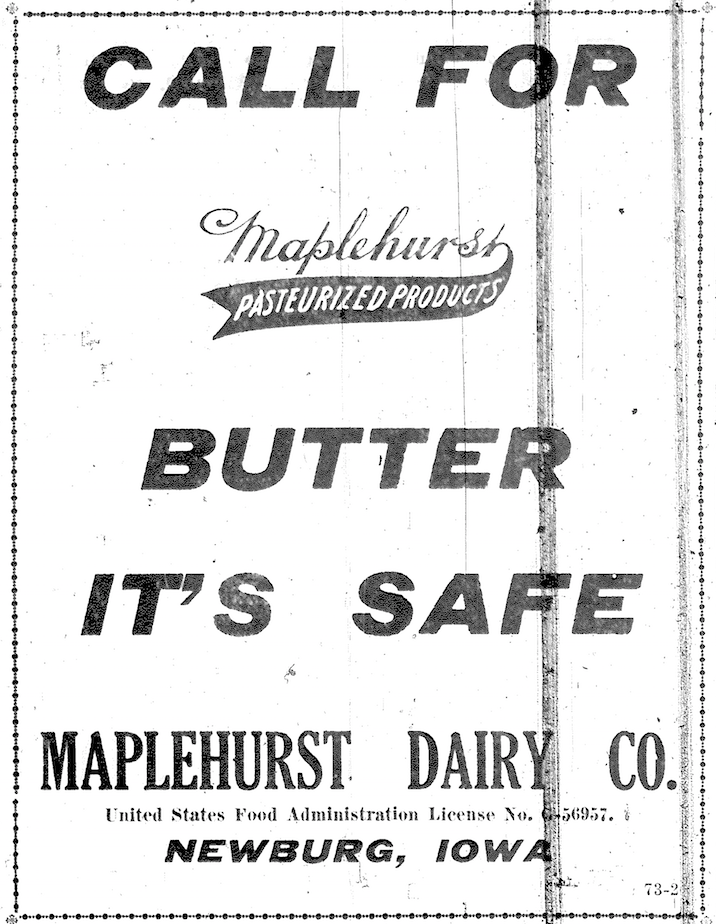
Local dairies were quick to pick up on Hamilton's point about milk, adjusting their advertising to point out that their products were pasteurized or that their bottles were not subject to infection from being left with customers.
Grinnell Herald November 29, 1918

Grinnell Herald December 10, 1918
For those citizens who were worried about the water, regardless of the expert's opinion, Colfax's Fry Bottling Company had a solution—bottled mineral water, "Safe against the Typhoid Germ," as the company's advertisements noted.

Concerning though they were, typhoid cases shrank in importance when compared to the inroads made by flu. All the same, officials were anxious to lift the quarantine and, encouraged by the hope that the disease had passed its peak, announced the end of the quarantine, effective October 28.
Grinnell Herald October 25, 1918
Alas, the optimism was short-lived. At an emergency meeting of the city's Board of Health on the very day that the quarantine was to be lifted, the Board rescinded the earlier order and reimposed the quarantine. According to the newspaper report, "quite a number of new cases of the disease [flu] were reported by the physicians of the city, so many in fact that the board considered the better policy to be on the safe side" (Grinnell Herald October 29, 1918).
Grinnell Register October 28, 1918
In an effort to get a better handle on the dimensions of the illness and apparently at the instigation of the Grinnell schools leadership, on Monday, October 28 the town's teachers, exiled from their classrooms by the quarantine, proceeded to canvas all quarters of the city in search of hard numbers on the extent of the epidemic. The results of the survey were published in the next day's Grinnell Herald. Not counting the 15 households that did not respond, the survey found 70 cases of "active" flu in town, and 159 "convalescing" cases. Another 21 individuals were reported to be suffering from typhoid. Teachers figured that 105 Grinnell families—which must have represented about 10% of the town's approximately 5000 residents—were dealing with at least one case of flu.

Within a couple of days, teachers were back on the streets to count the city's ill another time. On November 1st, the Herald published results of a survey undertaken the preceding day. The latest canvas reported 19 "new cases," and a total of 42 "active cases" along with 54 cases of people who were convalescing from the flu. According to this tabulation, 32 Grinnell families were struggling with at least one case of flu. Rephrasing the numbers, the second survey found that 73 fewer Grinnell families had a flu victim to care for. There were still 16 persons suffering from typhoid fever.
Grinnell Herald November 5, 1918
Authorities decided to lift the quarantine on November 4th, but the disease's hold on Grinnell proved tenacious, the plague continuing unabated through the Thanksgiving season. John Crosby, a thirty-year-old painter died November 4th, and on the 9th and 10th two more children passed. In the days before Thanksgiving (November 28 that year), a whole string of deaths were registered: one on the 19th, one on the 20th, one on the 22nd, one on the 23rd, three on the 24th, two on the 25th, two on the 27th, one on the 29th and one on the 30th.

Although most death certificates identified pneumonia as the cause of death, often with flu as a contributing factor, newspaper obituaries were more willing to assign primary responsibility for death to influenza. When Fred Plum died November 22, for example, his death certificate cited pneumonia as cause of death, with flu as a complication. The Herald obituary, however, blamed influenza, pointing out that 22-year-old Fred was not the only one suffering from the contagious disease; his wife and child were so ill with the flu that they could not attend Fred's funeral. Within a week, the flu pulled down Fred's sister, Hazel. "When the flu broke out in the Plum family," the newspaper reported, "Mrs. J. W. Plum, Charlie Plum, and Myron Plum were all stricken at the same time. Hazel was a wonderful help to her father in caring for the sick ones until she herself was taken..." (Grinnell Herald November 26, 1918).

Something similar happened in numerous other families. The same issue of the Herald that reported on Hazel Plum's death published a brief report on the Ernest Lawrence family, all of whose members were reported to be suffering through the illness. "Both Mr. and Mrs. Lawrence have been hardly able to move around and the four children have also been afflicted...." Only the volunteer help of a neighbor kept the ill family members hydrated and alive.

Some families found themselves not only without a hospital room but also without a doctor, so that their illnesses passed largely unseen by the public. For the few Mexicans then living in Grinnell, this must have been the usual experience. When in early November little one-year-old Aurora Baldingro fell ill, for example, her family cared for her without a doctor, as the child's death certificate proved. E. B. Wiley, the local health officer who signed the certificate, attributed death to influenza, adding "probably [my emphasis-DK], from what we get from the parents." In other words, Wiley had not seen the child before her death, and had to depend upon the parents' report to assign cause of death. The same thing had happened with Deodoro Lucis, who died October 17, pneumonia being cited as cause of death. But Dr. E. E. Harris could not say how long the illness had lasted, since he only saw Lucis the day before he died.
Death Certificate for Aurora Baldingro (1917-1918)
(https://www.familysearch.org/ark:/61903/3:1:3Q9M-CS6V-L9VY-8?i=2629&cat=2558528)
Consequently, when December arrived, Grinnell was still struggling with influenza, and some citizens expressed dissatisfaction with the way that authorities were handling the crisis. In a statement published in the Grinnell Herald December 10, Mayor White attempted to calm the waters. He said that, as of that morning, doctors reported a total of 65 influenza cases, new and old, and urged Grinnellians to avoid giving expression to wild rumors about the disease. "We may have the presence of this unwelcome visitor for a year," the mayor said, no doubt surprising and frightening his critics. Continuing on to his main point, the mayor allowed that Grinnell would "not be able to control [the flu] except by the cooperation of citizens." Urging people not to visit neighbors or friends afflicted with the flu until the victims were pronounced well, White hinted that, in the absence of voluntary cooperation, he might re-impose the quarantine. In the meantime, the mayor promised to post in city offices up-to-date counts of flu cases at least once a week.
Grinnell Herald December 27, 1918
Deaths from pneumonia and influenza continued, but apparently without significantly depressing local business. As an article in the December 27th Herald pointed out, the quarantine had interfered with the delivery of goods to local merchants, and the health scare had kept some people out of the business district. But merchants had managed to overcome these difficulties. Neither the unusually warm autumn weather nor the snow just prior to Christmas did much to undermine Christmas shopping, which most businessmen thought as good as, or even better than, 1917's holiday trade.
***
As residents of Grinnell hung new calendars in their homes, savoring the beginning of 1919, influenza crept quietly away. Although a spate of new cases emerged in late winter, the flu seemed less potent, and the fear of deadly illness dissipated. No one knew why the flu abandoned Grinnell; it certainly wasn't because physicians had figured out how to cure or prevent it. An early attempt at vaccination had been made on the college campus when in mid-October men in the Students Army Training Corps were inoculated, but the results of this effort were less than startling: after the mass vaccination SATC men continued to fall ill and die, leaving others to wonder at the effectiveness of the proposed remedy.

Easier to appreciate was the opening of Grinnell's two new hospitals—St. Francis Hospital on the east side of town in February and Grinnell Community Hospital on the west side in August. The new facilities provided more beds and much better conditions with which to fight epidemics. Consequently, when in winter 1920 another wave of flu—although not the same virus that had overwhelmed the town in 1918—appeared, Grinnell's hospitals coped well with the demand for beds and care.
Undated photo of Grinnell Community Hospital, a 45-bed facility that opened in August, 1919
(Digital Grinnell)
The 1918 uptick in typhoid also left a mark upon Grinnell. Pasteurized milk products gained a new foothold among Grinnell consumers, and helped drive the dairy industry toward 100% pasteurization. Similarly, largely because of the report of Dr. Hamilton, the city moved forward in requiring all city residences to abandon outdoor privies and connect to the city sewer system, changing forever the appearance of residential Grinnell and raising the expectations and responsibilities of city government.

All the same, the deadly course of the 1918 epidemic left its most somber imprint in Hazelwood Cemetery, many of whose gravestones bear witness to the lethal legacy of the 1918 epidemic. Some families lost several members as the virus hop-scotched from one victim to another, their grouped grave markers confirming in stone their common fate. As elsewhere, the 1918 flu preferred not the youngest and not the oldest, stealing away instead many of Grinnell's healthiest, prime-age population. These sturdy young people endured the brief rage of the virus, their lives cut short before they could understand what had deprived them of the future they intended to live.