Saturday, April 3, 2021

Grinnell's Would-Be Millionaire

When I was a boy and our Philco black-and-white TV was still new, I used to enjoy a 1950s program called "The Millionaire." Perhaps some of you remember it? Each episode featured the executive secretary of the fictional, fabulously wealthy John Beresford Tipton, a man who never appeared on screen, but who had the expensive hobby of giving away anonymously each week a million dollars. The show enjoyed an enthusiastic following for six seasons, in part because the idea of becoming a surprise millionaire was attractive to a lot of people.  It figures, right?

Headline from Cedar Rapids Gazette, June 1, 1901

I mention the TV show because in the first years of the twentieth century a Grinnell resident thought that perhaps she had stumbled onto some similarly good fortune. Fannie Partlow—a widowed and divorced washer woman—figured that she might inherit from millionaire William Marsh Rice (1816-1900), who had been murdered in New York City in September 1900. Fannie, whose maiden name was Rice, thought that she and her sister, Mrs. Maria (Rice) Schuler (1827-1911) of Des Moines, recognized in newspaper images of the dead millionaire their long-lost brother, William Rice. The Rice sisters intended to stake a claim on the Rice estate, which at the time was valued at about $8 million—almost $250 million when converted into twenty-first-century dollars.

Today's post examines Fannie Partlow's rags-to-riches plan, and how it played out in early twentieth-century Grinnell. 

###

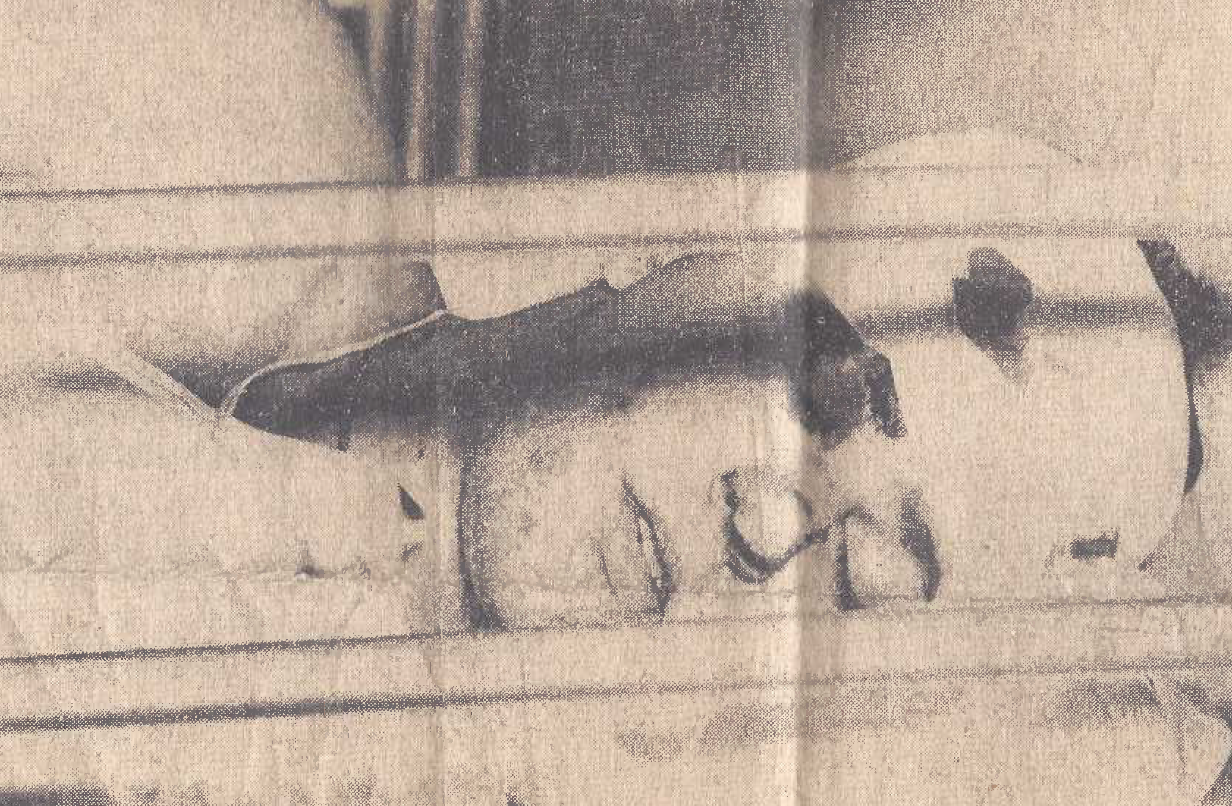
Newspaper Likeness of William Marsh Rice
(Audubon County Journal, October 11, 1900)

The biography of millionaire William Marsh Rice describes him as a self-made business phenom. When still a young man, Rice settled in Houston where he began his successful scaling of the American business ladder, investing in real estate, lumber, railroads, and cotton, among other things. Although the tycoon spent considerable time in New York, he regarded Houston as his home, explaining why in the 1890s he composed a will that bequeathed most of his considerable estate to creating in Houston the "William M. Rice Institute for the Advancement of Literature, Science and Art." Rice personally selected the trustees and had the institute—now better known as Rice University—formally chartered. By the terms of Rice's will, the institute could not open until after its donor's death, so the official opening did not occur until the September 1912 anniversary of William Rice's murder. The endowment that Rice bestowed upon the institution was so generous that until the 1960s Rice University did not charge tuition. Less happily, Rice's endowment, designated  only "for the white inhabitants of the City of Houston and the State of Texas," prohibited enrollment of African Americans, the first of whom gained admission to Rice only in 1965.

Rice's murder in New York on September 23, 1900 was big news all across the country, and many Iowa newspapers published the details, finally blaming the homicide on the rich man's valet, Charles Jones (1875-1954), and an avaricious lawyer, Albert Patrick (1866-1940)Unraveling the details of the crime took months, but ultimately the investigation revealed that Rice's valet, at Patrick's urging, had subjected Rice to some weeks of mercury poisoning. When the poisoning failed to achieve the prompt demise of the eccentric millionaire, Jones killed the eighty-four-year-old with chloroform. Meanwhile, attorney Patrick had authored a fraudulent will that gave the bulk of the estate to Patrick who had promised to share his gain with Jones. When an official autopsy of the victim revealed mercury poisoning, Jones confessed to his part in the scheme, but threw all the blame on Patrick. In exchange for his testimony, Jones was freed; Patrick, on the other hand, was tried, convicted, and sentenced to death, later commuted to life imprisonment (later still, Patrick was pardoned). 

###

Fannie Rice Partlow (undated photograph, perhaps from 1890s?)

OK; that's William Marsh Rice. Who was Fannie Partlow, and how did she become involved in this distant scandal?

Fannie Rice (1840-1924) was one of eleven (or more) children born to Peter Rice (1794-1878), a man with a foggy past and at least three wives. Like most of her siblings, Fannie was born in Crawford County, Pennsylvania, but by the time US census officials found the family in 1850 Peter Rice and children were living in Garnavillo Township, Clayton County, Iowa. The census describes Fanny (documents often mix the spelling of her name) as being seven years old, although in fact she had to have been about ten. The record reports that older sister Maria was 22 years of age, and brother William, the center of their subsequent claim to fortune, was 19.

Extract from 1850 US Census for Peter Rice Family

Ten years later the census confirmed that most of Fannie's older siblings had left the family hearth, now relocated to sparsely-populated Sperry Township in Clayton County, Iowa. At age 21, Fannie was second oldest of the children still resident in her father's home. By this date brother William had already fled, supposedly angry after a dustup with his father. In 1862 Fannie married William Partlow (1807-1876), who, because of an unspecified disability, had recently been discharged from the Fourth Iowa Cavalry (William Forse Scott, Roster of the Fourth Iowa Cavalry Veteran Volunteers 1861-1865 [NY: J. J. Little and Co., 1902], p. 70). Like Fannie's father, her husband was a farmer, and, although Partlow was thirty-three years older than Fannie, the couple had five children, two of whom died in infancy. William himself died in 1876, leaving his wife a widow with three young children (Mary [b. 1863], Maria [b. 1865], and Samuel [b.1870]).  According to her obituary, Fannie arrived in Grinnell in 1883, possibly following her oldest daughter who had married in Des Moines in 1881.

William Partlow (1807-1876) in Civil War Uniform
(https://www.ancestrylibrary.com/family-tree/person/tree/174526905/person/192273123575/facts?ssrc=&queryId=8db9e65100136ef5570d7e3d01d19926&ml_rpos=1)

Not long after reaching Grinnell, Fannie remarried, taking Charles Cleal (b. 1840?) as her second husband in an 1885 ceremony registered in Marshalltown. For the next several decades Fannie used her new husband's surname, Cleal—except, surprisingly, for the 1901 stories about her prospects for inheriting from Rice; in these stories she invariably appeared as Fannie Partlow, using the name of her first husband for reasons that were never explained.

Record of July 4, 1885 Marriage of Fannie Rice to Charles Cleal
(Iowa Marriage Records 1880-1951)

How long Fannie's second marriage lasted I don't know, but the bond certainly had broken by 1900 when Charles Cleal, who was then living alone on 3rd Avenue in Grinnell, told census-takers that he was divorced; Fannie said the same to Iowa census officials in 1905, but I did not find the divorce record to confirm the date of their separation. After the divorce, Charles continued to live on 3rd Avenue in Grinnell, apart from "Mrs. Fannie A. Cleal," who occupied the "third house north of 6th Avenue, west side of Penrose." The 1908 directory recalls only "Mrs. Fanny A. Cleal," who then resided in the Ames Block downtown (824-828 Main Street); Charles Cleal disappeared from Grinnell records, his fate unknown.

###

The news of William Rice's murder in far-away New York in 1900 apparently bypassed Fannie Cleal completely. Grinnell newspapers had not paid much attention to the scandal, and, in any event, as Fannie's sister later told newsmen, none of the Rice daughters could read. Nevertheless, it was Fannie's sister, Maria Rice Schuler, who first raised the possibility of their becoming millionaires. According to the story repeated in several newspapers, it was Schuler's Des Moines neighbor who, more than six months after Rice's death, introduced the sisters to their prospects for great wealth. The neighbor, who allegedly did not know Schuler's maiden name, saw a newspaper picture of William Marsh Rice and "was struck by the likeness of the picture of the murdered man" to Mrs. Schuler. The neighbor took the newspaper to Schuler, "who is unable to read," the newspaper added importantly, and asked Schuler if she knew the person pictured in the paper. "Why, that is a picture of my brother William," Mrs. Schuler is reported to have said, adding that William had left home fifty years earlier. Mrs. Schuler soon visited sister Fannie in Grinnell, "and after comparing notes they became convinced beyond doubt that the murdered man was their brother" (Davenport Daily Republican, June 4, 1901). 

Maria Rice Schuler and Fannie Rice Partlow
(Des Moines Register Leader, December 1, 1912)

Perhaps because the story had a Cinderella coloring, newspapers found it difficult to ignore, and tales of the prospective millionaire washer-women multiplied. The Marshalltown Evening Times-Republican was typical:

From the wash tub to the affluence of millions is a wide remove in the conditions of life, but this is likely to be accomplished by Mrs. Maria Shuler [sic] of Des Moines and Mrs. Fannie Partlow [sic] of Grinnell. The women have paused long enough in pursuing the arduous duties of the wash tub to remember that they had a brother named William M. Rice, and they claim that this brother was the late William M. Rice, the New York millionaire, who was recently murdered...and that they are the heirs to his estate of $8,000,000 (May 31, 1901).

Iowa newspapers seemed persuaded that the women's claim was legitimate, and they uniformly expressed confidence that the women would inherit a windfall. Even the Grinnell Herald gave an optimistic assessment of their chances:

Grinnell Herald, May 24, 1901

To advance their claim Fannie Partlow and her sister retained the services of Grinnell attorney J. H. Patton, whose obituary remembered his inclination to take on cases of the underprivileged. The Grinnell lawyer promptly set to work, dispatching a letter to Charles F. Jones, the former valet of William Rice, at that time imprisoned in New York for his part in murdering Rice. Patton observed that he represented "several illiterate but deserving persons," and sought information on how to proceed (New York Tribune, May 25, 1901).

Undated Photo of J. H. Patton
(L. F. Parker, A History of Poweshiek County Iowa, v. 2 [Chicago: S. J. Clarke Pub. Co., 1911], p. 924)

Writing to Jones seems an odd path for the attorney to have pursued. Not only was Jones acknowledged to have been complicit in the murder; he was also then in prison, and therefore in no position to help advance the interests of the Iowa petitioners. I suppose that Patton had in mind that, since Jones had long been the valet of the dead millionaire, he was best able to know whether, as the sisters maintained, wealthy William Rice had a snake-bite scar on his leg and a scar on his finger, as their long-lost brother had. These specific identifying features helped persuade newsmen that the Rice women had an authentic claim to the estate.

What reply Patton received to his inquiry is unknown; no record of a reply survives. However, if Patton did hear from Jones or from anyone else connected to the inheritance, the news must have been discouraging, as Patton seems to have let the case expire. Newspapers found no reason to reengage with the women's claim to great fortune, and the Rice women, now deprived of a public forum, were obliged to resume their humble occupations without the financial windfall they had sought.

###

Certainly those responsible for deciding the fate of William Rice's fortune had reason to be suspicious of the numerous petitioners who claimed to be kin to the dead tycoon. In January 1901, for example, months before Fannie Partlow had heard of William Rice's death, the New York Times announced discovery of "Three Persons, Living in Poverty in Missouri" who were said to be legitimate heirs of Rice's estate. "The three are ignorant country folks, and were not aware of their uncle's death nor the sensational circumstances connected with his demise," the newspaper said. Whether they could travel to New York seemed doubtful, the newspaper remarked, "as for many years they have been the poorest people in the county, being barely able to eke out an existence, and they have not the means to carry them out of the State" (New York Times, January 14, 1901).

Headline from story in New York Times, January 14, 1901

A few months later a Muncie, Indiana tailor also submitted a claim for the Rice estate. Carl J. Carrolson alleged that he was grandson and heir of William Marsh Rice. According to the Indiana man's story, his mother had gone to New York some years earlier "to establish her claim as a daughter-in-law, [but] met death in a mysterious manner." The newspaper thought Carrolson's "proof of identity so strong that his case has been taken by a prominent legal firm who will supply the money for prosecuting the claim" (Rock Island Argus, April 10, 1901).

That autumn a collection of Massachusetts folk who claimed to be relatives of the dead millionaire attempted to have the original Rice will quashed; if their effort proved successful, Rice would have been declared to have died intestate, and they could claim a share of the estate. The two sisters and two nephews, all from Springfield, Massachusetts, made light of the claims of Fannie Partlow and Maria Shuler of whom they had obviously heard (The World, November 26, 1901).

###

Back in Iowa, Fannie and her sister seem to have given up their pursuit of millions. Apparently, however, the washerwomen had not abandoned hope entirely, because, when Maria Schuler died "in poverty" in 1911, the Marshalltown newspaper expressed the view that "millions [were still] within reach." 

Marshalltown Evening Times-Republican, June 19, 1911

Consequently, when Albert Patrick was pardoned and released from prison in 1912, vowing to go to court to obtain a share of the Rice estate, the Iowa claimants attempted to revive their case. Fannie Partlow was still alive in Grinnell, but now a third sister, Elizabeth Chenoweth (1847-1933), and a Menomonie, Wisconsin brother, Joseph Rice (1852-1924), both unmentioned in the original petition, renewed the case, adding to the petitioners a raft of nephews and nieces along with Grinnell's Fannie Partlow. Why this third sister and brother had not been part of the original claim is unclear; perhaps the two women hoped to acquire their fortunes without sharing the money with anyone. The expanding roster of potential millionaires in 1912, however, indicates that the prospect of easy millions was very tempting, and encouraged the women's two siblings and a host of descendants from the next generation to pursue the gold.

Des Moines Register and Leader, December 1, 1912

The new claimants selected Des Moines attorneys, F. L. Meredith (1871-1947) and C. O. Holley, to represent them, an indication that the initiative this time lay with the Des Moines clan, rather than with Fannie in Grinnell or with their brother in Wisconsin. In a newspaper interview, Meredith explained his situation: 

I have corresponded with all of the heirs, and while I am not ready to say that [the Des Moines petitioners] are the real heirs, I am inclined to believe that they are, because of the honesty and sincerity of the sisters... Much of the life of Rice coincides with the printed reports of his years of work in Texas published since his death, and of which the relatives have had no knowledge (Des Moines Register and Leader, December 1, 1912).

The measured enthusiasm in Meredith's statement deserves attention. I could find no report of exactly how Meredith proceeded or what he learned from pursuing the claim. Instead, news of the Iowa hopefuls again disappears from the record, perhaps only a passive, although final, recognition that no millions were coming to the washerwomen in Iowa.

###

In the years after the dreams of great wealth had evaporated, Fannie's name occasionally made it into the newspapers. Unlike reporting on her pursuit of the Rice estate, in these years news accounts continued to identify Fannie by the surname of her second husband, without improving his or her reputation. For example, in late summer 1915 "Fannie Cleal" appeared in local court on charges of petit larceny. The complaint alleged that Fannie had walked out of the C. A. Blair store on Broad Street in Grinnell, taking with her a rain coat she had not purchased. The court fined her $100 and costs (Marshalltown Evening Times-Republican, August 28, 1915). The following year she and her daughter, Mary Martin (later Nutting; later still, Alltis), filed suit against E. B. Brande (1866-1928) and his son, Dawson Brande (1890-1940). According to the petitioners, Fannie and  her daughter were

driving along Third Avenue in Grinnell when their buggy was struck by a car driven by Dawson Brande and in which E. B. Brande, the owner of the car, was riding. It is alleged that the car was being driven at an excessive speed and that notwithstanding it was after sundown the car did not display lights in front. The ladies claim that they were thrown from the buggy by the force of the collision and each in her separate petition claims to have been injured and each sets out an itemized list of her money damages. Mary Martin asks $800 for pain and suffering and Fannie Cleal asks $900 for the same item (Marshalltown Evening Times-Republican, February 17, 1916).

In March the court found in Fannie's favor, awarding her $600 instead of the larger sum she had sought (Marshalltown Evening Times-Republican, March 18, 1916). Brande, however, appealed, and the case was reheard that fall, at which time the court reversed the earlier decision, finding now for the defendant—that is, it denied Fannie the money she had sought, noting that the women had been driving their buggy on the wrong side of the road (Marshalltown Evening Times-Republican, September 30, 1916). As with her attempt to acquire a share in the estate of William Marsh Rice, Fannie came away with nothing.

###

Death Certificate of Fannie Ann (Rice) Partlow Cleal, August 24, 1924

Fannie Rice Partlow Cleal died August 23, 1924 at her daughter's Grinnell home. The death certificate, certifying that the 84-year-old had died of uremia, confirms that much else about the woman remained unknown—intentionally or not. To the question asking the name of the father of the deceased, the document bears only the surname "Rice," with no given name. The certificate reports the birthplace of the father as "not known"; the spaces asking the maiden name of the mother of the deceased and her birthplace bear the same reply. Identifying the dead woman as "Fannie Ann Partlow," the death certificate continues the fiction of her married life, omitting entirely any reference to Fannie's second marriage. Worse, when Fannie's daughter May (or Mary, Mrs. Charles Alltis), informant for the death certificate, specified her mother's husband, she provided the name "Samuel Partlow," which was actually the name of Fannie's deceased son (and May's brother), not Fannie's first husband, William Partlow. 

Undated Photograph of Samuel Partlow (1870-1919), youngest child of Fannie Partlow; he
operated a number of restaurants in Grinnell, Marshalltown, Des Moines, Hampton, and Ottumwa
(https://www.findagrave.com/memorial/45854225/samuel-sylvester-partlow)

Although Fannie's published obituary omitted much, it did not fail to note that Fannie's "life has known much toil and not a little suffering" (Grinnell Herald, August 26, 1924). Nothing was said about the failed claim to the William Rice fortune and Fannie Partlow's dream of millions.

###

In truth, the claims of Fannie and her sister, despite all the public support, seemed dubious from the start. For example, how could Maria and Fannie have recognized in a newspaper picture of an elderly man their twenty-year-old brother whom they had not seen in half a century and from whom in those fifty years they had received not a single word? Moreover, the William Rice who died in New York was said to be 84, whereas, if we accept the story that the Iowa women told, their brother could have been no more than 70 years of age in 1900. Age reliability in this era was not too great, of course, but a fourteen-year difference surely occupied the outside range of possibility. Adding these considerations to the suspicions that attached to the numerous claims of the impoverished to the enormous Rice estate, we cannot be surprised that the Iowa washerwomen did not succeed in becoming millionaires.

Undated Photograph of the Set of "Who Wants to be a Millionaire"
(https://www.newscaststudio.com/2020/04/21/who-wants-to-be-a-millionaire-kimmel/)

At the same time, the lure of great fortune is perfectly understandable, and remains potent today. Decades after "The Millionaire" went off the air, "Who Wants to be a Millionaire," yet another show tempting contestants with great wealth, premiered on American television, going on to become "one of the highest rated game shows in the history of U.S. television." The nighttime version of the show attracted some 30 million viewers three times a week, one indication of the enduring appeal of an "easy" million. But, like the various jackpot lotteries now in operation, actually winning a million dollars was rare, despite the enormous appeal of the potential prize. Over the twenty-plus years when "Who Wants to be a Millionaire" was broadcast, for instance, only a dozen winners succeeded to the top payoff, a minuscule fraction of the thousands who auditioned to appear on the show.

Without access to Fannie's private thoughts—in a diary or letters, for example—we cannot know how optimistically she approached pursuit of the Rice bequest. Her 1916 civil suit against E. B. Brande, like her 1915 arrest for petit larceny, implies a cynical attempt to work the system. Perhaps from the very beginning she was aware that her claim was bogus. But what would we say if someone like "The Millionaire's" executive secretary, Michael Anthony, knocked on our door and announced that an anonymous donor wished to give us one million dollars?

###

PS. In the pandemic when so many institutions are closed, I owe special thanks to Marilyn Kennett, head of Drake Community Library (DCL), for allocating me some time in the library to check microfilm, and to Liz Cabelli, archivist at DCL, for checking files in search of J. H. Patton's role in pursuing the Rice legacy. I also thank Traci Patterson, archivist at Rice University's Woodson Research Center, who kindly undertook to search several folders of Early Rice Institute Records (UA 101) for evidence of Fannie Partlow and others connected to the Iowa petitioners. Regrettably, she found none, but I am grateful for her help all the same.


Sunday, February 28, 2021

That Time When a Convict Fell Out of the Sky...

Every once in a while I stumble across a story that really surprises me. Take, for instance, the story from May 1964 when, in the early morning hours of a stormy night, a Cessna 182 crashed on a farm northeast of Grinnell. Of course, airplanes sometimes crash in the daytime as well as at night, in good weather as well as foul. What made this crash special was that the person piloting the plane was a convict who had escaped from the prison farm at Fort Madison. Having walked away from the farm, Steven Barner found his way into the Fort Madison Airport sometime after midnight. There he discovered an airplane that was fully fueled and ready to fly, complete with keys in the ignition. However, one important ingredient, crucial to success of the convict's escape plan, was missing: a genuine pilot. The fugitive, who had been in the US Air Force briefly, apparently had never flown an airplane; nevertheless, it was he who rolled the Cessna down the runway in the darkness, which explains at least in part how the journey ended up in a Grinnell hay field. Today's story follows the adventures of the convict who fell out of the sky.

Headline from the Cedar Rapids Gazette, May 26, 1964
###
Steven Barner was the second son born to George S. Barner (1890-1952) and Gladys Leinbaugh Barner (1896-1985). Steven's father had been born into a farming family in Martelle, Iowa, and had operated the family farm for several years when tragedy struck. Steven's grandparents were taking a springtime walk on the Linn Grove farm; Mrs. Barner (1866-1925) (who had the unusual given name of Wealthy) wanted to collect some flowers, and her husband took along his shotgun, intending to shoot pigeons. Returning to the farmhouse from their stroll,
Mr. Barner [1862-1926], as was his custom, started to unload his gun, stopping in the act while Mrs. Barner walked on. When the gun accidentally exploded the discharge hit Mrs. Barner, causing instant death (Mount Vernon and Lisbon Hawkeye Herald, May 7, 1925).
News accounts reported that the dead woman's husband was prostrate with grief, which might help account for his death the following year.  Presumably the couple's son, George S. Barner, was also deeply affected. All the same, the farm awaited George's attention, and the deaths of his parents so close together may have spurred him to find a wife, which he did in 1927, marrying Gladys Leinbaugh. Neither partner was young—George was 37 and Gladys was 31—but no children were born to this union until 1932, when Creighton Lee joined the family. Another eight years passed before the second son, Steven, was born in October 1940 (or, as in some sources, 1941 or 1942). The public record reveals little about the family as the boys grew; presumably their lives followed the usual traces without attracting much attention. 

Then the boys' father died suddenly in 1952. Creighton Barner (1932-2016), the older son, was already 20, and he soon charted his own life course (which was not without difficulty). Several months after his father's death, Creighton enlisted in the US Air Force, intending to take aviation training. For reasons unknown, Barner was soon out of the Air Force and back in Iowa. Perhaps his mother needed him home to work the farm, and for a time Creighton did take over operation of the family farm. In 1954 he married Lola Horstmann (1932-2017), and together they kept the farm going.  His marriage, however, went south, and he and Lola divorced in the early 1980s. After Creighton remarried (at the Anamosa Sale Barn, no less) in 1983, Lola filed suit against him, demanding $76,000 dollars, apparently a consequence of their divorce (Cedar Rapids Gazette, November 27, 1986).
 
Photographs of the 1983 Wedding of Creighton Barner and Mary Ulrich
(Cedar Rapids Gazette, May 2, 1983)

Steven, the central actor in our story, was only twelve years old when his dad died, and eight years younger than Creighton, so his father's early death may have been more affecting to the boy. The public record reveals nothing about Steven's earliest years, but soon his name began to appear in newspapers. In March 1959 the Cedar Rapids Gazette published word that Steven was following his brother's plan of enlisting in the US Air Force, and had already been sent to Texas for training (March 21, 1959). However, as with his older brother, something quickly went wrong, and Steven was soon back in Iowa. Later accounts claim that Steven had been given a medical discharge, but I could find no confirmation of this explanation. At any rate, exactly one year after enlisting in the Air Force, Barner appeared before a Cedar Rapids judge, and pleaded guilty to driving a car without the owner's consent. The news report said that Barner had escaped with a bench parole, but records of the Anamosa Reformatory indicate that Steven received a one-year sentence, and served nine months, being released December 31, 1960 (Cedar Rapids Gazette, March 16, 1960). 

Anamosa Reformatory (later Penitentiary)
(https://digital.grinnell.edu/islandora/object/grinnell:13487)

This collision with the law might not have been Barner's first offense, as Anamosa Reformatory records indicate that Steven left school after tenth grade. In any case, in early 1962 Steven again stood before a judge.  This time the charge was more serious: "uttering a forged instrument," which is to say that he tried to cash a forged check at a Cedar Rapids store. Apparently a juvenile friend had actually forged the check; but Steven, who claimed to be twenty years old when he pleaded guilty, received a ten-year sentence at Fort Madison (Cedar Rapids Gazette, January 26, 1962). According to the prison records, he gained parole in late September 1963, but was not as careful as his parole officer might have wished.

1959 Cedar Rapids Yellow Pages, p. 131

In early February Barner and a young collaborator stole "between 15 and 19 cases of empty beer bottles from Kalell's Grocery and Market" in  Cedar Rapids. Albert Abdo Kalell (1896-1962), who had founded the market that he and his family operated, had immigrated to the US from Syria early in the twentieth century, and was part of the growing Muslim population of Cedar Rapids. It is not clear how Barner and his accomplice settled on Kalell's store, but, because the theft constituted a parole violation, the authorities promptly sent Barner back to Fort Madison (Cedar Rapids Gazette, February 4, 1964). In the days after his return, Steven seems to have conducted himself well enough to be trusted to work on the less carefully guarded Fort Madison prison farm. Apparently it was there that Barner nourished dreams of his ill-fated, flying escape only months after being returned to prison.
###
Many aspects of the 1964 escape seem irrational. What, for example, drove Barner to think that his best route to freedom was to try to fly away from incarceration? What made him think that, even if he successfully made it to the Fort Madison Airport, he would find a plane fully fueled, unsecured, and ready to take off? And what made him think that he could do the flying? No obvious answers to these questions emerge from news stories.

The Fort Madison warden at the time, John Bennett, told the Cedar Rapids Gazette that Barner "might have read up on flying at the prison library" and might even have flown a plane "a time or two" (May 26, 1964). Moreover, as the warden confirmed, the prison farm was only about one-half mile from the airport, so perhaps Barner simply chose the closest, most immediate option, despite the other, potentially fatal, complications implicit in this plan. 
A Cessna 182, similar to the plane that Barner flew
(Photo by Adrian Pingstone (Arpingstone) - Own work, Public Domain, https://commons.wikimedia.org/w/index.php?curid=10836531)

Somehow—whether from his prison library reading or from some unknown previous experience—Barner knew enough to start the plane and somewhere around 1AM get it airborne, despite what the newspapers called "rainy, turbulent weather" (yet another reason to give one pause about this plan of escape). Once aloft, Barner later told investigators, he first headed toward Burlington, flying very low, "just skimming the treetops." But then the novice pilot got his craft headed toward Cedar Rapids where, he later said, he had intended to land. Witnesses there said that they saw and heard the Cessna circling for two hours or so. A Cedar Rapids policeman thought the sounds indicated just "another leisurely cruise," although who would be taking a "leisurely" cruise through the Cedar Rapids skies through a rainstorm in the middle of the night seems difficult to imagine (Daily Iowan, May 27, 1964). 

Why Barner did not attempt to land at Cedar Rapids remains unknown; perhaps the storm gave him pause. If he really did not know how to land—officials later found in the airplane a manual opened to landing instructions—Barner might have worried that landing in a storm was a bridge too far (Daily Iowan, May 27, 1964). Indeed, he told the Dubuque Telegraph-Herald that the manual "didn't do any good when he moved in for a landing" (May 29, 1964). 

But then why did he leave the Cedar Rapids area and head west? Barner might have thought that he could fly out of the storm, and find someplace where his chances of landing safely were better. So far as I could learn, Barner never explained this decision. All that we know for sure is that, soon after leaving the Cedar Rapids skies, his Cessna was flying west, just north of Grinnell. As investigators later learned, there was still fuel in the airplane's tanks as the plane had traveled altogether only about 125 miles (Burlington HawkEye, May 26, 1964). But for reasons unknown, in the early morning hours Barner decided to land in the open fields of a farm in Chester Township, northeast of Grinnell. 
Map of Area Northeast of Grinnell where Barner Landed

The Grinnell Herald Register reported that Barner had "brought the plane in for a near-perfect 3-wheel landing, bounced once and then again on the crest of a small hill, and crashed nose first into the ground about 500 feet from the spot where he first touched down" (May 29, 1964). Perhaps Barner himself relayed these details; it is difficult to know who else could have witnessed the landing, as the newspaper itself reported that "no one witnessed the crash." If the landing began as "near perfect," it did not end that way. "The impact of the crash shattered the plane's windshield and knocked off both doors and the front wheel" (ibid.).

Photograph of the Crashed Cessna 182 on Richard Beck's Farm
(Dubuque Telegraph-Herald, May 26, 1964)

Richard Beck (1933-2010), who owned the field where Barner landed, told reporters later that he had never heard the airplane, but that, after having finished morning milking and having turned the cows out to pasture around 7 AM, he saw "the tail of a plane sticking up in a hay field." The nose of the plane was smashed and there was blood in the cockpit (Daily Iowan, May 27, 1964). Beck telephoned his neighbors, the Hendricksons; Nancy Hendrickson told him that the 7 AM news had reported that a Fort Madison convict had escaped via airplane. Beck then collected several neighbors (Wayne Hendrickson [1931-2006], Harvey Harris [1908-1992], and Henry Harris)—all armed—to help him search the area.  Nancy Hendrickson, who had driven over to the Becks' place after her husband left to help Beck, watched from inside the Beck farm house. She saw that Beck and the other men, after having inspected the crashed airplane and having discovered that it was empty, began to look elsewhere.
Spreading out they began looking in the grove, corn crib, and other buildings...Wayne [Hendrickson] and Dick [Beck] were going from one portable hog house to another, sticking their heads in the window in search of the prisoner. Suddenly we saw Wayne jump back, as though he had been struck, tripping over his own feet as he hurried back across the hog lot to the pasture fence, shouting at the top of his lungs, "He's in here—he's hurt—he's hiding in the corner—I found him" (Nancy Hendrickson, "The Crash").
Hog Shed on Beck Farm Where Barner Was Discovered
(Grinnell Herald-Register, May 29, 1964)

It was about 8 o'clock when searchers found Barner in one of Beck's hog houses to which the fugitive had crawled after the crash—about 1000 feet from the stricken airplane. Except for a pen knife, Barner was unarmed, and his injuries prevented him from offering much resistance. By this time two Iowa State troopers—Judd Kahler (1929-1983) and John Flannery—and one Grinnell policeman (Max Allen [1934-2000]) were on the scene, and took charge of the fugitive, delivering him first to Grinnell Community Hospital.
Steven Barner in Grinnell Community Hospital Bed
(Grinnell Herald-Register, May 29, 1964)

As Grinnell's Dr. John Parish (1904-1997) later learned, Barner had suffered several injuries during the rough landing. Newspapers gave somewhat different reports of the fugitive's condition; apparently Barner had a serious gash and lacerations on his head, losing enough blood to require a transfusion; he also had a broken leg, and other fractures that led to surgery in Grinnell Community Hospital (Grinnell Herald-Register, May 29, 1964; Daily Iowan, May 27, 1964). By the 28th Barner was back at Fort Madison, his airborne adventure behind him.

Extract from the Record for Steven Barner, Fort Madison Penitentiary
(Iowa US Consecutive Register of Convicts, Fort Madison Penitentiary)

###
Prison records indicate that Barner was released on parole again in July 1967, but he was back in prison soon after Christmas that year. What offense earned him a return visit to the penitentiary I did not discover. Apparently he spent the next two years at Fort Madison without causing any trouble. Finally, in August 1969 Steven Barner was released from prison, and, so far as I could learn, he did not work his way back into any Iowa penitentiary. 

After that, Steven Barner's name pops up occasionally in records from the western states. For instance, he seems to have lived in California for a time, and in the 1970s married twice there (one marriage lasted only three months); records indicate that in the late 1970s he married in Nevada. He lived in Kansas for a time, as well as in a half-dozen towns of eastern Iowa. However, so far as the public record reveals, he never again flew an airplane, perhaps fulfilling the pledge he gave reporters after his capture in 1964: "You couldn't get me near a plane again" (Dubuque Telegraph-Herald, May 29, 1964).

***
Special thanks to Nancy Hendrickson for sharing with me her file on the events of 1964 and her recollections of that upside-down day.


Wednesday, February 17, 2021

When College Students Go Missing....

If you Google "college student disappears," search results will identify more than 7 million hits. Of course, many of the hits reproduce the same disappearance, but the total is nevertheless alarming. It's clear that the disappearance of students is not a rarity. Some cases go back quite far, the subject of the search still undiscovered. Lauren Spierer, for example, a student at Indiana University who disappeared June 3, 2011 when she was twenty years old, remains unaccounted for. Other cases date back even further. More recently, Jason Landry, a twenty-one-year-old student at Texas State University, disappeared last December. His crashed automobile was found in a remote area, but, as of this writing, Jason remains undiscovered. Occasionally, the fog of absence abruptly lifts when someone discovers a body, as happened in 1992 when Tammy Zywicki disappeared en route back to Grinnell College.

Was it always like this? Did college and university students of yesteryear go missing like Jason Landry or Lauren Spierer did? Or is the phenomenon a modern happening without precedent?

Today's post examines two cases from the early history of Grinnell College to help us compare the past with more recent experience. These early disappearances indicate that, although the past is often very different from the present, sometimes it's hard to tell the difference between then and now.

###

Marshalltown Evening Times-Republican, October 24, 1899

In the last years of the nineteenth century, Grinnell College—including its preparatory academy and the Music School—enrolled on average about 500 students, the great majority of them from Iowa. Therefore, the September 1899 arrival in Grinnell of Wayne Bagley (b. 1881) from State Center, Iowa provoked little attention. An older brother had attended Grinnell in the late 1880s when the family was living in Melbourne, Iowa, so young Wayne—eighteen years old when he enrolled—was no doubt familiar with the college. Moreover, like most of his classmates, his home was nearby. 

Details of Wayne's previous schooling remain unclear, but evidently college officials did not deem him sufficiently prepared for the rigors of the college curriculum. Instead, according to the 1899-1900 college catalog, Wayne enrolled not in the college itself, but rather as a senior in the Academy, a sort of preparatory school. The college catalog, in enumerating schools whose curriculum the college recognized as satisfactory, lists the State Center schools in a second, lower category than the preferred, recognized schools, which probably explains Bagley's placement in the Academy.

1899-1900 Iowa College Catalog, p. 99

The Academy offered three years of preparatory work, and it is to Bagley's credit that Iowa College officials deemed him sufficiently well-schooled to enter the third, senior year in the Academy. As a review of the catalog confirms, the senior-year curriculum was no pushover, demanding competencies not easily attained in today's secondary schools. For example, all students in Bagley's Academy cohort were obliged to take Latin, English, and Physics five times a week, along with one additional language, choosing among Greek, German, or French. A catalog footnote pointed out that anyone wishing to continue toward the bachelor's degree had to have Greek, an indication of the high expectations the Academy held for its students.

Main Street, State Center, Iowa (before 1910)
(https://digital.grinnell.edu/islandora/object/grinnell:14307)

Happily for Bagley, he entered the Academy with two other students from State Center—John Gaffield Capron (1876-1918) and Wilbur H. Schilling (1881-1951). State Center was not then (and is not now) a large community: the 1900 US Census counted just over 1000 residents, so it is not unreasonable to think that the three young men were acquainted. In fact, the 1900 US Census for State Center lists the Capron and Schilling families next to one another, so they must have been neighbors. Moreover, Capron's mother (Clara Bagley Capron [1841-1901]) was a Bagley relative. It seems likely, therefore, that the three shared an acquaintance and may well have arrived in Grinnell together.

View of Grinnell College Campus; Goodnow Hall, Chicago Hall, Blair Hall, all built in 1880s
(https://digital.grinnell.edu/islandora/object/grinnell%3A13335)

But if the three young men were close, their friendship seems not to have helped Wayne Bagley adjust to the academic and social rigors of Grinnell. Barely a month after arriving in Grinnell, Bagley vanished. The Scarlet and Black, reporting the "mysterious disappearance," noted that Bagley was last seen "Friday evening [October 20th] directly after prayer meeting..." (October 25, 1899), only about five weeks after his arrival in Grinnell. "What makes the case more singular," the Marshalltown newspaper observed, "is [that] the young man has no bad habits, and there is no known reason for his absence" (Evening Times-Republican, October 24, 1899). Inquiries made in State Center, on the assumption that Bagley might have simply gone home, yielded no help; no one at home had heard from him and no one had a clue about where Bagley might have gone. So, the newspaper said, the boy's father would travel to Grinnell.

In fact, however, as the Marshalltown paper announced a few days later, it was Harlow Bagley (presumably meaning James Harlow Bagley [1868-1946], Wayne's oldest brother) who came to Grinnell, "doing everything in his power to trace his brother Wayne." If today searchers might send faxes, emails, or texts, in 1899 officials prepared and mailed post cards bearing Bagley's description to "all towns and villages in central Iowa." The newspaper, in an attempt to explain the young man's disappearance, opined that academics was not the problem, as young Wayne "was well up in his studies and there was absolutely no friction with teachers, students or anyone else" (Marshalltown Evening Times-Republican, October 27, 1899). An editorial in the college newspaper asserted that "Mr. Bagley had proved himself a faithful and diligent student and a young man of fine character," leading the editor to conclude that "we cannot but believe that some harm has befallen him" (Scarlet and Black, November 1, 1899). Perhaps the editor was not alone, as Grinnell officials set about dragging local ponds in search of a body (Daily Iowa Capital, October 30, 1899); none was found.

Des Moines Daily News, November 11, 1899

As often happens in cases like this, soon there were reports of bodies being found elsewhere—in a coal house, in the basement of the Methodist church, and in the baptistry of the Baptist church—"but the reports were unfounded" (Marshalltown Evening Times-Republican, October 31, 1899). The range of possible explanations gradually expanded, spurring still more speculation. In early November, almost two weeks after Bagley disappeared, someone raised the possibility that Wayne had "skipped away and enlisted in the army under an assumed name," but there was no evidence to confirm the supposition (ibid., November 2, 1899). A $200 reward for "information leading to his discovery" also failed to generate any solid leads (Des Moines Daily News, November 11, 1899). 

Months passed with no more light being shed on the mystery. When another Bagley brother visited the area in March, five months after the young man vanished, the newspaper could report that "nothing whatever has been learned as to [Wayne's] whereabouts" (Marshalltown Evening Times-Republican, March 31, 1900). One month later the discovery of a body near Oxford, Iowa led some to think that the missing student had at last been found; but the body was not Bagley's, and again the paper had to observe that "not a syllable of information concerning Bagley has been received since the evening last fall that he was seen in Grinnell" (ibid, April 30, 1900). The college newspaper marked the anniversary of Bagley's disappearance, observing that "all investigations proved unavailing, and his case is yet shrouded in mystery" (Scarlet and Black, October 31, 1900). 

Extract from Obituary of J. H. Bagley
(State Center Enterprise, March 31, 1904)

When Wayne's father, J. H. Bagley (1827-1904), died in 1904 without having seen his youngest son since he set off for Grinnell five years earlier, the obituary omitted mention of Wayne. The text noted that the deceased was father to five sons, but identified only four, making no mention of Wayne  (State Center Enterprise, March 31, 1904). Similarly, when Bagley's mother died many years later (1940), the death notice made no reference to Wayne (Marshalltown Times-Republican, June 6, 1940). Clearly the trail had gone cold. In what might have been the family's final acknowledgment of the missing Wayne, his brother, John Heman Bagley (1871-1929), gave the name Wayne to his fourth and final chid—Wayne R. Bagley (1909-1986). So far as I could learn, no other news of the missing young man has ever surfaced.

###

1132 Broad Street (2016 photo), Campus Residence of Roy McNamara '05

While his family and Grinnell classmates were still wondering about the fate of Wayne Bagley, news of the disappearance of another Grinnell student rocked the community. In late March 1902 the campus newspaper reported that Roy McNamara '05, like Bagley, an Academy student, was missing. Last seen Tuesday morning, March 18th, McNamara failed to return to his room at 1132 Broad Street where he was a boarder in the home of Mrs. Maria Hibbard (1841-1903).  At widow Hibbard's place McNamara earned his keep by monitoring the furnace and waiting table, but that Tuesday the young man left the house with a package that searchers suspected held a change of clothes (Marshalltown Evening Times-Republican, March 20, 1902).

Friends were concerned and sounded the alarm. "A searching investigation was made," the newspaper noted, "but absolutely no trace of the young man could be found." As with Bagley, friends and officials could divine no reason for McNamara's disappearance. "His home relations were pleasant and there were no financial reasons for his leaving school at this time...no mental derangement is known of." Similar to the description of Bagley, McNamara was said to be "a quiet young fellow of steady habits, a faithful student, and [he] paid close attention to his work in the college." A student journalist declared the case "an absolute mystery" (Scarlet and Black, March 26, 1902).

Newspaper portrait of Roy McNamara '05
Marshalltown Evening Times-Republican, March 20, 1902

Again Grinnell distributed word of the young man's absence to surrounding towns and to police forces "all over the country." The boy's father, a Congregational minister in Onawa, Iowa rushed to Grinnell to try to help, but the Reverend was "at a loss to account for his son's disappearance, and thinks he must have been temporarily deranged" (Marshalltown Evening Times-Republican, March 20, 1902). 

Undated Photograph of Main Street, Onawa, Iowa
(David Shedlock Iowa Postcard Collection [http://iagenweb.org/monona/TownPhotos/Onawa.html])

The next day's Marshalltown paper had little news to add, and concentrated instead on McNamara's past. Like Bagley, young McNamara came from a small town where  he was well-known. The 1900 US Census counted just under 2000 residents in Onawa; with his father pastoring one of the larger churches in town, Roy McNamara enjoyed the acquaintance of many. He had met more Onawans by working in a store the summer before coming to Grinnell. And, like Bagley, McNamara came to Grinnell in the company of other hometown youngsters (Marshalltown Evening Times-Republican, March 21, 1902; Onawa Gazette, September 13, 1901).

The third day of his disappearance brought news that Des Moines detectives were working on the case (Marshalltown Evening Times-Republican, March 22, 1902), but after another ten days the newspaper reported "No News of McNamara." For the second time, journalists raised the possibility that the missing young man had experienced "a temporary aberration of his mind" (Marshalltown Evening Times-Republican, April 2, 1902). 

Photograph of Roy T. McNamara, Onawa Gazette, March 28, 1902

As with Wayne Bagley, in McNamara's case, too, false leads occasionally stimulated hope. In late March came word that perhaps Roy had ended up in Sioux City, where Rev. McNamara had once pastored the local Congregational Church. Apparently a Sioux City barber had given a shave to a young man who had expressed interest in the newspaper story about McNamara's disappearance. The barber thought that the young man resembled Roy McNamara's picture. So Rev. McNamara rushed north, hoping to find Roy there. The young man in question had disappeared, but McNamara used his time to print circulars with the boy's description and photograph, and these he "sent to cities and towns all over the west" (Onawa Gazette, March 28, 1902; Marshalltown Evening Times-Republican, April 4, 1902). In interviews with journalists, Rev. McNamara betrayed growing pessimism about his absent son's fate. "I am convinced," he said, "that Roy has either become demented and wandered away, or has taken his life." The worried father told newsmen that he had tried to explain his son's flight by worries over his studies at Grinnell, "but this is hard to believe," he said, "because he had expressed no dissatisfaction over being at school." Roy, he said, was looking forward to having his younger brother join him next year at Grinnell, so his absence made no sense (Marshalltown Evening Times-Republican, April 29, 1902; Onawa Gazette, March 28, 1902).

In the last days of April a report from yet another place raised hopes anew. Rev. McNamara, back home after a disappointing sojourn in Sioux City, received a telegram from Indianapolis, hinting that Roy might be living there. Newspaper stories expressed some confusion, some asserting that Roy had applied to work in a drugstore, others that Roy was working in a railroad shop, having given as reference the name of the man in whose drug store he had worked as a youth (Onawa Democrat, May 1, 1902; Ottumwa Semi-Weekly Courier, May 1, 1902)). His father thought the lead worth pursuing, and hastened to Indianapolis (Marshalltown Evening Times-Republican, April 29, 1902).

The good news was that Roy McNamara had in fact been found, even if at first the young man declined to return to Iowa (Ottumwa Semi-Weekly Courier, May 1, 1902). The Onawa Weekly Democrat reported that Roy confessed to having suffered

nervous prostration, the result of overstudy in college, the tasks being very severe, and he believed he was well nigh insane, as he has an indistinct recollection of leaving the institution (May 8, 1902).

As he told the story, Roy claimed to have been so disoriented that "his mind failed to grasp the situation, and he did not realize that there had been a great change in his life." The physical work of the railroad yard, the outdoor life, and freedom from mental strain helped buoy the young man, and his memory gradually improved. Even then, he was uncertain about to how to proceed, fearing what family and friends might say if he admitted his flight (ibid.)

Great was the rejoicing, however, when early in May Rev. McNamara returned to Onawa in the company of his missing son. Roy told the local newsman that "he was feeling better and gradually getting stronger, but was not yet well." He told the reporter that he "had no recollection of leaving Grinnell, his mind being a blank for many days." The news story attributed this condition to the fact that McNamara "had been studying very hard for some time before going away... .and his condition is plainly the result of overstudy" (Marshalltown Evening Times-Republican, May 7, 1902; Onawa Gazette, May 9, 1902).

As he had promised, Roy took some time to recover, telling Grinnell that he planned to return to campus, but would spend the entire next academic year at home (Scarlet and Black, April 18, 1903). Although Roy's brother, Leo, did in fact enroll at Grinnell that year, Roy never returned to the college. None of the college catalogs of those years name Roy among the college's students, and later news notices indicate that Roy pursued other options. A brief note in 1906, for instance, told readers that until recently Roy had been working with a railroad crew in Mondamin, Iowa (Onawa Sentinel, September 14, 1906). The following year an advertisement for Selleck's pharmacy encouraged customers to visit their new soda fountain, which "our demonstrator, Roy McNamara, will be pleased to show you..." (Onawa Sentinel, May 16, 1907). Sometime later Roy moved to Bliss, Idaho where he joined with others to acquire the Bliss Gazette. "Roy's Onawa friends," the hometown paper commented, "will not only be pleased to know that he has the paper, but even better pleased to know that he is doing well in a business way" (Onawa Weekly Democrat, July 6, 1911). Two years later Onawa newspaper readers learned that Roy had married a "popular Onawa young lady," Miss Jennie Douglas; apparently the pair had been sweethearts all through their schooling, but only decided to marry after both had reached their thirties. The wedding took place in Onawa, and immediately thereafter the couple settled in Bliss, Idaho where Roy was "engaged in the surveying business and is at present water manager of a large irrigation company" (Onawa Weekly Democrat, January 16, 1913). Unfortunately, sorrow soon found Roy McNamara again: in October 1914 the newspaper relayed the sad news that Jennie McNamara had fallen ill, perhaps with typhoid; she was rushed to hospital in Boise (Onawa Sentinel, October 15, 1914), but within a week she was dead. 

###

Although the 1914 death of his wife must have depressed Roy McNamara, his story is on balance a good one. Unlike many of the missing, McNamara returned alive. He had emerged from that demi-world of the disappeared, and then put together what seems to have been a successful life: he carved out a career in Idaho where, by the time he died in 1948, he was managing a bank. After the death of his first wife in 1914, McNamara remarried, and ended up in a Boise cemetery next to his second wife. No doubt the trauma of his 1902 disappearance left its marks on him and his family, but he revived and survived.

Gravestone of Roy McNamara, Morris Hill Cemetery, Boise, Idaho

The story was less happy for Wayne Bagley and his family; his parents, siblings and all his friends passed the remainder of their lives without ever knowing Wayne's fate. Had he suffered? Had he been murdered, like so many of today's missing? Or did he, perhaps, manage to reinvent himself under another name somewhere, having jettisoned the memory of those heady days of autumn 1899 in Grinnell, Iowa? Did he, like Roy McNamara, feel enervated by the intensity of academics, or did something else drive him out of the world he knew? We are unlikely ever to know, as is regrettably true for so many of the young women and men who in recent years joined their names to the legions of the missing.