Saturday, July 1, 2023

Black and White: 1940s Grinnell

1940s Grinnell was about as white as it had ever been. Several African American families still had homes in town, but as children left Grinnell and older family members passed away, the population of Blacks shrank. Altogether only about a dozen African Americans resided in 1940s Grinnell whose total population the 1940 US Census put at 5219.

Similarly, Grinnell College was almost entirely white in these years: the college did not appoint its first Black to the faculty until 1964, and when Edith Renfrow graduated in 1937, she was the lone Black in the student body. As a result, in the 1940s Black men and women were rare on the  campus where the Depression and World War II had driven student enrollment down to 321 by 1943.

Nate Towles Orchestra and Its Sleeper Bus (September 1940)
(https://events.timely.fun/zgbi8ufc/event/68170404)

And yet into this very white small-town world came a series of Black musicians, artists, and performers. Newspapers reported that Grinnell's white audiences enthusiastically received these Black men and women, frequently demanding encores and additional contact with the visitors. Today's post examines the intersection of Black and white in 1940s Grinnell with an eye to understanding what racial difference meant to a very white community some eighty years ago.

###

1940s Grinnell welcomed numerous musicians and special speakers, mostly at the invitation of the college which each year arranged a concert series that included a half-dozen performers. The overwhelming majority of these visiting artists and speakers were white, just like Grinnell itself. But almost every year at least one Black artist appeared to perform either at the college's Herrick Chapel or in the auditorium of the High School downtown. 

The most frequent Black musician to visit Grinnell in these years was Nat Towles who brought his orchestra to the college where it provided the music for several college dances. 

Scarlet and Black March 4, 1939

Although born in New Orleans, Nat Towles (1905-1963) spent much of his adult life in the Midwest where, beginning in the 1930s, he headquartered his dance orchestra. From its base in Omaha, the Nat Towles fifteen-piece orchestra played at dances all over the north central states. According to the college newspaper, Grinnell students danced to the music of "Lots of Poppa" Towles at least four times between 1939 and 1949. In March 1939 the class of 1940 had Towles play for the junior prom (Scarlet and Black, 3/8/1939). Six weeks later, college women in James, Haines, and Read hosted the Black orchestra for a "southern colonial" dance in Quad dining hall (ibid., 4/22/39). Just after the war ended, the college Gadabouts hired the orchestra for its dance (ibid., 11/8/1946), and had the "all-Negro" orchestra return three years later for a dance in the women's gym (ibid., 1/21/1949). 

Undated Photo of Nat Towles
(Scarlet and Black January 21, 1949)

One might imagine that the arrival of sixteen Black musicians in 1940s Grinnell would have caused a stir, bringing into Grinnell more Blacks than resided in town at that time. But because the band played only for college events, townsfolk seem to have taken little notice. I found only one reference in the Grinnell Herald-Register to the orchestra's appearance in Grinnell, the newspaper omitting mention of the orchestra's all-Black membership (GHR 3/13/1939); subsequent visits earned no notice in the Herald-Register, since, after all, the dances were strictly college events. The college newspaper, of course, paid attention to all the band's visits, regularly pointing out the racial identity of the musicians. A brief S&B story that preceded the orchestra's 1939 visit called the group a "negro band" and a 1946 story welcomed "the all-Negro band" (Scarlet and Black 3/8/1939; ibid., 11/8/1946). 

Despite the low visibility of the band in town, townsfolk may well have learned about the visitors. For one thing, chaperones for college dances always included, along with the president and his wife, several deans and a half-dozen faculty and spouses. Indeed, for its 1949 dance the Gadabouts invited "the entire faculty," so that townsfolk who lived in homes near college faculty will have heard about the visit of the all-Black orchestra. Nevertheless, since Towles had his group travel in a specially-designed sleeper bus, the musicians did not have to seek rooms in local hotels as most other college visitors had to do. Therefore, except perhaps for having seen the unusual vehicle enter or leave town or having heard from college administrators or faculty about the orchestra, Grinnell residents had no reason to know that sixteen Blacks had been to town.
###
The 1947 Harlem Globetrotters
(https://www.nasljerseys.com/EBA/Rosters/Globetrotters_EBA_Rosters.htm)

In March 1941 another group of Black men came to town. Thanks to an invitation from Grinnell's Jaycees, the Harlem Globetrotters, an all-Black basketball team, arrived to play against a group of Grinnell "All Stars." Founded in Chicago in 1926 and renamed several times afterward, the Globetrotters toured the country—and later, the world—to compete and entertain, usually playing against all-white opponents. On the first of March 1941 the five or so Black men ("colored flashes," said the Herald-Register [2/27/1941]) and their white owner/coach, Abe Saperstein, took on a group of white Grinnell basketball stars at the college gym before some 350 sports fans. The Grinnell Herald-Register told readers that the "clowning Negroes had little trouble in winning the game," their comedy routine keeping "onlookers in an uproar a good share of the time." The Globetrotters ("colored boys," said the Scarlet and Black [3/1/1941]) especially impressed the audience with their ball handling and passing when, toward the game's end, all ten Grinnell players came onto the court trying—in vain—to outplay their five Globetrotter opponents (3/3/1941).

The appearance of the Globetrotters in Grinnell seems not to have occasioned much mention. But one wonders: where did the men eat and spend the night before heading on to their next engagement? Did a Grinnell restaurant and a Grinnell hotel offer accommodations, despite the rarity of Black guests—not to mention five or six Black guests at once? On the heels of the 1929 Stock Market Crash, Saperstein had purchased a used Model T into which he crammed the five men of the "travelling team" (Ben Green, Spinning the Globe: The Rise, Fall, and Return to Greatness of the Harlem Globetrotters [NY: Amistad, 2005], 51). So long as the Globetrotters were performing in the Midwest, the Model T was sufficient, although, of course, it provided no beds. Consequently, in each town where the Globetrotters played, Saperstein had to find a place that would accept Black guests. Racial bias emerged often as the Globetrotters criss-crossed the country, but if Grinnell's hotels and restaurants resisted the Globetrotters, the newspapers said nothing about it. 

###

1936 Photo of Dorothy Maynor
(https://www.blackpast.org/african-american-history/maynor-dorothy-leigh-1910-1996/)

The following year Grinnell welcomed to the concert stage Dorothy Maynor (1910-1996), contralto soloist. Born into a churchman's family in Norfolk, Virginia, Maynor gained most of her early music training in church. She later enrolled at Hampton where she majored in Home Economics but sang in the choir. Graduating in 1933, Maynor won a scholarship to Westminster Choir School where she studied conducting and received a degree in 1935. After a brief stint teaching at Hampton, Maynor moved to New York where she studied voice. After performing to much acclaim with the Boston Symphony, Maynor made her Town Hall recital debut in New York in November 1939. Reviews were very complimentary, encouraging Maynor to book concert tours here and abroad. When she first sang at Grinnell, therefore, her career and fame were still young (Patricia Turner, Dictionary of Afro-American Performers [NY: Garland Publishing, 1990], 262-63; Randye Jones, "Dorothy Maynor").

The Herald-Register made no secret of Maynor's racial identity, headlining its story "Famous Negro Contralto to Sing Here" (10/12/1942). The Grinnell newspaper's review, published two weeks later (10/26/1942), was admiring and congratulatory, indicating at one point that Maynor's voice was "able to perform miracles." There was also praise for Maynor's rendition of art songs of Schubert and Debussy, all of which greatly pleased the audience which demanded several encores (GHR 10/26/1942).

But the Grinnell reviewer, like others who heard Maynor in Boston and New York, could not resist stereotyping the soloist.

The great contribution which Miss Maynor, as a Negro singer, can give and is giving is in the interpretation of the Negro spirituals, a type of folk music native to her race...The spirituals, assembled during the days of Negro bondage, constitute a body of music of unique charm which can be sung effectively only by Negroes (GHR 10/26/1942).

Black commentators took exception to racial stereotyping like this. For example, Elmer Carter (1889-1973)writing in Opportunity, a publication of the National Urban League, joined in the praise of Miss Maynor's explosive success, likening her to the better-known Marian Anderson (1897-1993). But Carter rejected reviewers' racialization, observing that 

the art of neither Miss Anderson nor Miss Maynor is particularly Negroid. They  have proved that there are no racial limitations to musical interpretation...they have attained not only technical mastery of, but understanding and feeling for, the music of the Italian and the German, the French, the Spanish—no less than the music of their own race and country ("Dorothy Maynor," Opportunity 28, no. 2 [February 1940]:34).

###

Undated Photo of Anne Wiggins Brown
(https://www.operabaltimore.org/annebrown)

The entire town seems to have taken notice when Anne Wiggins Brown (1912-2009), "better known as Bess of Gershwin's Porgy and Bess," visited Grinnell. Born in Baltimore to parents whose ancestry was African, Cherokee, and Scots-Irish, the future soloist attended Morgan State and Columbia University's Teachers' College, all with the aim of becoming a teacher. Brown also continued to study voice, earning certificates in 1932 and 1934 from what became the Juilliard School (Darryl Glenn Nettles, African American Concert Singers Before 1950 [Jefferson, NC: McFarland & Co.,]30-31). Then she met George Gershwin (1898-1937) who, after having heard her sing the spiritual, "City Called Heaven," rewrote and renamed his opera to feature Bess, the role that Brown would famously play. Porgy and Bess, which premiered in 1935, catapulted Brown to instant fame. 

Consequently, Brown's visit to Grinnell generated much excitement. The campus newspaper announced that Brown would open the 1943-44 college concert series, hard on the heels of having played herself in the new film based upon Gershwin's life, Rhapsody in Blue (S&B 10/1/1943; 10/15/1943)). The Herald-Register reported that the "sensational original star of George Gershwin's negro opera Porgy and Bess" was coming to town (GHR 10/21/1943). Post-concert reviews were even more expansive. The Herald-Register did not employ the racial stereotype with which it had described Dorothy Maynor; instead the newspaper called Brown a "lieder singer of fine attainments," possessing "a well-trained soprano voice of concert calibre." Lauding the soloist's ability to vitalize the songs she sang, the Grinnell reviewer barely mentioned "two superbly rendered spirituals," concentrating instead upon the European art songs of the program. Emphasizing the appreciation of the many soldiers in the audience, the newspaper judged that Brown had brought down the house (ibid., 10/25/1943).

Brown returned to Grinnell the following autumn, as college president Samuel Stevens told the Scarlet and Black, which described the soloist as a "negro lyric soprano" (9/29/1944). Likewise, the town's newspaper in 1944 welcomed the return of the "famous Negro soprano who scored an immediate success when she appeared in recital here last year." The Herald-Register told readers that Brown had "displayed a beautiful voice combined with a gift for dramatic interpretation which made her concert one of the most popular of the series" (11/16/1944). A few days later the Herald-Register lavished compliments upon the "talented Negro artist" who endowed songs with such drama as to draw the audience into their spirit. The large and "rapturous" audience "loved it all and was insistent with its evidences of appreciation" (ibid., 11/20/1944).

The relatively light attention paid to Brown's race, especially at her first visit in 1943, might have depended in part upon her appearance. Because of her mixed ancestry, Brown was not always identified as Black and sometimes "passed" as white. "I've lived a strange kind of life," she told Barry Singer many years later: 

half black, half white, half isolated, half in the spotlight. Many things that I wanted as a young person for my career were denied to me because of my color. On the other hand, many black folks have said, 'Well, she's not really black.'..Onstage, though, if they couldn't take me as I was—the hell with them" (Barry Singer, "On Hearing Her Sing, Gershwin made 'Porgy' 'Porgy and Bess," New York Times 3/29/1998). 

###

In between Brown's two Grinnell concerts Langston Hughes (1902-67) came to town. Of all the Black artists who appeared in 1940s Grinnell, Hughes was probably the best known. Born to well-educated parents in Joplin, Missouri, Hughes grew up mostly in the company of his mother, as his parents had separated when the future poet was just a boy. His single-parent mother, therefore, found it necessary to move often throughout the Midwest, with stops in Lawrence and Topeka, Kansas; Lincoln, Illinois; and Cleveland, Ohio. After graduating from a Cleveland high school, Hughes moved to Mexico City to live briefly with his father. Soon he was back in the US to study at Columbia University, but withdrew to begin extensive travels abroad, visiting numerous ports in Africa and spending time in Paris. When the money ran out, he returned to the United States and to his mother, who by then was living in the District of Columbia. In 1925 Hughes won a poetry contest in Opportunity magazine and obtained his first book contract that resulted in The Weary Blues (1926). A second volume of poetry, Fine Clothes to the Jew, appeared in 1927. Meantime, Hughes enrolled at Lincoln University from which he graduated in 1929 (Notable Black Men, ed. Jessie Carney Smith [Detroit: Gale, 1999], 580-84).

1942 Photo of Langston Hughes (Jack Delano, 1942; Library of Congress)
(https://www.britannica.com/biography/Langston-Hughes)

Invited to Grinnell College in 1944 by the "social budget committee," Hughes brought to town a legacy of poetry, essays, plays, and autobiography. As the Scarlet and Black observed in announcing the visit, Hughes had been "largely concerned with depicting Negro life in America," and much of that work has appeared in "Negro publications" (4/21/1944). A second article that advertised his visit pointed out that the college library, to mark their guest's appearance, was featuring an exhibit of Hughes's publications, including The Ways of White Folks (1934), The Big Sea (1940), Shakespeare in Harlem (1942), Not without Laughter (1930), "Freedom's Plow" (1943), and Popo and Fifina (1932), which he had written with Arna Bontemps (1902-73) (4/28/1944). Whether the student journalist was familiar with these works may be doubted as the newspaper mangled several of the titles. All the same, it is clear that Hughes's visit was a big moment on campus.

The town's newspaper also touted the arrival of Hughes, although the text seems to have depended rather heavily upon the original announcement in the Scarlet and Black (4/24/1944). Calling Hughes a "Noted Negro poet," the Herald-Register recognized the great variety of Hughes's works, and told readers that Hughes would "give readings from his poetry Sunday evening" in Herrick Chapel. In fact, however, Hughes used the chapel platform to deliver what the Scarlet and Black called an "informal autobiographical talk" which "bore obvious traces of social propaganda." Although Hughes concluded the talk by reading several unpublished poems, his presentation seems to have emphasized the "economic suppression of his race" in the United States and elsewhere in the world (including Africa). The student journalist complained that Hughes "made no tangible suggestions for alleviating the situation," reinforcing the journalist's suspicion that he was a "propaganda poet" (5/5/1944).


Postcard that Langston Hughes Wrote in Grinnell, April 30, 1944
(Courtesy of Grinnell College Library Special Collections and Archives)

How Grinnell's townsfolk responded to Hughes is hard to gauge; the Herald-Register did not review his talk, which may tell us all we need to know on that score. But unlike the other African American visitors of the 1940s, Hughes did leave slight traces of his visit. A postcard that Hughes sent from Grinnell on the same day as his college talk survives in the college archives; alas, the poet had no comment upon the college or town. Hughes also used his Grinnell visit to send a letter to his friend and occasional collaborator, Arna Bontemps. Like the postcard, the letter is dated April 29, 1944, and begins by reporting that Hughes had found a room in a Grinnell hotel (Arnold Rampersad identifies the hotel as the Monroe [The Life of Langston Hughes, 2 vols. (NY: Oxford University Press, 1986-88], 2:85) that had "refused to house Marian Anderson a year or so ago—but here it is housing me!" (Arna Bontemps-Langston Hughes Letters, 1925-1967, ed. Charles Howard Nichols [NY: Dodd Mead, 1980], 164). So far as I could learn, however, Anderson never visited Grinnell, let alone been shut out of a room here, so Hughes must have had in mind another African American—perhaps Dorothy Maynor or Anne Wiggins Brown, although so far I have found no evidence that either was refused a room in Grinnell.
###
Undated Photograph of Roland Hayes
(https://www.georgiaencyclopedia.org/articles/arts-culture/roland-hayes-1887-1977/)

Roland Hayes (1887-1977), a well-known tenor soloist, opened the 1945-46 Grinnell concert series. Born to freed slaves in Georgia, Hayes was living in Chattanooga, Tennessee when an Oberlin Conservatory student heard him sing, and encouraged him to pursue more musical training. Intending to enroll at Oberlin, Hayes ended up at Fisk where he studied several years without taking his degree. But he continued to sing, and his career received a boost after a 1917 concert that he himself arranged at Boston's Symphony Hall. Past thirty and not yet enjoying enough attention to live off his concerts, Hayes decided in 1920 to leave America. Studying and concertizing in Europe (where he performed before King George V and Queen Mary), Hayes developed a reputation that "disillusioned the curiosity-seekers and chastened the gossip-mongers." Alain Locke, quoting a critic about a concert in Vienna, told readers of the newly-founded journal Opportunity that Hayes had become a "sensation," "not as a Negro, but as a great artist." "Indefatigable work [during his European sojourn]...has made a seasoned artist of a gifted, natural-born singer" (1[1923]:356). Success in Europe gave new impetus to Hayes's career, energizing concert tours across the United States in the 1930s and 1940s (Turner, Dictionary, 198-208; Notable Black American Men, 526-528).

The Grinnell Herald-Register welcomed the "celebrated Negro tenor," advertising a "varied program" scheduled for Herrick Chapel on October 15, 1945. As usual, the bulk of Hayes's program depended upon classical European composers—Scarlatti, Bach, Mozart, Schubert, Debussy, Saint Saens, and others. But the program ended with the emphasis upon African American music, including Hayes's own arrangements of three spirituals (GHR 10/11/1945). One week later the newspaper review observed that Hayes had sung "many perfect songs," the highlight of which the reviewer judged the unaccompanied rendition of "the familiar spiritual, 'Was [sic] you there when they crucified my Lord?'"
While he was singing it was as though the audience was holding its breath. One could have heard a pin drop and when he was through it seemed that applause might well be dispensed with. All the suppressed love and yearning and aspirating of an enslaved race had been expressed through that simple melody (ibid., 10/18/1945).
Apparently Hayes sang to a full house, as the newspaper claimed that "every seat in the chapel was taken and chairs on the platform did not accommodate the overflow." Delegates to the Congregational Christian conference helped swell attendance, but the review took pains to report that college students and townspeople alike were in attendance (ibid.).

Frequently denied stays in hotels because of his race, and beaten and jailed by whites at least once in the 1940s, Hayes nevertheless thought that post-war America had demonstrated progress in race relations. He hoped that he had helped lessen the division between peoples. "When I began my career," he wrote, "I realized that if I would speak to all men, I must learn the language and the way of thought of all men...So I learned to sing the songs of all people. The song I sing is nothing. But what I give through the song is everything" (Elizabeth Nash, Autobiographical Reminiscences of African-American Classical Singers 1853-Present [Lewiston, ME: Edwin Mellen Press, 2007], 135). 

###

Camilla Williams (1919-2012) reached Grinnell in late November 1947. Born in Virginia in 1919, Williams, like some other Black musicians of that era, received her earliest musical training in church. She took a degree in music education from Virginia State College in 1941, after which she taught for a time in a hometown elementary school. Soon she was living in Philadelphia where she studied languages at the University of Pennsylvania and voice with Marian Szekeley-Freschi. Her big break came with winning the Marian Anderson Award in 1943 and again in 1944. After having impressed Geraldine Farrar, the well-known opera soprano, at a 1945 concert, Williams earned an audition with the New York City Opera with whom she soon signed a contract (the first steady contract of a Black woman with a major opera company) and with whom she debuted as Cio-Cio-San in Madama Butterfly in 1946. There followed a series of very successful concert and opera appearances (Turner, Dictionary of Afro-American Performers, 391-92; Southern, Biographical Dictionary, 403; Notable Black American Women, 2:712-13). Newsweek (5/27/1946) featured a story about her operatic debut, and the National Urban League put her photo (as Cio-Cio-San in Madama Butterfly) on the cover of its winter 1947 issue. Consequently, when Williams appeared in Grinnell in 1947, although still only 27 years old, she was wildly popular, having been named the "First Lady of American Opera" by the Newspaper Guild (Notable Black American Women, 2:713). 

1960s Publicity Photo of Camilla Williams
(Elizabeth Nash, "A Day with Camilla Williams," The Opera Quarterly 18, no. 2 [spring 2002]:227)

The college newspaper welcomed "the talented young negress" to Grinnell, advising readers of the various achievements in Williams's then still-young career (Scarlet and Black 11/7/1947). Much the same prose appeared in an article published on the eve of her November 21st concert, but the newspaper added the complete program, which noted that Williams began the last section by singing "Summertime" from Porgy and Bess as well as three spirituals. The student review was brief and focused upon the "lovely pianissimo on high tones" and the "color and brilliance of her voice," but did point out that Williams, responding to the crowd's applause, sang several encores (ibid., 12/5/1947).

The Herald-Register acknowledged the fame surrounding the visitor, calling her a "high ranking Negro soprano." Judging her program "exacting," the reviewer praised her "ample vocal equipment [that] qualified [her] to sing everything from grand opera to Negro spirituals." Saying little about the spirituals included in the last part of the concert, the newspaper praised her rendition of songs of Mozart, Schubert, and Brahms as well as several opera arias (11/24/1947).

###
Other than the polite—sometimes even boisterous—applause with which Grinnell audiences favored the performers, what, one wonders, did white Grinnell make of its Black visitors? For instance, when college students danced to the music of "Lots of Poppa" Towles and his orchestra, did they wonder why no Black men or women were dancing with them and the only Black people in the room were in the band? And when Grinnellians gathered to listen to Anne Wiggins Brown or Roland Hayes sing, did they wonder at the rarity of Blacks in the audience...or in their town? Did they think that the amazing Globetrotters were exceptions to a presumed inferiority of Blacks? We have scant evidence with which to answer questions like these. 

Certainly 1940s America remained acutely aware of race. Not only did Jim Crow thrive in the South, but occasionally episodes of racial hatred blazed brightly in the news. Take, for example, the May 1943 story out of Selfridge Army Air Base near Mount Clemens, Michigan where the base commander, Col. William T. Colman, used his .45 pistol to shoot Pvt. William R. McRae, a Black man who was behind the wheel of Colman's vehicle. It turns out that Colman had issued a standing order "never to be sent a Negro chauffeur," so the furious commander fired two shots into the belly of McRae. The segregated U.S. Army also was responsible for the 1943 "race riot" at Shenango Depot in Western Pennsylvania, the consequences of which minimized the shots directed at Black U.S. soldiers.
Scarlet and Black 12/13/1939

Some Grinnell college students—like Virginia Foote '45—were aware of horrors like this, and attempted to rouse students to protest ("Letter to the editor" in S&B 10/22/1943). But the campus itself was hardly overflowing with racial tolerance. The college's 1939 Honor G club initiation, for instance, had as its theme "negro 'jimdandies' and 'mammies,'" and obliged initiates to "act the part of man and wife, appearing in public with blackened faces and carrying laundry or buckets of water" (Scarlet and Black 11/25/1939). A 1945 survey by students in a race relations class found that of some one hundred Grinnell women who were asked if they had race prejudice, seventy denied it. Yet almost a quarter of those inventoried were unwilling to have Blacks admitted to the college and half did not want to have "Negro blood plasma" administered to them. Many respondents admitted that they did not even want to sit next to a Black in class (ibid., 5/4/1945). 

And yet during these same years the campus gave evidence of changing attitudes to race. The college's post-war seminar that began in 1942 examined race prejudice, and in February 1943 announced its support for admitting Blacks to the college:
One way to combat the rising tide of race prejudice is through active association. One contribution which we could make, one gesture of amity, and one expression of good will is to get two or three negro students for this college (Scarlet and Black 2/26/1943).
This rather modest recommendation seems to have gained force over time. A 1945 editorial in the campus newspaper acknowledged that "Admittance of colored persons [to Grinnell] would automatically mean the withdrawal of a number of white students." In other words, the editorial acknowledged that racism flourished on campus, even if it was not universal. However, the newspaper argued that justice demanded that the college admit Blacks. 
Can we keep our tongues in our cheeks as we bewail the conditions that Negroes in America endure?And if we decide that segregation is the best policy, that we can learn all we need to know about the Negro in a semester course in race relations, that we are incapable of seeing a man's worth regardless of his color, then let's quit all this hypocritical bellowing by students and administration about the Grinnell spirit of democracy and equality (ibid., 12/14/1945).
The number of Black students on campus rose slightly over the next several years, and the exchange program with Hampton brought a small number of additional Black students to Grinnell so long as the program survived. Even with these changes, however, 1950s Grinnell College, like the town which was its home, remained a bastion of whiteness.

###
PS. My thanks to Harley McIlrath who, some time ago alerted me to the visit of Langston Hughes and his comment about Marian Anderson. His heads-up got me thinking about Blacks who visited Grinnell and the reception they received. 

Tuesday, February 28, 2023

Born Black in Grinnell: Overlooked No More

A recent study of childbirth in California revealed that Black mothers—even "rich" Black mothers—and their babies fare much worse in childbirth than do white mothers—even worse than poor white mothers. In this study 350 babies out of 100,000 children born to poor white mothers died before their first birthday, whereas 437 babies per 100,000 born to the richest Black mothers perished before their first birthday. The numbers are even worse for the poorest Black mothers, confirming that, although income powerfully affects the outcome of childbirth in the United States, race has an even more potent effect.

New York Times, February 12, 2023

Grinnell's small population and its even smaller population of African Americans make it difficult to see how this dynamic of childbirth played out in central Iowa. Of course, African American babies had been born in Grinnell almost from the very founding of the town. The great majority of all local births, however, had happened at home and had not automatically entered the record books. After the establishment of hospitals in Grinnell early in the twentieth century and the gradual transition of delivery to hospitals, record-keeping became more regular. But few Black children have been born here since then, making it difficult to know if in Grinnell there was any significant difference between African American births and all other births.

Grinnell Herald-Register, December 29, 1955

I was thinking about this problem recently while skimming the December 29, 1955 issue of the Grinnell Herald-Register where I found a surprise: a photograph of Mr. and Mrs. Carl Thomas—both African Americans—holding their newborn twins, Anthony and Andrea, born December 26, 1955 at Grinnell's St. Francis hospital.

As I came to learn, both Anthony and Andrea (1955-2016) survived their first year, distinguishing themselves from the large numbers of Black babies in the California study who died before reaching their first birthday. But who were the Thomases? I had studied Grinnell's African Americans but I had never heard of Carl or Anna Mae Thomas. Today's post aims to recover the slimly-documented history of this Black American family that spent a half-dozen years in Grinnell in the 1950s.

###

Our story begins not in Grinnell, but rather in Monroe County, some sixty miles south of Grinnell. It was there in 1923 that Pearl Thomas (1882-1960), a 40-year-old African American man, took as his second wife 19-year-old Hazel Hollingsworth (1904-1973) (Albia Union-Republican, March 29, 1923). This union generated twelve children, one of whom, Carl Eugene, became father to the twins whose photo I discovered in the 1955 newspaper.

Albia Union Republican, March 29, 1923

Although Blacks were not uncommon in the early twentieth century in this part of Monroe County where coal-mining had given rise to communities like Buxton where Blacks were numerous, in Albia Pearl's family lived on the margins. Their home in the 500 block of B Avenue West quite literally placed them at Albia's geographic edge, a metaphor for their economic vulnerability. The precariousness of the family economy appears in Pearl's work history that shows him to have moved through a series of low-paying jobs. When Pearl first married in 1912, he worked as a "fireman" for a local firm ("Iowa,  County Marriages, 1838-1934," FamilySearch); the 1920 US census remembers him as a "porter" in a bakery, and 1930 census described him as a "laborer" in an auto shop, a position that may explain how later that year Pearl advertised his business of washing and cleaning cars (Albia Union Republican, June 5, 1930). 

Albia Union Republican, June 5, 1930

After the Depression settled onto Monroe County, Pearl cast about for work; by 1940 he was employed by the Works Progress Administration in road construction. The 1950 US census left blank the space where Pearl's work might have been listed, but evidently he organized a new business, hauling trash and garbage (see, for example, Albia Union Republican, December 29, 1955). 

Carl Eugene Thomas (1928-1995), who with his own family is the focus of our story, was the fourth child born to Hazel and Pearl. In 1940 Carl was still too young to be working, but when he registered for the military draft in 1946, Carl told the registrar that he was employed at a "malleable foundry" in Fairfield, Iowa. The 1950 US census has both Carl and his brother, Kenneth (1932-2014), "trucking fertilizer" for a feed store. Although the census does not identify Carl's employer, he likely worked for Goode Feed & Seed Co., an Albia business that sold fertilizer along with seed.

Lovilia Press, April 6, 1950

Soon after the census-takers left Albia, Carl married Anna Mae Brooks (1933- ) in nearby Pershing. Anna Mae was the child of Leonard Brooks (1903-1933) and Mary Tessel Washington (1910-1981). Leonard and Mary both had been born in Buxton, the mainly Black coal-mining town near Albia. Leonard's father had been a blacksmith (and minister), but from an early age Leonard had worked in the coal mines, an occupation that may have contributed to his early death (at age 30) from lobar pneumonia (Standard Certificate of Death, Monroe County, Rexfield Village, Registered No. 68-6). When Leonard married in Buxton in December 1928, he was 26 and his bride not yet 19 (Iowa State Board of Health, Return of Marriage to Clerk of District Court, 77-13647). At least one brother, William (1929- ) had preceded her into the family, but Anna Mae followed in May 1933, just a few months before Leonard's death in September. Consequently, Anna Mae grew up without knowing her father. Her mother remarried in December 1935, taking the Thomas's recently-widowed neighbor on Albia's B Avenue West, Lewis Dudley (1897-1961), as her second husband ("Iowa, County Marriages, 1838-1934," Family Search). The 1940 US Census shows Anna and her brother, William, living with their mom in the newly-blended Dudley family in Pershing, Iowa.

Carl was 22 in June 1950 when he married Brooks, who was then just 17. How the two met I do not know; Pershing is about 25 miles north of Albia, and in 1940 Anna would have attended elementary school there, and probably attended high school later in Knoxville. It seems likely, therefore, that the couple did not meet at school. However they got together, the match resulted in the birth of eight children. Their first child, Shelia Ann (1950-2013), was born September 1950 in the Albia home of Anna Mae's grandmother, Sallie (Harrelson) Brooks (1878-1952). In a telephone conversation with me (February 20, 2023), Anna remembered that at birth Shelia weighed more than 8 pounds and arrived in good health. 

Undated Photograph of Anna Mae (Brooks) Thomas Juarez
(Facebook account of Anna Juarez)

Until the birth of Shelia Ann, the lives of Carl and his bride had centered on Monroe County, especially on Albia where the 1950 US census found about 4800 people. But at just this moment Carl and Anna Mae decided to take their little girl and move, first briefly to Des Moines, and then to Grinnell whose population the 1950 census counted at 6800. Because of this move, Carl and Anna were already resident in Grinnell when on February 3, 1952 Anna gave birth at Grinnell's St. Francis Hospital to her second child, Gregory Eugene (1952-1995), who weighed a healthy 8 pounds and 1/2 ounce (Grinnell Herald-Register, February 4, 1952). Anna's doctor for this and subsequent deliveries in Grinnell was Thomas Brobyn (1908-1966), who in post-war Grinnell practiced with Dr. Edwin Korfmacher (1904-1960); both physicians were on staff at St. Francis hospital. But it is Sister Pauline (1897-1991), who helped welcome generations of babies into the world at St. Francis hospital, whom Anna remembers now. 

Sister Pauline with Dorothy Tarleton Palmer and Baby Cynthia (1949)
(https://digital.grinnell.edu/islandora/object/grinnell%3A12073)

One may imagine that it was the attraction of a job that brought Carl to Grinnell. Several of his siblings left Albia for Moline, Illinois and jobs at the John Deere Harvester Works, but Grinnell had no factory so large as that. If Carl continued the kind of work he had done in Albia, he might have driven a truck for one of Grinnell's two seed companies, DeKalb or Sumner Brothers. DeKalb was the bigger operation, and in Grinnell was headquartered in the former home of Grinnell Washing Machine Company at 733 Main (where today the Elks' Lodge stands). Sumner Brothers Seed Company's home at 4th and Spring was closer to the Thomas's first Grinnell home on Prairie Street (Polk's Grinnell City Directory 1940, p. 182).

Polk's Grinnell City Directory 1940 (Omaha: R. L. Polk & Co., 1940), p. 14

In fact, however, Carl worked at neither of these firms. Anna remembered that instead Carl worked for a Grinnell automobile dealer's service department. All these years later she could not recall the name of the dealership, but did remember that Carl often washed and polished newly-delivered automobiles, following in the footsteps of his father who had done similar work in Albia in the 1930s.

1932-1943 Sanborn Map of Western Grinnell
(https://www.loc.gov/resource/g4154gm.g026731943/?sp=8&st=single&r=-0.14,-0.025,1.281,0.59,0)

When Gregory, the family's second child, was born the Grinnell newspaper reported that the Thomases were living at 1003 Prairie Street, at the intersection of Prairie and Fifth Avenue, which at the time constituted the western-most edge of Grinnell (Grinnell Herald-Register, February 4, 1952). Although today a solid ranch house stands on that lot, nothing survives to describe the building in which the Thomases settled in 1952. When I spoke with Anna by telephone, she remembered the house as having had only one bedroom, and, like the Pearl Thomas home in Albia, the Thomas's first residence in Grinnell stood on what was then the outskirts of town.

Almost exactly one year after having delivered Gregory, Anna gave birth to the couple's third child, Leonard Macey; he, too, was born at St. Francis Hospital, weighing 7 pounds, 6 1/4 ounces (Grinnell Herald-Register, February 23, 1953). Telephone directories indicate (if the initial in the listing ["Thomas Carl W"] is an error) that by the time Leonard came home with his mother, the Thomases and their three children were living at 1031 Elm, a two-story house with three bedrooms, apparently a significant upgrade over the Prairie Street address.

1031 Elm Street (2013 photo)

The 1954 telephone directory found the Thomases at 714 Center Street, an address that brought them close to other African Americans. Carrie Redrick (1886-1969) was then living at 729 Center, just across the street a ways, and Eva Renfrow (1875-1962) was about two blocks away in the family home at 411 First Avenue. One may imagine, given the few Blacks then resident in Grinnell, that the proximity of African Americans brought Carl and Anna Thomas some satisfaction. However, Carrie and Eva, both widows and considerably older than Carl and Anna (Carrie was almost 70 and Eva was in her late 70s), may not have provided as much support as the Thomases hoped for. Moreover, the house on Center Street seems to have been much smaller than their Elm Street residence; a one-story structure, 714 Center could boast only two bedrooms and total living area of less than 1000 square feet.


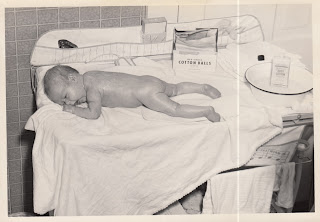
An Unidentified Newborn at St. Francis Hospital (1949)
(https://digital.grinnell.edu/islandora/object/grinnell%3A12074)

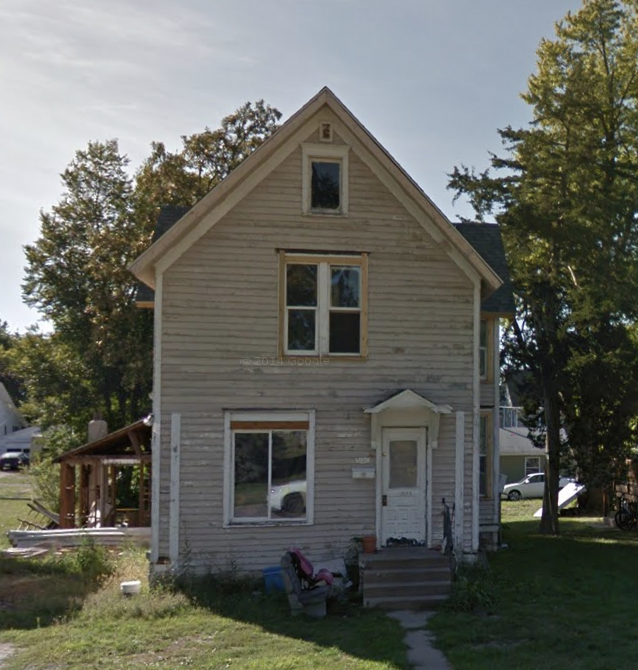
It was Anna's next delivery, again at St. Francis hospital, that brought into the world their twins, Anthony and Andrea. The newborns did not weigh quite as much as their older sister and brothers—Anthony weighed 7 pounds, 2 ounces and Andrea weighed 5 pounds 10 1/2 ounces (Grinnell Herald-Register, December 26, 1955)—but they were not seriously underweight, and both survived well beyond their first year. When Anna left the hospital, she brought the twins to their next Grinnell home at 723 Summer Street. At this point Carl and Anna had five children under the age of six, but their home had only two bedrooms and a living space of 636 square feet, less than either of their two previous homes. 

723 Summer Street (2013 photo)

As with the house on Center Street, the Summer Street address brought the Thomases close to African Americans: another widow, Mamie Tibbs (1892-1973), at that time resided at 712 Elm which was just across the back yard from the Thomas home, and Mamie's second son, Albert Tibbs (1922-1997), and his family lived down the block from the Thomases at 707 Summer (since razed and replaced). Mamie, who would have been in her early 60s when the Thomases moved to Summer Street, was not in a position to help much, either financially or physically, as she had plenty of challenges to keep her own household operating ("The Hard Life of Widow Tibbs," in Daniel H. Kaiser, Grinnell Stories: African Americans of Early Grinnell [Grinnell: Grinnell Historical Museum, 2020], 157-166). Albert and Virginia Tibbs (1924-2014), on the other hand, although about ten years older than Carl and Anna, were closer in age and also had young children: If Albert, Jr. (1943- ), Larry (1944-2014), and Robert (Danny) Tibbs were older than the Thomas children, Barbara Tibbs (1948- ) was almost the same age as Shelia Thomas and a neighborhood playmate.

Albert S. Tibbs (1922-1997)
(Grinnell Herald-Register, March 3, 1955)

Like the Renfrow children of an earlier time, Shelia began school in Grinnell, the only African American in her class. I could not find a record to confirm my guess, but I assume that Shelia began school at Davis, entering kindergarten probably the same year her mother gave birth to the twins. If the Thomases left Grinnell in 1957, Shelia would then have also done first grade at Davis Elementary, which at that time served most of south Grinnell. She probably made her way to school in the company of her slightly older neighbor, Barbara Tibbs, who was almost certainly the only Black in her class, a grade or two ahead of Shelia. Before the Thomases moved to Wisconsin, Greg might  have started school too, but I found no record to confirm that possibility.

Shelia, Greg, and Leonard Thomas, Grinnell Herald-Register, September 3, 1955
(Thanks to Monique Shore for taking this photograph from the library's bound copy of the newspaper)

On the telephone and again in a subsequent email, Anna made a point of the fact that her family had encountered no racial discrimination in Grinnell. Some support for that reading comes from a surprising source—a series of advertisements for the local dairy. Every ten days or two weeks Lang's Dairy published a photograph of young children, accompanied by an image of a Lang's milk carton and a ditty affirming the quality of the milk. Of the 100 or so Lang's ads I found in the pages of the Grinnell Herald-Register in the mid-1950s, only one advertisement included a photograph of Black children: Shelia, Greg, and Lennie Thomas (September 3, 1955). Of course, there were few non-white children in 1950s Grinnell so we can hardly be surprised that the children of only one Black family gained a place in the ads.

The details of the Thomas family's subsequent days in Grinnell remain unknown. Sometime before June 3, 1957, when Anna gave birth to Jeffrey C. Thomas—the couple's sixth child—, the Thomases left Grinnell for Milwaukee, Wisconsin, to live close to Anna's relatives. In addition to Jeffrey, in Milwaukee Anna delivered another two sons to the family—Steven in December 1959 and Ricardo Brooks Thomas (1962-2000) in 1962. All eight of the Thomas children, including the four born in Grinnell, successfully lived into adulthood, although four (including Andrea, the twin) died relatively early. Ricardo, the last-born, was only 37 when he died in 2000; Gregory, the first child born to the Thomases in Grinnell, was 43 when he died in 1995; Andrea, who struggled with both diabetes and asthma (Milwaukee Journal Sentinel, August 7, 2005), was 61 at the time of her 2016 death; and Shelia, Anna's first-born, was just 62 when she died in 2013 (Milwaukee Journal Sentinel, February 8, 2013).

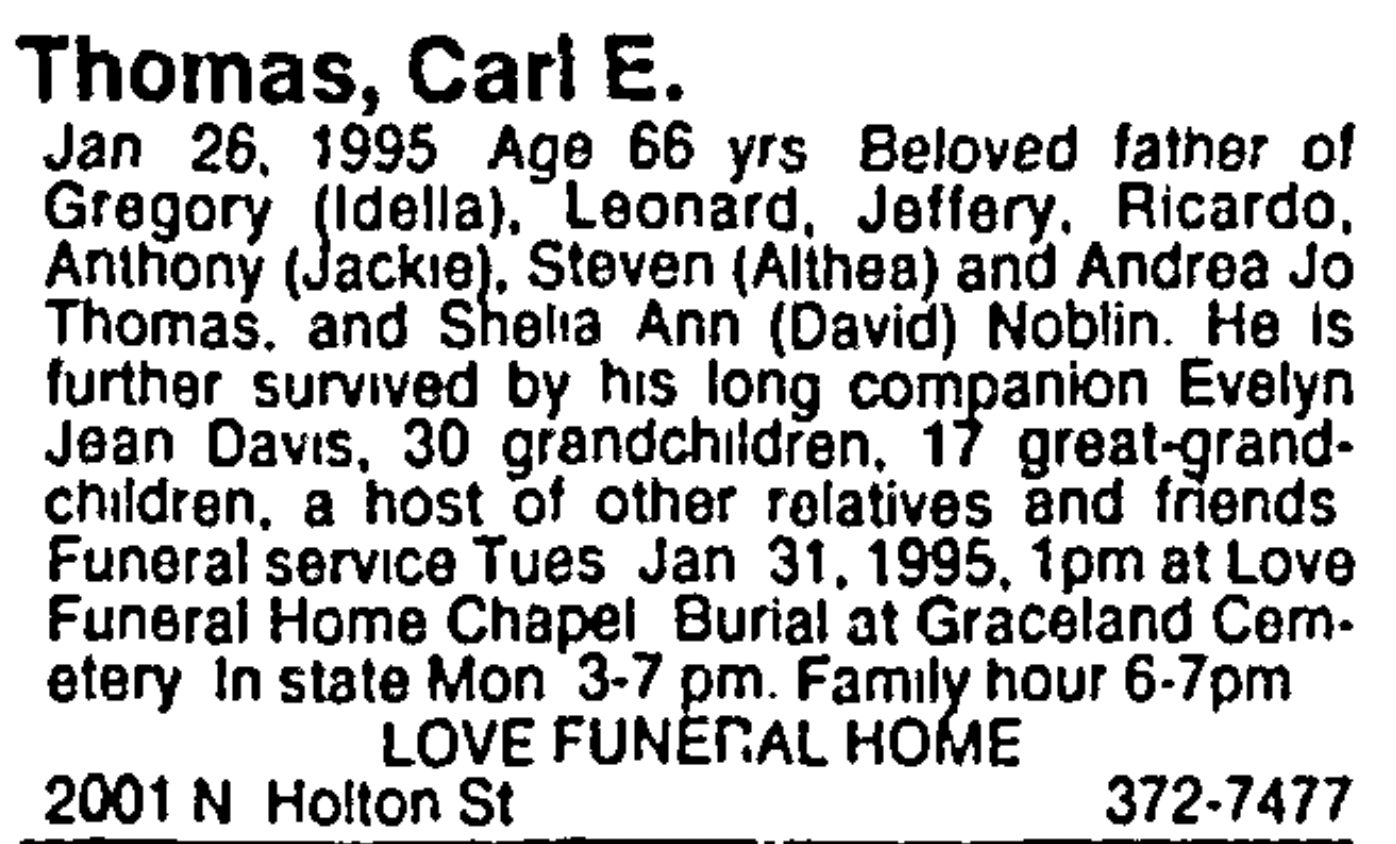
Milwaukee Journal, January 28, 1995
(Thanks to Melissa Shriver of the Milwaukee Public Library who found and scanned this notice for me)

Carl, the focus of our story and father of the Thomas family, also died early; in January 1995 when still only 66 years of age, Carl died in Milwaukee and was buried in Graceland Cemetery there. At the time all eight of his children were still alive, but he and Anna had evidently parted ways: Carl's death notice makes no mention of Anna, but does remember his long-time companion, Evelyn Jean Davis. Anna remarried, taking as her second husband Roberto Juarez. A series of notes she posted in 2014 on the Findagrave websites of her deceased children indicates that she has retained a strong bond with her original family, including those children born to her in Grinnell, two of whom remain alive.

###

The New York Times periodically publishes biographies of people long gone but unnoticed at the time of their deaths. Entitled "Overlooked No More," the series tries to restore to the record obituaries of "remarkable people whose deaths...went unreported in the New York Times." With the little information presently available it is hard to argue that Carl Thomas or anyone else in that family was "remarkable," even for a small town in central Iowa. But plenty of Grinnell people had their ordinary lives regularly documented in the newspaper and in other records—from their church, their business, their club, their sports team, etc. The newspaper even found space to report on visitors or dinner guests. Not the Thomases, however; I could find no one who remembered them and the slim published record that survives does little more than confirm the presence in Grinnell of Carl and Anna Mae Thomas and their children. Born Black in Grinnell, these babies survived their infancy, like most other children born in Grinnell's hospitals in those years. All the rest disappears in the mist.


Friday, January 27, 2023

When Grinnell College Collaborated With A Black College...

Perhaps nothing was so evil in America's ugly history of racial hatred as the 1955 murder of Emmett Till and the long history of lynching, but the 1960s witnessed its own explosive series of high-profile crimes based on race. Among the most well-known moments of this grim history are the 1963 bombing of the Sixteenth-Street Baptist Church in Birmingham, Alabama; the 1963 murder of Medgar Evers, an NAACP field worker in Jackson, Mississippi; and the 1968 Memphis murder of Dr. Martin Luther King, Jr. The 1965 Selma to Montgomery March, including the bloody confrontation at the Edmund Pettus Bridge, along with riots in Watts that same year and the 1967 Detroit riot, highlighted the violent divide between America's Black and white communities.

1966 Participants of Grinnell-LeMoyne College Student Exchange
(Grinnell College Libraries Special Collections, RG-R, Ser. 6, Box 25; printed in Des Moines Tribune, March 9, 1966).

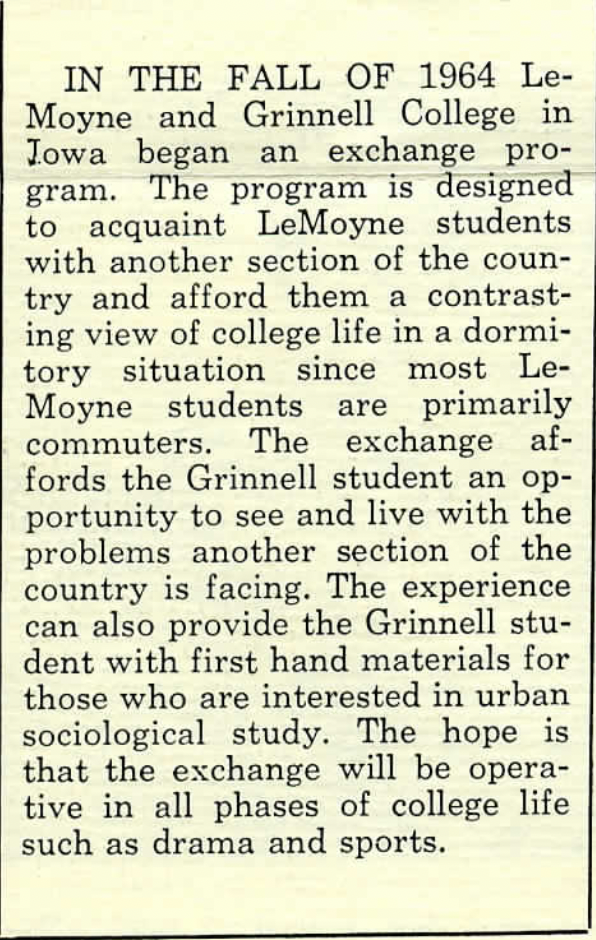
Written into this history in a small font was a Grinnell College plan which, like its predecessor with Hampton Institute, aimed to collaborate with a Black college. The scale and aims of the program were modest, particularly when seen against the persistent racism of Jim Crow and the growing public demands among African Americans for Black Power. Indeed, so far as the documents can prove, Grinnell's interest in the program did not concentrate upon improving inter-racial relations; initially, at least, the college seems to have conceived of the arrangement as a means to attract Black students to Grinnell and perhaps increase the attraction of the college to Black faculty. However, for the Grinnell students who took part in the exchange that was a part of the collaboration, concerns about racism—their own and their country's—were primary. Today's post examines the Grinnell arrangement with LeMoyne (later, LeMoyne-Owen) College and how the plan played out in a tumultuous era of American history.

###

In October 1963, Howard Bowen (1908-1989), then approaching the end of his Grinnell College presidency (1955-1964), circulated to college trustees some comments headlined in trustee minutes as being devoted to "Negro education." In order to "give greater attention to the place of Negroes in our student body," Bowen proposed that Grinnell consider two strategies: 

(1) to establish a relationship with a Negro college involving various exchanges and mutual assistance; and (2) to join with several liberal arts colleges...in a joint program involving Negro student recruitment, financial aid, and special educational assistance (Minutes of Executive Committee, Grinnell College Board of Trustees, October 16, 1963, Grinnell College Libraries, Special Collections, US US-IaGG Archives/RG-TR).

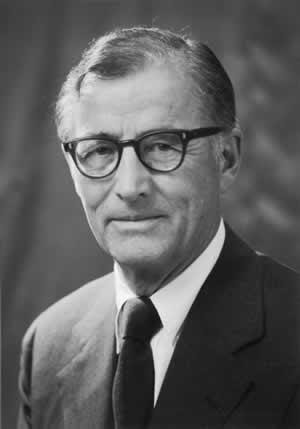
Undated Photograph of Howard R. Bowen
(https://economics.Illinois.edu/spotlight/historical-faculty/bowen-howard-r)

When the full board of trustees gathered two weeks later Bowen rehearsed the options, again entered in trustee minutes beneath the heading "Negro Education." But now Bowen proved to be more specific about a Negro college with which Grinnell might work: "Among the possibilities the President mentioned," trustee minutes report, "would be an arrangement between Grinnell and LeMoyne College, a Negro liberal arts institution located in Memphis, Tennessee" (ibid., October 30, 1963).

Postcard Photograph of LeMoyne College (before 1968)
(https://www.historic-memphis.com/memphis-historic/lemoyne/lemoyne.html)
 
Exactly how LeMoyne had emerged so quickly as the focus of Grinnell's attention the surviving records do not say. It seems likely, however, that Bowen, who assumed the presidency of the University of Iowa in 1965, was central to the decision, because soon after Bowen arrived in Iowa City the University of Iowa also established a formal connection with LeMoyne (and nearby Rust College). Moreover, Bowen's published resume identifies (without specifying dates) LeMoyne College among the organizations for which Bowen served either as a director or trustee (Howard Bowen, Academic Recollections [Washington, DC: American Association for Higher Education and American Council on Education, 1988], pp. 97, 152). These coincidences suggest that Bowen himself was behind the original Grinnell plan to partner with LeMoyne. Bowen had trained as an economist, and economics was also the specialty of Hollis F. Price (1904-1982), the first African American president of LeMoyne (1943-1970) who headed LeMoyne when Bowen proposed collaboration. It seems reasonable to conclude, therefore, that Bowen approached Price with the idea, and the two men together worked out the plan between their respective institutions.

Undated Photograph of Hollis F. Price (1904-1982)
(https://www.historic-memphis.com/memphis-historic/lemoyne/lemoyne.html)

LeMoyne-Owen College, as it is known today, grew out of the ashes of America's Civil War. Founded as LeMoyne Normal and Commercial School by the American Missionary Association when Federal troops occupied Memphis in 1862, the new institution suffered several tragedies, including being burned to the ground by whites immediately after the Civil War. The 1870 cash gift of the Pennsylvania abolitionist Francis Julius LeMoyne gave the school a name, and, like other Historically Black Colleges and Universities, for many years white men ran the institution. Having occupied several sites around Memphis in its early history, in 1914 LeMoyne moved to its present location on Walker Avenue in south Memphis. Ten years later it became a junior college, and in 1930 a four-year college which, without dormitories, served mostly local Memphis Blacks. In 1968 LeMoyne merged with Owen Junior College (founded by Baptists in 1947) to create LeMoyne-Owen College on the Walker Street site on which LeMoyne had stood since 1914.

###

An anonymous Grinnell memo dated October 30, 1963, the same day that college trustees embraced Bowen's plan, reported that LeMoyne and Grinnell "have agreed to associate in various activities for the mutual benefit of the two institutions." "Our purpose," the memo continued,

is to extend educational opportunity, to strengthen both institutions, to broaden the experiences and horizons of our students and faculty, and to achieve better understanding between two sections of the country and two racial groups ("Proposed Association of LeMoyne College and Grinnell College," Grinnell College Libraries, Special Collections, US-IaGG Archives/RG-D-2-2, Box 1963-1973).

This list of goals barely mentions inter-racial understanding, emphasizing instead vague expressions of regional understanding along with institutional and personal betterment. Even the May 29, 1964 letter that Bowen distributed to students to announce the program could offer nothing more encouraging than to applaud the "significant educational opportunity" which would "enable a student to express his concern for racial integration and equality" [emphasis mine—DK] (Grinnell College Libraries, Special Collections and Archives, RG-A2-RG-A Misc-3-7. Box 1955-1972). LeMoyne's own description of the arrangement's attractions to students is equally general, making no mention at all of race.

The LeMoynite (May 1967)

As later parts of Grinnell's October 30 memo confirm, however, Grinnell's ambitions for the program definitely included recruitment of Black students, a point made clear in Bowen's presentation to college trustees. Articulating programs for which it sought funding—an exchange of students; exchange of faculty members; joint conferences; joint research, etc.—the memo solicited support for the  "preparation and recruitment [emphasis mine—DK] of gifted Negro high school students." Allotting about one-third of the proposed budget to this goal, the document imagined a series of special Saturday classes at LeMoyne for gifted Black high school sophomores in Memphis.

Those who showed promise in their Saturday work...would be chosen to attend without cost a special summer academy of 6 weeks to be offered on the LeMoyne campus and to be staffed by LeMoyne and Grinnell faculty members...Those who succeeded in this summer program would be selected for a second special summer academy of 6 weeks at Grinnell to be given in the summer following their junior year...Those students who completed the second summer with a satisfactory record would be assisted in gaining entrance to the colleges of their choice...Those who were admitted to college would then attend a third summer academy of 6 weeks at Grinnell at the end of the senior year. After this, they would enter college...well-prepared and highly-motivated (ibid.).

Although the memo specified that "Those completing the program would not be limited to LeMoyne or Grinnell [in their choice of college]," the repeated experience on the two campuses—including two summers at Grinnell—clearly intended to influence the academy students to choose one of the host institutions.

The multi-year project of special education for Memphis teenagers laid out in the 1963 memo seems not to have materialized. Whether this failure was the result of unsuccessful fundraising or derived from some other issue I do not know. Nevertheless, in the summer of 1964 Grinnell and LeMoyne established an initial humanities academy on the LeMoyne campus for Memphis high school juniors. Rather than college faculty (as the funding proposal had imagined), two rising Grinnell seniors, Dodi Holcher and Kristi Williams (1944-2013) along with three Yale graduate students spent five weeks at LeMoyne teaching history, speech and philosophy to about eighty Black high school juniors. 

Dodi Holcher '65 and Kristi Williams '65
(Scarlet and Black, October 23, 1964)

Holcher and Williams reported that the students whom they taught worked hard and enthusiastically ("Practice Teacher for Negro Youths," Hennepin County Review: Hopkins Edition [1965?]; thanks to Dorothy Swanberg for providing me with this article); the leadership of LeMoyne's Professor Clifton H. Johnson (1921-2008), who went on to establish the African American archive at the Amistad Research Center, helped the summer academy succeed (The LeMoynite, September 1964). Nevertheless, so far as Grinnell records can confirm, there was never any follow-up summer study at LeMoyne or at Grinnell as the 1963 memo had imagined. As a result, Grinnell's hope that the program might increase Black enrollment evaporated. Similarly, the proposal's plan for faculty exchanges and conferences also foundered. What remained and prospered over the next several years was the exchange of undergraduates between LeMoyne and Grinnell.

###

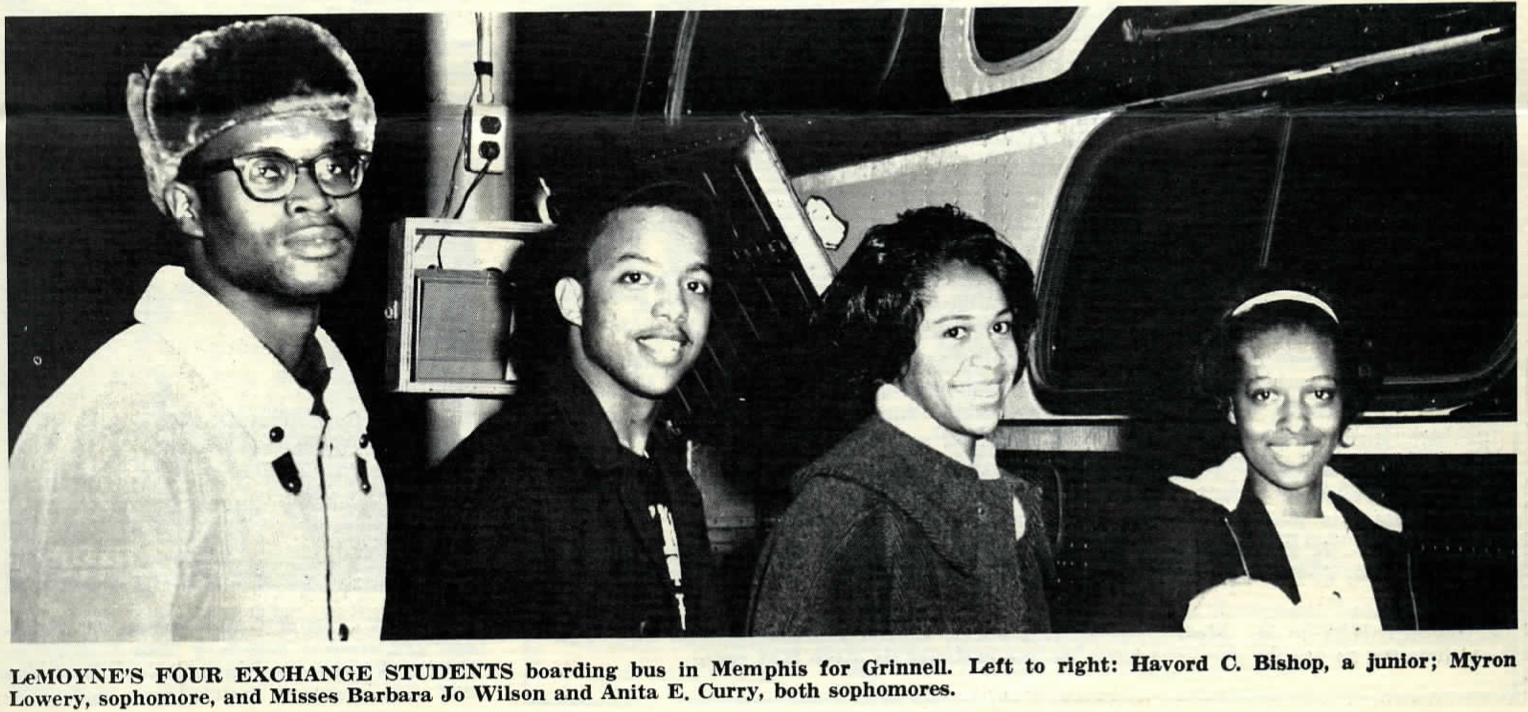
Between 1964 and 1972 a total of 26 Grinnell students and 24 LeMoyne students (an undated, typed list from the Grinnell Registrar's office mistakenly identifies only 19 LeMoyne participants) took part in the exchange, each spending one semester at the partner institution. As had been true of the Hampton exchange, women predominated: about two-thirds of the Grinnell students who studied at LeMoyne were women and a similar ratio prevailed among the LeMoyne students at Grinnell.  Most of the LeMoyne participants hailed from Memphis, but a few had grown up elsewhere and had come to Memphis to attend LeMoyne. Myron Lowery, for instance, had grown up in public housing in Columbus, Ohio, but upon graduation from high school had moved to Memphis in order to enroll at LeMoyne. Something similar could be said about Clarence Christian, who was born in Horn Lake, Mississippi, but who moved to Memphis to attend LeMoyne.

Exchange Participants, Spring 1965 (Afro-American, March 27, 1965)
L-R, Front Row: Margaret Bluhm (Grinnell), Dorothy Harris (LeMoyne); 2nd row: Lois McGowan (LeMoyne), Cynthia Brust (Grinnell); standing: Michael Fort (Grinnell), Lou Harvey (LeMoyne), James Stephens (Grinnell), and Frank Patterson III (LeMoyne)

The exchange started with a burst of enthusiasm, with eight LeMoyne students at Grinnell during the first year (1964-65), four in the fall and four in the spring. Subsequently LeMoyne sent four students to Grinnell each spring semester until 1969, when only two students studied at Grinnell. No one from either school took part in 1970, and when the exchange resumed in 1971 only one LeMoyne woman came to Grinnell; again in 1972, the last year of the program, just one LeMoyne student studied at Grinnell.

LeMoyne Students En Route to Grinnell College (January 1966)
(The LeMoynite, April 1966)

Grinnell's participation followed a similar curve. The first Grinnell exchangees—two men and two women—arrived in Memphis in January 1965. The following year saw Grinnell send five students to study at LeMoyne; in addition, that autumn six students took their spring semester play, "Slow Dance on the Killing Ground," to LeMoyne where they put on three performances to large and enthusiastic audiences. 
Photograph from "Slow Dance on the Killing Ground" at LeMoyne College
(Scarlet and Black, November 9, 1966)

In 1967 another five Grinnell students traveled to LeMoyne, but only two took advantage of the opportunity the following year, perhaps a reflection of the growing public rage around race. In 1969 Grinnell sent six students to Memphis, but this seems to have marked the high-water point. With the Vietnam war agitating the country, Grinnell College closed abruptly in 1970 and no Grinnell student studied at LeMoyne that year. In 1971, only three Grinnell women enrolled at LeMoyne, and in 1972 Shirley Johnson became the last Grinnell student to spend a semester at LeMoyne.

Why did Grinnell students apply to the program?

Letters explaining the applicants' reasons for wanting to study at LeMoyne survive only for about half the Grinnell students who spent a semester in Memphis (Grinnell College Libraries, Special Collections and Archives, Dean's Office Records, Box 1963-1973); additional insight into the exchange experience comes from press reports about participants. Although applicants identified a wide range of motives for applying, almost all of them—coming of age in an America riven by racial antagonism—expressed the hope that their LeMoyne semester would enable them to contribute to a better understanding between Black and white America. In this way, the ambitions of Grinnell student participants deviated from the inflated diction of institutional benefit that had characterized the original proposal. 

Sheena Brown, 1967 Ottumwa High School Yearbook

Sheena Brown '71, for instance, who came to Grinnell from nearby Ottumwa, hoped that by living in a minority community she could improve her understanding of Black and white cultures. "If mutual understanding cannot be reached to a large extent in this experience," she wrote, "can we ever hope to reach an understanding and tolerance among peoples of the world?" Tish Lower '73, who grew up in tiny, all-white Parnell, Iowa, used her application to confess to holding unconscious racism, although "to no greater extent than the average white American." Hoping to exorcise the racist assumptions she acknowledged, Lower argued that "only...if I can understand [Blacks] personally will I be able to understand how they feel...about things that concern all of us." In a similar vein, Terry Poland '69 told the application committee that he had never experienced "severe segregation comparable to that in Memphis," and that he hoped that experiencing that world would "have a pronounced effect on my attitudes and [would] enable me to better combat racism...." 

Mary (Tish) Lower, 1970 Williamsburg High School Yearbook

Mary Gleysteen '69 began her application by emphasizing the virtues of living off campus in a large city in the South, circumstances bound to contrast with her Grinnell experience. Moreover, she continued, instead of the limited connections she had previously had with Blacks, "At LeMoyne I would not only be spending class hours with my contemporaries, but I would also be able to share their experiences, thoughts, ambitions, and burdens" out of class. Carol Moulder '73 (1951-1980), who came from the Chicago suburb of Park Forest, imagined that "living in Memphis and...getting to know people who are not white, middle-class students...will broaden my ability to communicate with different peoples...[and] give me...insight into the theme of race." 

In her 1968 application, Diane Alters '71 remarked upon the transition she had perceived between efforts of the early 1960s aimed at integration and the more strident ambitions of the late 1960s. "White America," she wrote, "must exert itself to...understand the jump from 'integration' to Black Power...." 

Kay Sophar, 1969 Potomoc, Maryland High School Yearbook

Like many other applicants, Kay Sophar '73 admitted to "a White, middle or upper-middle class life and White upper-middle class attitudes." Noting that integration and assimilation had lost their appeal to Black activists who emphasized instead the embrace of Blacks' own culture, Sophar confessed to an "appalling" ignorance of that culture. A semester at LeMoyne, she wrote, was essential to understanding the Black community and to making her a "mature, responsive member of the human race." 

1971 Photograph of Shirley M. Johnson '73 in Grinnell College Mail  Room
(https://digital.grinnell.edu/islandora/object/grinnell%3A3465)

Shirley Johnson '73 (1951-2012), the sole Grinnell College Black to participate in the program, offered a different perspective, pointing out how poorly Grinnell served its Black students. "Grinnell [College] does not offer a Black student much of a representation or a reading library of Blacks," Johnson wrote. "I find it almost impossible to attempt research [on Blacks] here in Grinnell...." "If I am accepted to go on the LeMoyne-Owen exchange program," she continued, "I would be able to take courses...[that are] Black oriented [and] geared toward culturing young Blacks."

Application files indicate that most of the Grinnell participants intended to enroll in courses that would focus upon Black history and the Black experience in America. Mary Gleysteen, for instance, told Grinnell administrators that she planned to enroll in "The Negro in American Life," "Race Relations," and "20th-Century English and American Literature." Grant Crandall '68 proposed to take "The Negro in American Life" and "Race Relations" as well as "Social Problems" and "Contemporary History." Terry Poland also planned to enroll in the first two of these courses along with "Introduction to Sociology" and "Social Problems." Mary Brooner thought she would enroll in "Civil War and Reconstruction" along with "Social Problems."

What Did Participants Take Away from the Exchange Experience?

Like many other Grinnell students who went to LeMoyne, James Stephens '67 embarked upon the semester's study in hopes of improving race relations. Stephens told a reporter for the Des Moines Tribune that "I went to LeMoyne...because I wanted to get acquainted with the racial problem, but when I got there and started attending classes the problem seemed to vanish" (Des Moines Tribune, March 9, 1966). Something similar emerged in the recollections of Meg (Bluhm) Carey '67. Having come to Grinnell from New Haven where she had attended independent schools, she looked forward to an opportunity to expand her experience with Blacks. Dancing at LeMoyne to "My Girl" and other Motown hits, she assembled a group of Black friends with whom she would hang out. "At some point I looked down and was shocked to see my white hands among the brown ones...I had lost an awareness of color for the first time" (email communication, January 3, 2023). Cynthia Brust '66 (1944-2017), who grew up in a Trotskyist family in St. Paul, told a reporter that "at LeMoyne we discussed such things as religion, politics and race, and there was a real  desire on the part of both groups to get to know each other" (Des Moines Tribune, March 9, 1966). Amy Rossman '68 told readers on campus, "I'd never been anywhere where Black people lived." After being challenged to define her identity, Rossman admitted that she had not previously given her race much thought. "White doesn't figure in when you're in the majority"(Scarlet and Black, February 22, 2002). At the same time, Rossman, like several other Grinnell women at LeMoyne, had a Black boyfriend, and she "took great pleasure in walking around town hand in hand, trying to shock people" (personal email, January 5, 2023).

Amy Rossman '68
(1964 Portland, OR High School Yearbook)

But white Grinnell students recognized that the differences between them and their LeMoyne parallels were not only racial. Commenting upon the audience she saw at LeMoyne's 1966 commencement, Janet Poland noticed that "a large number of the parents were wearing uniforms...These were not military uniforms. They were maids' uniforms [and] janitors' uniforms," reflecting the occupational and class differences intimately connected to racial difference (Scarlet and Black, February 22, 2002). Another participant wrote, "[At LeMoyne] My eyes were opened to the many differences between being black in the South and white in the Midwest. I learned firsthand that the levels of fear, violence, and opportunity were in stark contrast..." (email communication, January 17, 2023). Students reported being refused service at restaurants when they were in the company of Black friends; mixed-race couples endured the jeers of white passers-by; and students who joined in Black protests found themselves in jail. In 1960s Memphis, like elsewhere in America, race mattered.


Mary Brooner '71
(1967 Summit, New Jersey High School Yearbook)

Indeed, because of the murder of Martin Luther King Jr., Memphis put a microscope on race. In a 2015 interview Mary Brooner '71 remembered 1969 Memphis as "a town that was raw, having gone through the Garbage Strike and then the assassination of Dr. King." Valerie Budig '70, who was studying at LeMoyne when King was shot, told S&B readers of having heard King speak at Mason Temple the day before his death. In his sermon King had acknowledged that his life had been threatened. "Well, I don't know what will happen now," King said.

We've got some difficult days ahead. But it doesn't matter with me now. Because I've been to the mountaintop. And I don't mind. Like anybody, I would like to live a long life. Longevity has its place. But I'm not concerned about that now...I'm not fearing any man (Simon Seabag Montefiore, Speeches that Changed the World [London: Quercus, 2007], p. 155).
A few days later, when Memphis and much of the United States erupted on the heels of King's murder, Budig joined some 42,000 people—the great majority of them Black—in a march to Memphis City Hall, carrying banners that read: "Honor King: End Racism Now!" (Scarlet and Black, April 12, 1968). Budig's experience was powerful and rare, connected to an iconic moment in American history. But other Grinnell students who studied at LeMoyne, both before Budig and afterward, took home the same message, even if they were not in Memphis to march in King's wake. 

###

Although Howard Bowen had initiated Grinnell's participation in the exchange with LeMoyne College, he was gone by the time students from the two institutions took up residence at their opposite college. Bowen's successor, Glenn Leggett (1918-2003), had the unenviable job of presiding over the campus in the late 1960s when racial tension was most acute. As the title of his academic memoir indicates (Years of Turmoil, Years of Change), he found the duties challenging. Nevertheless, whether because of initiatives all his own or because of other forces that were driving social change, Leggett did see increased numbers both of Black faculty and Black students at Grinnell. 

Photograph of Glenn Leggett, Grinnell College President 1965-1975
(https://www.timetoast.com/timelines/45128)

These modest gains did not blind Leggett to the fact that much remained to be done, as he admitted in a 1971 report:

We have not...had much success with a faculty or student exchange with black colleges; our admissions and counseling efforts for more black students have not been so successful as we would like; and the energies we have put into the recruitment of more black faculty and staff have not been sufficient to the task... (Glenn Leggett, Years of Turmoil, Years of Change: Selected Papers of a  College President 1965-1975 [Danville, IL: The Interstate Printers and Publishers, 1978], 170-71).

Viewed primarily as an attempt to increase Black enrollment at Grinnell, the arrangement with LeMoyne might be thought a failure, which may explain why the LeMoyne exchange ended soon after Leggett made these remarks. Like Bowen before him, however, Leggett overlooked the reasons that impelled Grinnell students to participate in the program. 

Most Grinnell applicants looked to their time at LeMoyne not as a lever by which to increase Black enrollment at Grinnell, but rather as a means to help them personally understand and improve race relations in America. Most thought that their experience at LeMoyne had been successful in this respect and had deeply altered their views on race in America. More than that, the semester at LeMoyne had cemented their intention to root out their own racism and to work hard to erase it in the communities they inhabited.

And that was no small achievement.